Dining Room Wall Art: Five Paintings That Hold the Conversation at the Table
Updated: Sep 26
The dining room is the household interior where wall art is read by a seated audience at conversational distance over a one-to-two-hour visit. The five paintings below are chosen for that audience. Each carries a single legible focal point that registers from the dining table at approximately 2-3 metres viewing distance without competing with the conversation, a controlled palette that survives both candle-light and warm pendant lamp-light, and subject matter that complements rather than describes the meal in progress. The seventeenth-century Dutch still life tradition was developed specifically for the dining-room wall and is therefore the natural starting point; the other four paintings are chosen because they share the still-life's dining-room-suitable register without restricting the room to a single national tradition.
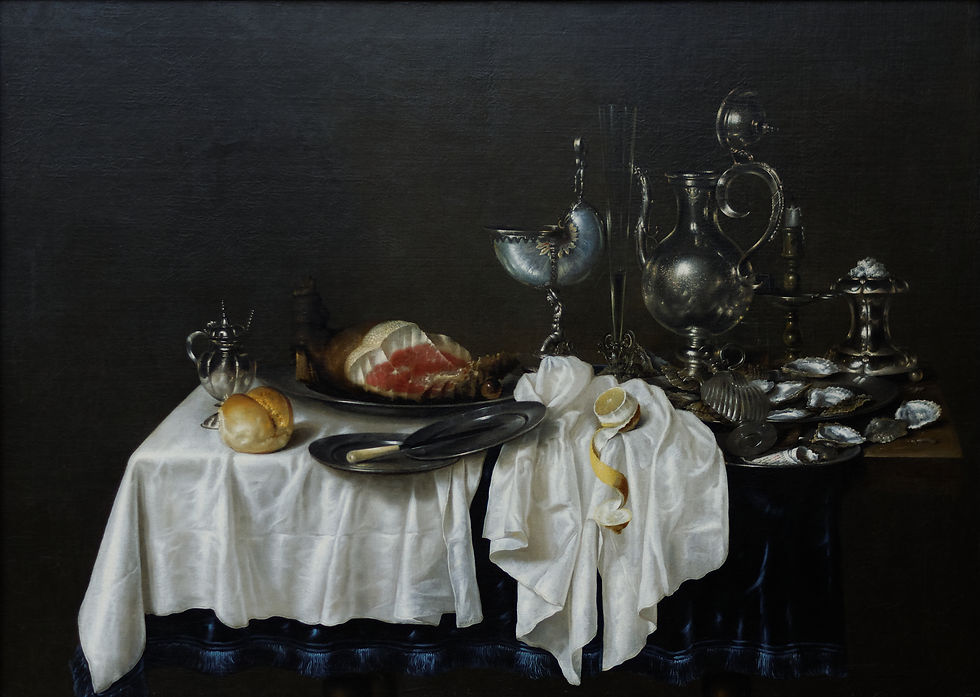
1. Heda, Still Life with Nautilus Cup (c. 1640) — the canonical dining-room painting
Heda's Nautilus Cup canvas is the canonical dining-room painting — the 17th-century Dutch still life tradition was literally developed for this placement. A half-eaten meal on a polished wooden table: an overturned silver tazza, a lemon with its peel coiled, a green-glass römer wine glass, a polished pewter plate, the nautilus-shell cup of the title. Print at 70 × 100 cm horizontal, frame in dark walnut, mount centred above the sideboard or the dining wall at approximately 155 cm floor-to-canvas-centre. The painting was made for exactly this room and works without further explanation. The Heda is the strongest single decision for any dining room where the household wants the room to read as serious about food and hospitality.
2. Caravaggio, Calling of Saint Matthew (1599-1600) — the formal dining room
Caravaggio's Calling is the alternative for formal dining rooms where the household hosts longer-format dinners (5+ guests, multi-course, 2+ hour duration). The painting's specific composition — a Roman tax collector and his small group of card-playing collectors illuminated by a single beam of daylight from upper-right, with Christ's figure standing in deep shadow at the right pointing across the table at Matthew — reads at dining-table distance as a sharply-lit figural group and rewards the second look between courses. Print at 80 × 110 cm horizontal, frame in dark walnut, mount centred on the dining wall at approximately 155 cm. The painting is the cultural-seriousness signal for the room that hosts intellectual conversation over multi-course meals.

3. Cassatt, Tea (c. 1890) — the breakfast nook or small dining
Cassatt's Tea is for the breakfast nook, the small kitchen-dining alcove, or the four-seat dining room where the Heda or Caravaggio would overwhelm the available wall. Two women in pale cream and dove grey at a low table with the silver tea-service; the viewer is positioned at conversational distance. Print at 60 × 80 cm horizontal, frame in black-stained European ash, mount centred above the breakfast-nook bench or the small dining wall at 150 cm. The painting fits the morning-coffee-and-toast register cleanly and works as the visual continuation of the breakfast ritual.

4. Vermeer, The Milkmaid (c. 1660) — the bar cart corner or wet bar
Vermeer's Milkmaid is for the bar-cart corner of the dining room or the wet-bar alcove off the dining wall. A single female servant pours milk from a brown earthenware jug into a low ceramic bowl, the morning sun coming through a leaded window from the upper left. Print at 40 × 35 cm, frame in dark walnut with narrow brass inner liner, mount on the wall above the bar cart at standing-eye-level. The Milkmaid's pouring gesture is the visual rhyme for the bar's actual pouring activity — guests who notice the painting during the pre-dinner drinks moment read the rhyme on the second visit.
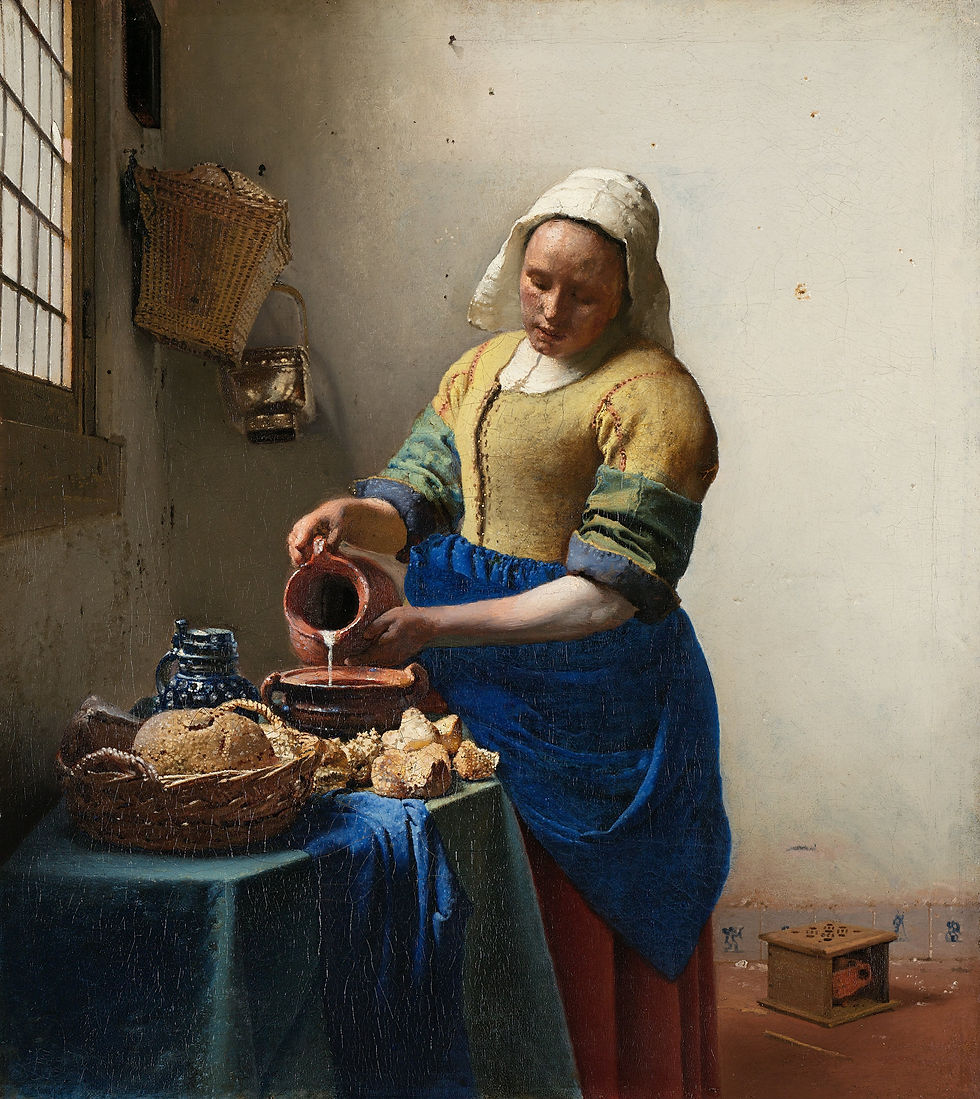
5. Renoir, Young Girl Reading (c. 1890s) — the family dining wall
Renoir's Young Girl Reading is for the everyday family dining room — the room that hosts the household's own daily meals rather than the formal entertaining occasions. A single figure in profile, head tilted slightly down to the page, the warm pink-and-cream palette of Renoir's late-1880s Provence period. Print at 50 × 70 cm vertical, frame in slim dark-walnut moulding, mount on the wall opposite the household's primary seat at the dining table at 150 cm. The painting reads at every meal as a quiet familiar presence — it does not require attention but it accumulates a warm relationship across years of daily exposure.

Mounting, framing, lighting — universal dining-room rules
Three rules govern all five dining-room placements. First: HEIGHT. The centre of the canvas should sit at approximately 150-155 cm floor-to-canvas-centre — at seated-eye-level for the table and at standing-eye-level for guests at the sideboard. Second: SCALE. The painting's horizontal width should be approximately 60-70% of the dining table's length. A 200 cm table takes a 120-140 cm painting; a 240 cm table takes 150-170 cm. The 60-70% rule produces the same proportional balance as the above-sofa wall. Third: LIGHTING. The dining-wall painting needs dedicated picture-light at 2700K warm-white. The picture-light should be controllable from the room's primary dimmer switch and should drop with the chandelier dimmer during dinner so the painting's lighting matches the table's lighting register. Mismatched lighting (bright painting + dim table or vice versa) creates a visual discord that interferes with the meal's settle-down register.
Key takeaways
Dining room art is read by a seated audience at conversational distance over a 1-2 hour visit. Mounting: 150-155 cm floor-to-canvas-centre (seated-eye-level at table + standing-eye-level at sideboard). Scale: 60-70% of dining table length. Lighting: 2700K dedicated picture-light, controllable from primary dimmer, drops with chandelier dimmer during dinner.
Five paintings + placements: Heda Nautilus Still Life (main dining wall above sideboard, 70×100 cm), Caravaggio Calling of Matthew (formal dining room, 80×110 cm), Cassatt Tea (breakfast nook or small dining, 60×80 cm), Vermeer Milkmaid (bar cart corner or wet bar, 40×35 cm), Renoir Young Girl Reading (family dining wall, 50×70 cm vertical).
17th-century Dutch still life tradition was developed specifically for the dining-room wall — sized for above-sideboard placement, intended to be read at conversational distance from the table. Heda's monochromatic-warm-ochre canvases are the canonical example. Any contemporary dining-room art programme that includes a Dutch still life is operating in the tradition's original intended placement.
Frame material guidance: Heda + Caravaggio + Vermeer = dark walnut. Cassatt = black-stained European ash. Renoir = slim dark-walnut moulding. The single-frame-material-per-room rule still applies — pick one and use across the whole dining room.
Pre-purchase calibration: measure the actual dining table length, calculate the 60-70% rule before ordering any print. A 50×70 cm print on a 280 cm long dining wall reads as undersized; a 150×200 cm print on a 250 cm long dining wall reads as overwhelming. The dimensions matter more than the painting selection.
Browse dining room fine prints in the archive at zocineartdesign.etsy.com.


Comments