Wall Art for Therapy and Counselling Offices: Five Paintings That Hold a Room Designed for Difficult Conversation
Updated: Sep 28
A therapy or counselling office is the rare commercial interior optimised for a single seated client at conversational distance over a fifty-minute session, returning to the same room one-to-three times per week for months or years. The wall art has to satisfy three specific clinical constraints. First: the painting needs to be present in the room without becoming a topic of conversation (the painting cannot draw therapeutic attention away from the session's actual content). Second: the painting must survive multiple weekly sessions of the same client looking at it across many months (the painting that fascinates on Session 3 may be tedious or actively interfering by Session 30). Third: the painting must avoid subject matter that could trigger or worsen the specific issues the session is working through (no scenes of violence, distress, loss, or interpersonal conflict; no depictions of intoxicating substances; no nudity or sexually-charged figures; no specifically religious or politically-marked imagery). The five paintings below are chosen for those clinical constraints.
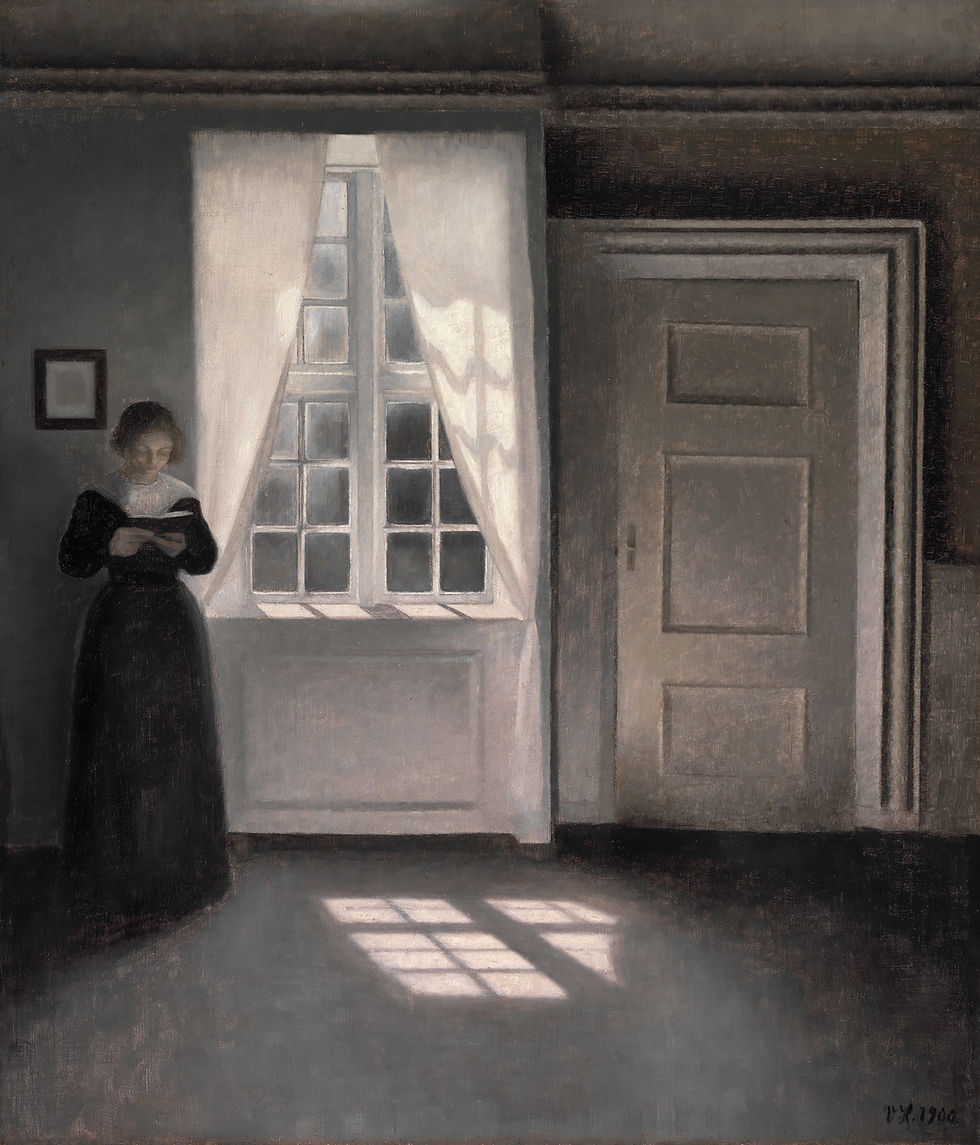
1. Hammershøi, Interior, Strandgade 30 (1900) — the primary consultation room
The Hammershøi is the canonical therapy-office painting. A single back-turned female figure walks through an empty room toward an open doorway; the room is cool grey and dove white with a splash of yellow afternoon sun on the floor. The painting carries no narrative, the back-turned figure has no identifiable emotion that could be projected onto, the cool palette is calming, and the painting's subject (an empty room with a single figure moving through quiet space) is structurally similar to the psychological work the therapy session is conducting. Print at 70 × 60 cm, frame in unstained European oak, mount on the wall opposite the client's seated position at approximately 145 cm floor-to-canvas-centre. The painting reads from the client's chair across the 2-3 metre therapeutic distance as a calm visual environment that does not interrupt the session.
2. Monet, Water Lilies (1899) — the secondary wall or waiting area
Monet's Water Lilies are the alternative for therapy offices that want a more saturated chromatic environment. The 1899 Japanese Footbridge canvases or the 1916-26 Orangerie panels both work; print at 60 × 90 cm horizontal, frame in slim unstained European oak, mount on the secondary wall of the consultation room or in the waiting area. The painting's all-over green-and-blue chromatic field reads as the visual continuation of an outdoor garden view (calming biophilic association) without any specific figural or narrative content that could become therapeutic material. Particularly effective in trauma-focused practices where the Hammershøi's back-turned figure might be inappropriately suggestive — the Monet has no figures at all.

3. Vermeer, The Milkmaid (c. 1660) — the small consultation room
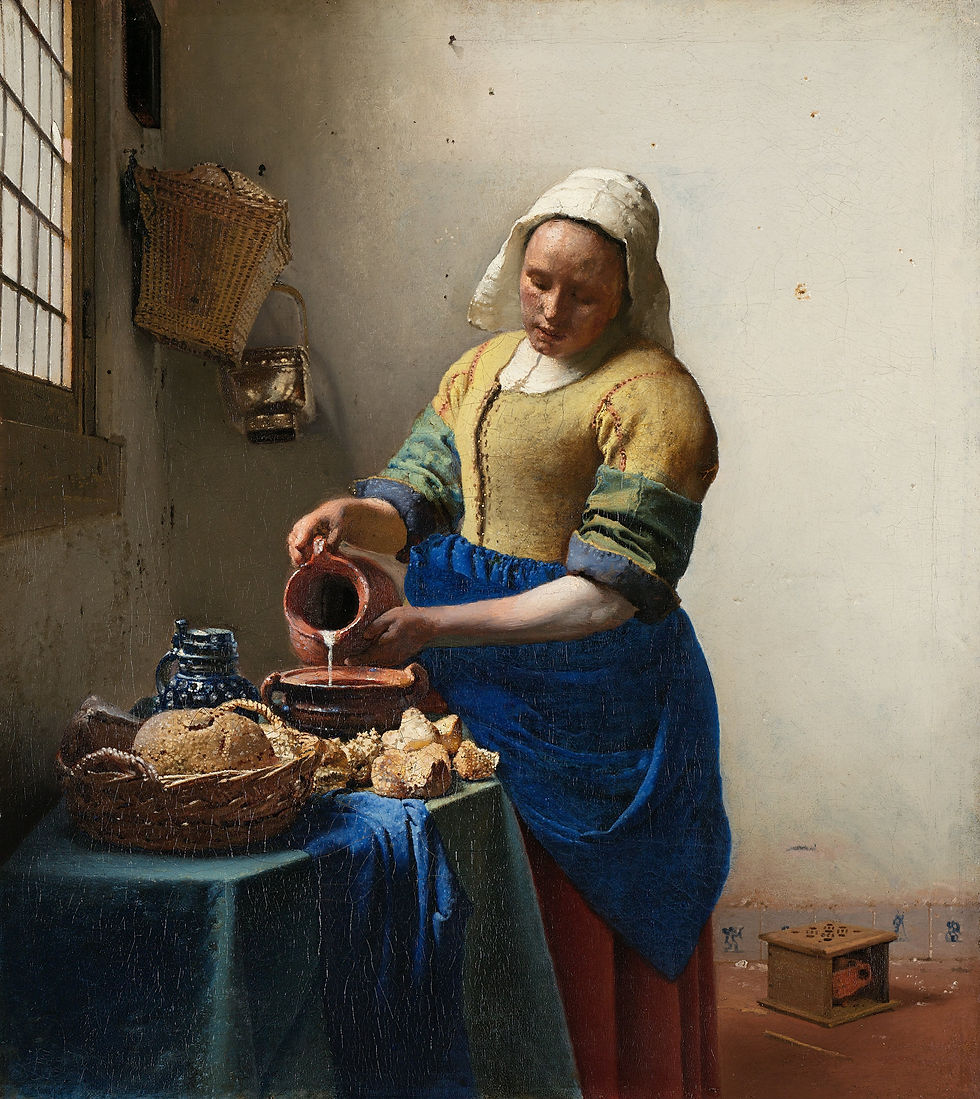
Vermeer's Milkmaid is for the small consultation room (under 12 square metres) where the larger Hammershøi or Monet would overwhelm the available wall surface. The Milkmaid's small scale (the original is 45.5 × 41 cm) makes it perfect for the small clinical space. Print at 40 × 35 cm, frame in dark walnut with a narrow brass inner liner, mount on the wall behind the therapist's chair (so the painting is visible to the client across the consultation but is at the therapist's back rather than in the client's central vision). The painting's quiet domestic competence is calming without being abstract; the single female figure performing a careful domestic task carries no emotional projection material that could become therapeutic content.
4. Cassatt, Tea (c. 1890) — the family-therapy or couples seating area
Cassatt's Tea is for the family-therapy or couples-counselling room where the consultation involves multiple seated clients rather than a single individual. Two women in pale cream and dove grey at a low table with the silver tea-service. The painting carries the same emotional register as the family or couples conversation the room is hosting (two figures in calm proximity, neither dominant, both engaged in shared attention) without being explicitly representational of any specific family configuration. Print at 60 × 80 cm horizontal, frame in black-stained European ash, mount on the wall opposite the multi-client seating at approximately 145 cm.

5. Heda, Still Life with Nautilus Cup (c. 1640) — the reception or intake area
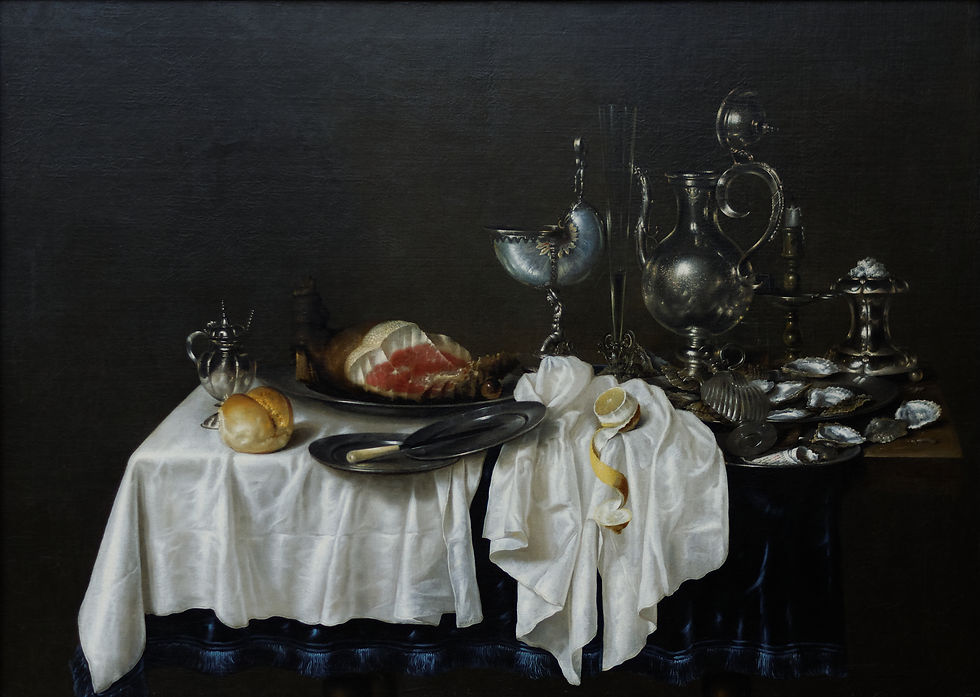
Heda's Nautilus Cup canvas is for the reception or intake area — the room where the client waits before the session begins and where the intake forms are completed. The painting is bookless and figureless; it carries no narrative; it depicts a small number of beautiful objects observed carefully. The painting's emotional register (calm competence with material objects) is exactly the register the practice wants to communicate to a client who is arriving anxious for a first appointment. Print at 60 × 90 cm horizontal, frame in dark walnut, mount centred on the reception wall at standing-eye-level (approximately 155 cm). The Heda signals professionalism without coldness.
Practical rules for the therapy-office wall programme
Three rules govern all five therapy-office placements. First: SCREEN PROTECTION. No painting should be hung directly in the client's line of sight from the chair if it could become a focal point during difficult moments — therapy clients in distress sometimes fixate on visual elements in the room and the fixation can become a barrier to therapeutic progress. The recommended geometry is to mount the painting at an angle to the client's primary chair so the painting is visible but not central. Second: REFLECTIVE-SURFACE AVOIDANCE. No glass or Plexiglas covering on the painting — reflective surfaces can produce unintended visual content (the client seeing their own reflection during the session, the therapist's office equipment reflecting back into the painting). Use non-reflective museum-quality giclée prints mounted on dibond or stretched canvas, or matte-acrylic non-reflective glazing. Third: NEUTRAL FRAMING. Pick unstained European oak or black-stained ash; avoid dark walnut (carries the wrong emotional weight — too funereal for therapy contexts) and avoid gilt frames (carries a wrong-register luxurious-religious association). The single-frame-material rule still applies but the material choice itself is more constrained in clinical contexts than in domestic ones.
Key takeaways
Therapy / counselling offices have three clinical art-selection constraints: (1) painting cannot become a topic of session conversation, (2) must survive multiple weekly viewings across months of return visits, (3) must avoid trigger content (no violence/distress/loss/conflict/intoxication/nudity/sexually-charged figures/specifically religious-or-politically-marked imagery).
Five paintings + placements: Hammershoi Strandgade Interior (primary consultation room, 70×60 cm), Monet Japanese Footbridge or Water Lilies (secondary wall or waiting area, 60×90 cm), Vermeer Milkmaid (small consultation room, 40×35 cm), Cassatt Tea (family-therapy or couples-counselling seating area, 60×80 cm), Heda Nautilus Still Life (reception or intake area, 60×90 cm).
Three universal rules: (1) SCREEN PROTECTION — no painting directly in client's line of sight from chair; mount at angle to primary chair so painting visible but not central. (2) REFLECTIVE-SURFACE AVOIDANCE — no glass/Plexi covering (client could see own reflection during session); use non-reflective giclée on dibond or stretched canvas or matte-acrylic non-reflective glazing. (3) NEUTRAL FRAMING — unstained European oak or black-stained ash; AVOID dark walnut (too funereal) and gilt frames (wrong luxurious-religious register).
Trauma-focused practices: prefer Monet (no figures) over Hammershøi (back-turned figure could be inappropriately suggestive in trauma context). Couples / family therapy: Cassatt Tea works as visual rhyme for multi-client work. Pediatric / child therapy practices need a different selection — children respond differently to old-master canvases than adults; a separate selection of bright simple compositions is recommended (Matisse paper cut-outs, illustrated children's books at scale, abstract colour-field works).
Programme cost: under $1,200 for a five-painting therapy-practice set (high-quality fine prints + appropriate frames + clinical-safe non-reflective glazing + LED frame-lighting kits). The Hub D therapy-office wall programme works as both interior-design and patient-experience-design investment — the wall art is read by the client during the most psychologically attentive moments of their week and accumulates a relationship to the practice that contributes measurably to therapeutic engagement.
Specifying art for a therapy practice, medical office, or clinical space? Send room photos via our consulting service — free consultation, custom shortlist, framed-and-shipped delivery. Browse the full archive at zocineartdesign.etsy.com.


Comments