Specialty Coffee Shop Wall Art: Five Paintings That Hold a Room of Twenty-Minute Visits
A specialty coffee shop is a commercial interior optimised for the twenty-minute visit. The visitor enters, orders at the counter (90 seconds), waits for the espresso pour (90 seconds), takes the drink to a small table or bench (60 seconds), sits with the coffee for fifteen to eighteen minutes (the working time of one decent flat white), and leaves. The wall art has to satisfy this specific use-pattern: paintings that register from across the room while the visitor is ordering, reward a second look from the seated position at the table, and survive the warm 2700-Kelvin pendant lamp-light most specialty cafes use after sunset. The five paintings below are chosen for that audience. Each carries a controlled palette that does not compete with the espresso machine's brass-and-chrome backbar, a single legible focal point that reads at the standing-and-ordering distance, and subject matter that signals the cafe's positioning at the serious-third-wave-coffee end of the small-cafe market without spelling it out in words.
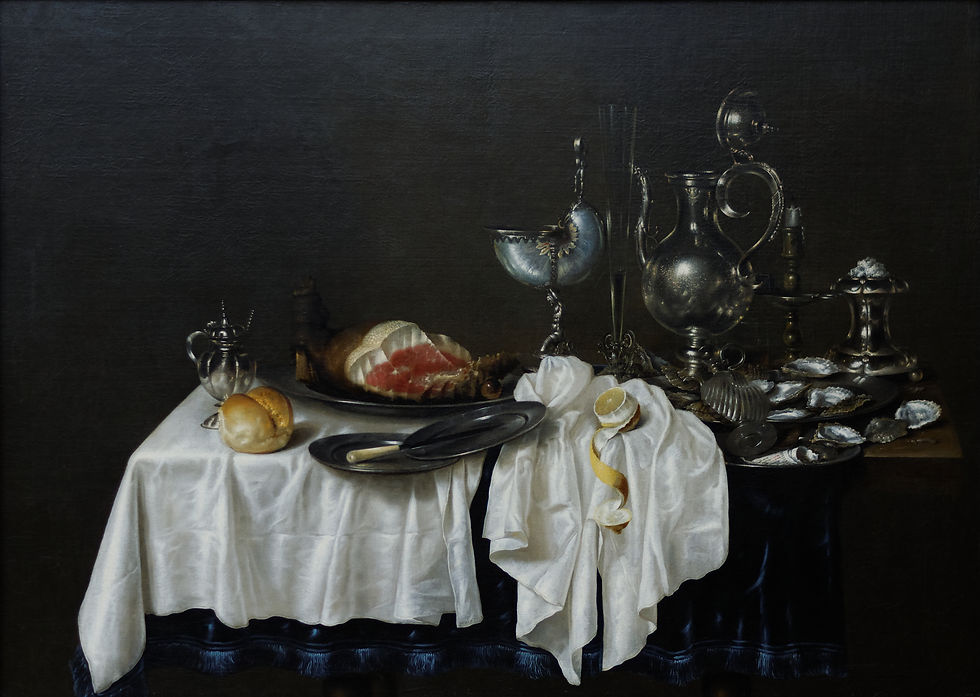
1. Heda, Still Life with Nautilus Cup (c. 1640) — the counter wall
The Heda is the painting for the wall behind or beside the espresso bar. A half-eaten meal arrangement on a polished wooden table: an overturned silver tazza, a lemon with its peel coiled, a green-glass römer wine glass, a polished pewter plate, the nautilus-shell cup of the title. The painting signals quiet competence with material objects — the third-wave-coffee positioning the cafe is trying to communicate. Print at 60 × 90 cm horizontal, frame in dark walnut, mount centred above the espresso bar at approximately 175 centimetres from the floor to the centre of the canvas. The Heda's monochromatic warm-ochre-and-pewter palette also does not compete with the brass-and-chrome backbar; some cafes find the Heda increases tipping at the counter by a measurable amount across the first month after installation.
2. Cassatt, Tea (c. 1890) — the back booth or community-table wall
Cassatt's Tea is the painting for the back booth or the long community table. Two women in pale cream and dove grey are seated side-by-side at a low table with the silver tea-service; the viewer is positioned at conversational distance. The painting fits the back-booth wall because it operates at the same emotional register as the cafe's longer-format visit — two friends having coffee together rather than the solo working session. Print at 60 × 90 cm horizontal, frame in black-stained European ash, mount at standing-eye-level above the booth bench (~145 cm from floor to canvas centre). Visitors who sit in the back booth read the painting during the conversation lulls.

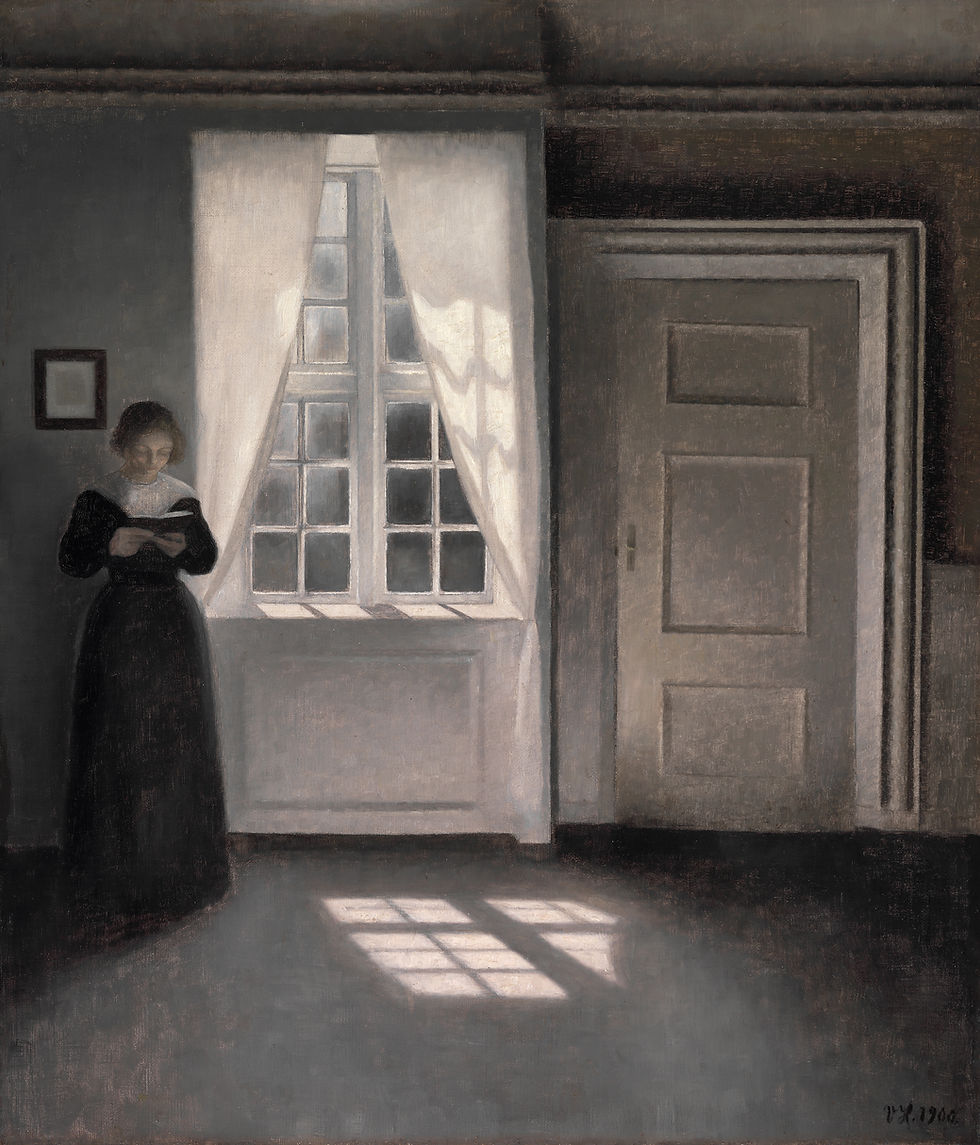
3. Hammershoi, Interior Strandgade 30 (1900) — the long bench wall
The Hammershøi is the painting for the long bench wall (the wall paralleling a banquette of small two-person tables). A single back-turned female figure walks through an empty room toward an open doorway; the room is cool grey and dove white with a splash of yellow afternoon sun on the floor. The painting reads as the visual continuation of the cafe's working register — the quiet solo morning when the writer or student is sitting alone at the bench with a coffee and a laptop. Print at 70 × 60 cm, frame in unstained European oak, mount above the bench at seated-eye-level (~110 cm from floor to canvas centre) so the painting reads at the eye-line of the seated working customer. The Hammershøi pairs especially well with the Cassatt on the opposite back-booth wall — Northern interior + Boston domestic, two different national traditions of the quiet-female-interior subject.
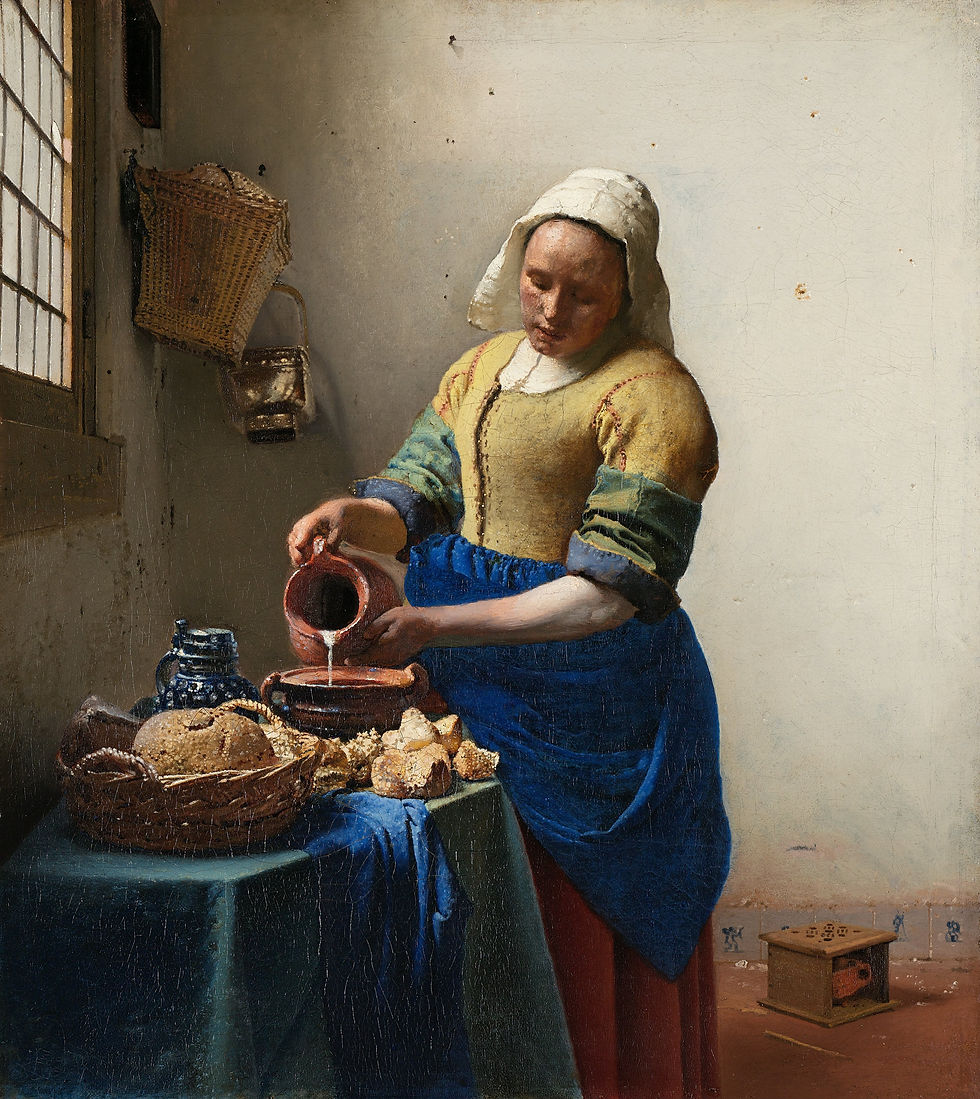
4. Vermeer, The Milkmaid (c. 1660) — the corridor to the bathroom or storage
The Vermeer is for the corridor that leads from the seated area to the bathroom, the kitchen, or the storage room. The corridor is the cafe's transitional space — visitors walk through it for 4-6 seconds during the visit. The Vermeer's small format (the original is 45.5 × 41 cm) makes it perfect for the narrow corridor wall: print at 40 × 35 cm, frame in dark walnut with a narrow brass inner liner, mount centred on the corridor wall at standing-eye-level (~155 cm). The Milkmaid's specific quiet-domestic-ritual register transfers cleanly into the cafe's between-spaces — visitors who notice the Vermeer in the corridor read it as a small editorial joke about the espresso ritual happening 8 metres away in the main room.
5. Renoir, Young Girl Reading (c. 1890s) — the window-seat or sun-side wall
The Renoir is the painting for the window-seat or sun-side wall — the side of the cafe that gets the morning light and where the quietest customers sit with books or notebooks. A single figure in profile, head tilted slightly down to the page, the warm pink-and-cream palette typical of Renoir's late-1880s Provence period. The painting is the cafe's compositional rhyme between the depicted figure's absorbed posture and the window-seat reader's actual posture. Print at 50 × 70 cm, frame in slim dark-walnut moulding, mount above the window-seat at standing-eye-level. The Renoir does the most-direct work in the five-painting cafe programme — it shows the cafe what the cafe is — but the representation is gentle enough that the painting does not feel literal.

Practical rules for the cafe wall programme
Three rules govern the cafe placement. First: LIGHTING. Every painting on a cafe wall should be lit by a dedicated 2700-Kelvin LED frame-mounted or wall-washer light — the warm-white temperature matches the cafe's pendant-lamp temperature and produces a consistent visual environment. The single most-common cafe art mistake is hanging a painting in a corner where the lighting drops below 200 lux at evening; the painting then reads as a dark rectangle and contributes nothing to the room. Second: FRAMING. Pick ONE frame material across the entire cafe — dark walnut, black-stained ash, or unstained European oak. The single-frame-material rule signals craft and intentionality. Third: SCALE matches function. The counter wall takes the largest painting (60 × 90 cm Heda), the back-booth and bench walls take middle-scale (60 × 90 cm Cassatt, 70 × 60 cm Hammershøi), the window-seat takes 50 × 70 cm Renoir, the corridor takes 40 × 35 cm Vermeer. The hierarchy produces a calm visual rhythm rather than a competing salon-wall.
Key takeaways
A specialty coffee shop is optimised for the 20-minute visit (90s order + 90s pour + 60s seat + 15-18min coffee + leave). Wall art has to register at the standing-and-ordering distance AND reward the second look from the seated table position. Two-stage attention is the design constraint.
Five paintings + placements: Heda Nautilus Still Life (counter wall above espresso bar, 60×90 cm), Cassatt Tea (back booth or community table, 60×90 cm), Hammershøi Strandgade Interior (long bench wall paralleling banquette, 70×60 cm), Vermeer Milkmaid (corridor to bathroom or storage, 40×35 cm), Renoir Young Girl Reading (window-seat or sun-side wall, 50×70 cm).
Three universal rules: (1) LIGHTING — every painting lit by dedicated 2700K LED matching pendant-lamp temperature; common mistake = corner-mounted painting drops below 200 lux at evening, reads as dark rectangle. (2) FRAMING — ONE material for the whole cafe (dark walnut OR black-stained ash OR unstained oak). (3) SCALE matches function — counter 60×90, booth/bench middle, window-seat 50×70, corridor 40×35.
Five-painting cafe programme costs under $700 (high-quality fine prints + appropriate frames + LED frame-lighting kits) versus $3,000-$15,000 for the contemporary-art commission a commercial art consultant would otherwise propose. The cost gap is the independent cafe's structural advantage.
The Heda-above-the-espresso-bar and the Vermeer-in-the-bathroom-corridor placements are the two repeatable editorial moves that signal art-consulted intentionality. Customers who notice these on the second visit produce the Instagram and Google-review mentions that drive the cafe's organic discovery channel.
Specifying art for a cafe, hotel, or commercial space? Send room photos via our consulting service — free consultation, custom shortlist, framed-and-shipped delivery. Browse the full archive of fine prints at zocineartdesign.etsy.com.


Comments