Alexander Calder Built the Same Rules in Steel and on Paper
Updated: Jun 17
In October 1930 an American engineer in his early thirties walked into Piet Mondrian's studio in Paris and stared at the wall.
Mondrian had pinned rectangles of coloured paper to a white plaster wall. Pure red. Pure blue. Pure yellow. The arrangement was the painting. Alexander Calder, who had trained as a mechanical engineer at Stevens Institute, looked at the rectangles and said: but they should move.
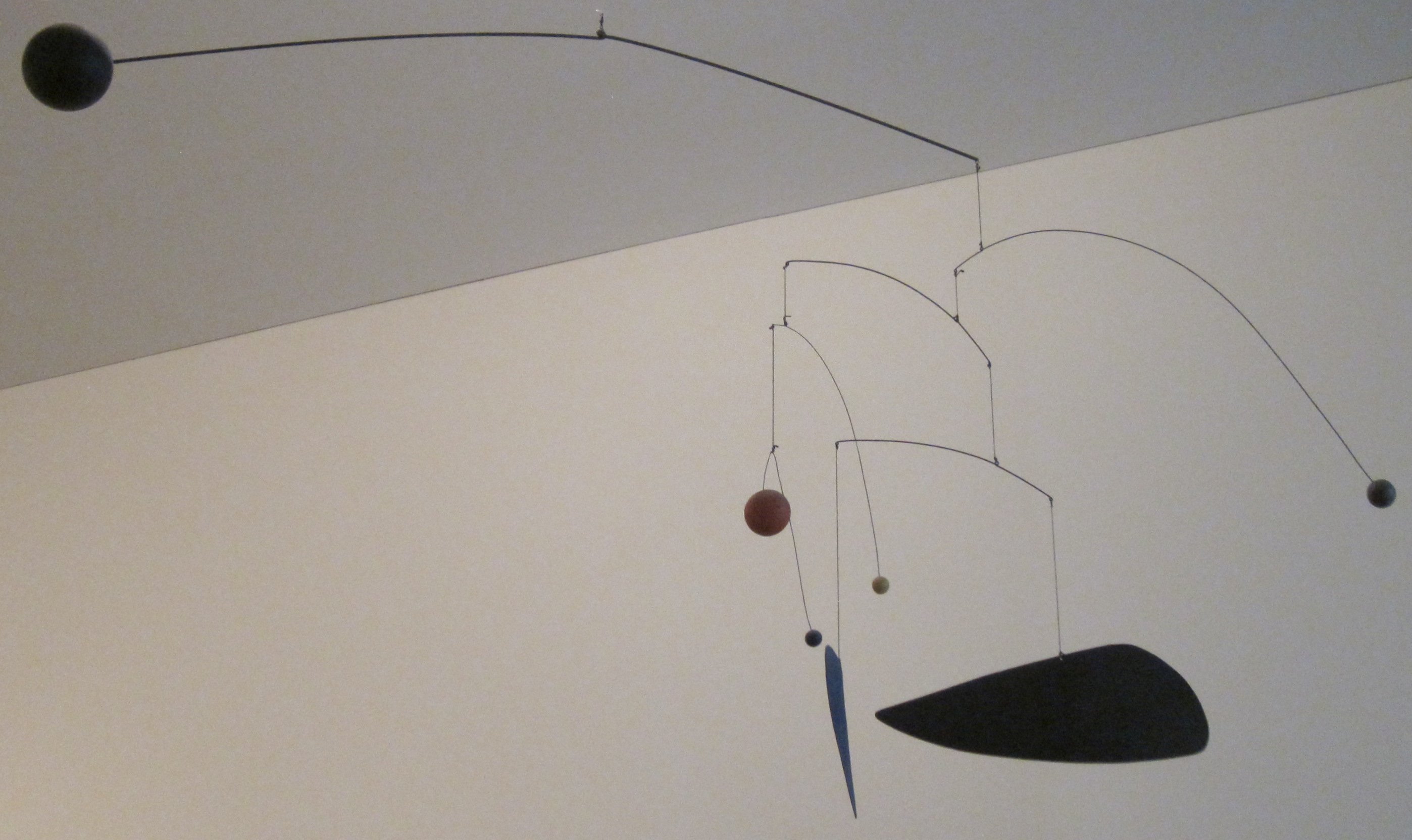
An engineer in Paris
Calder was the son and grandson of sculptors. He had also taken an engineering degree at Stevens Institute in 1919 — boiler design, materials calculations, mechanical drawing. By the late 1920s he was making wire portraits and a miniature circus he carried in suitcases from Paris apartment to Paris apartment, performing it on Saturday evenings for the avant-garde.
The visit to Mondrian in 1930 was the pivot. Within months Calder had abandoned figurative sculpture entirely and was suspending coloured discs from thin steel rods that turned in the slightest draft. Marcel Duchamp, watching one work in a Paris studio, suggested the name: mobile. Calder kept it.
Black and white first — then red
Calder's palette, like his geometry, was reduced to a system of forces. He once said: "I want things to be differentiated. Black and white first — then red."
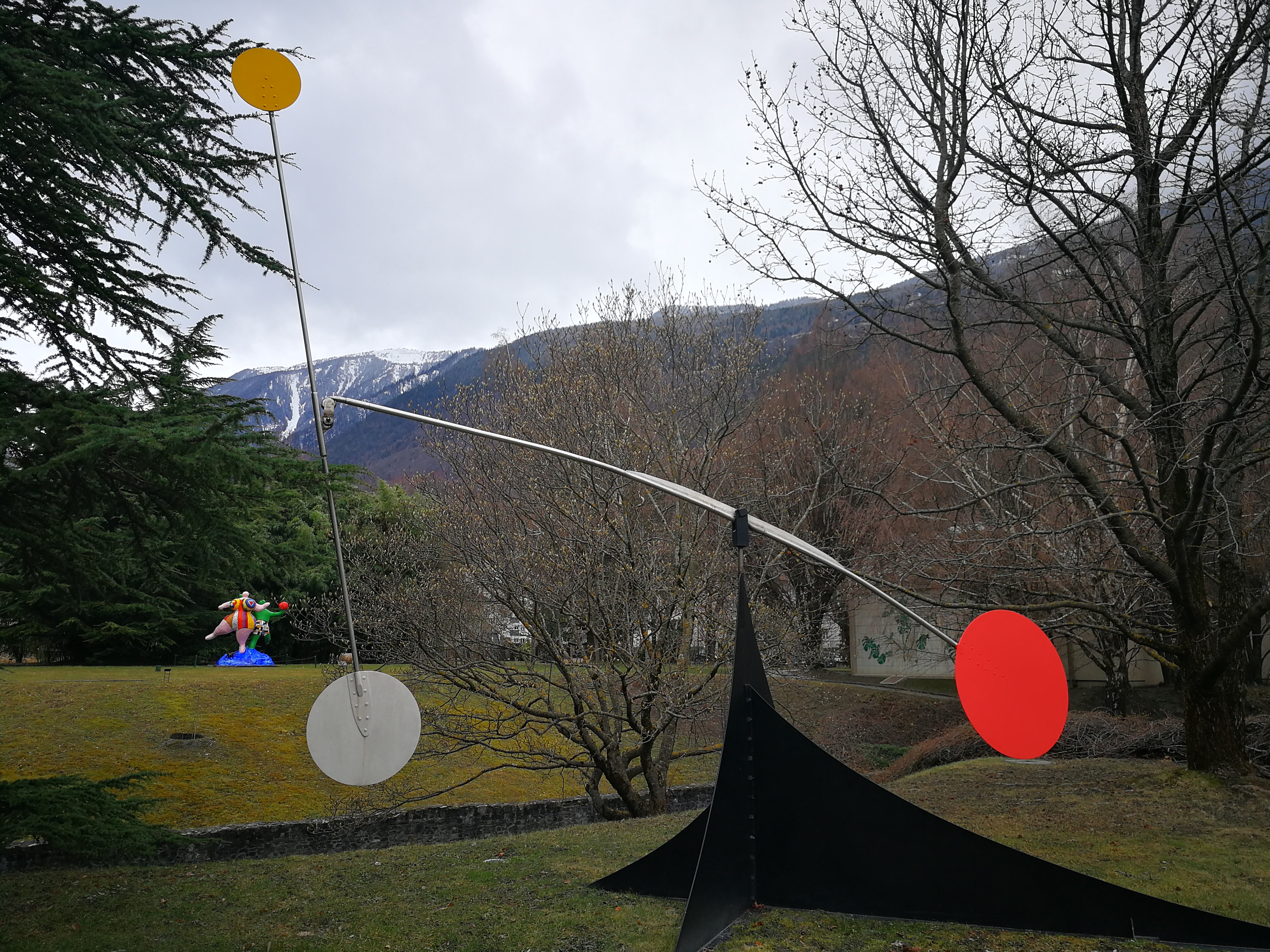
It is the most engineering-school sentence ever uttered by a sculptor. Black stabilises. White opens breathing space. Red asserts. The three together carry the composition without help from yellow, green or blue. He did add other colours to specific commissions — the yellow discs and blue paddles in the great outdoor stabile-mobiles — but the foundation stayed: differentiate first, then add.
Mobile, stabile, stabile-mobile
By the mid-1930s Calder had named three categories of sculpture, and the language he invented for them is still the language used today. The mobile is the moving sculpture, suspended or balanced so that the slightest current of air rearranges it. The stabile — a name suggested by his friend Hans Arp — is the standing sculpture, anchored to the floor or the ground, often monumental. The stabile-mobile combines the two: a fixed base with moving elements suspended above it.
Each is built around the same balance problem. The engineer's question — what holds, what swings, what pulls against what — carries every Calder work, on whatever scale.
Fifty feet of steel, painted vermilion
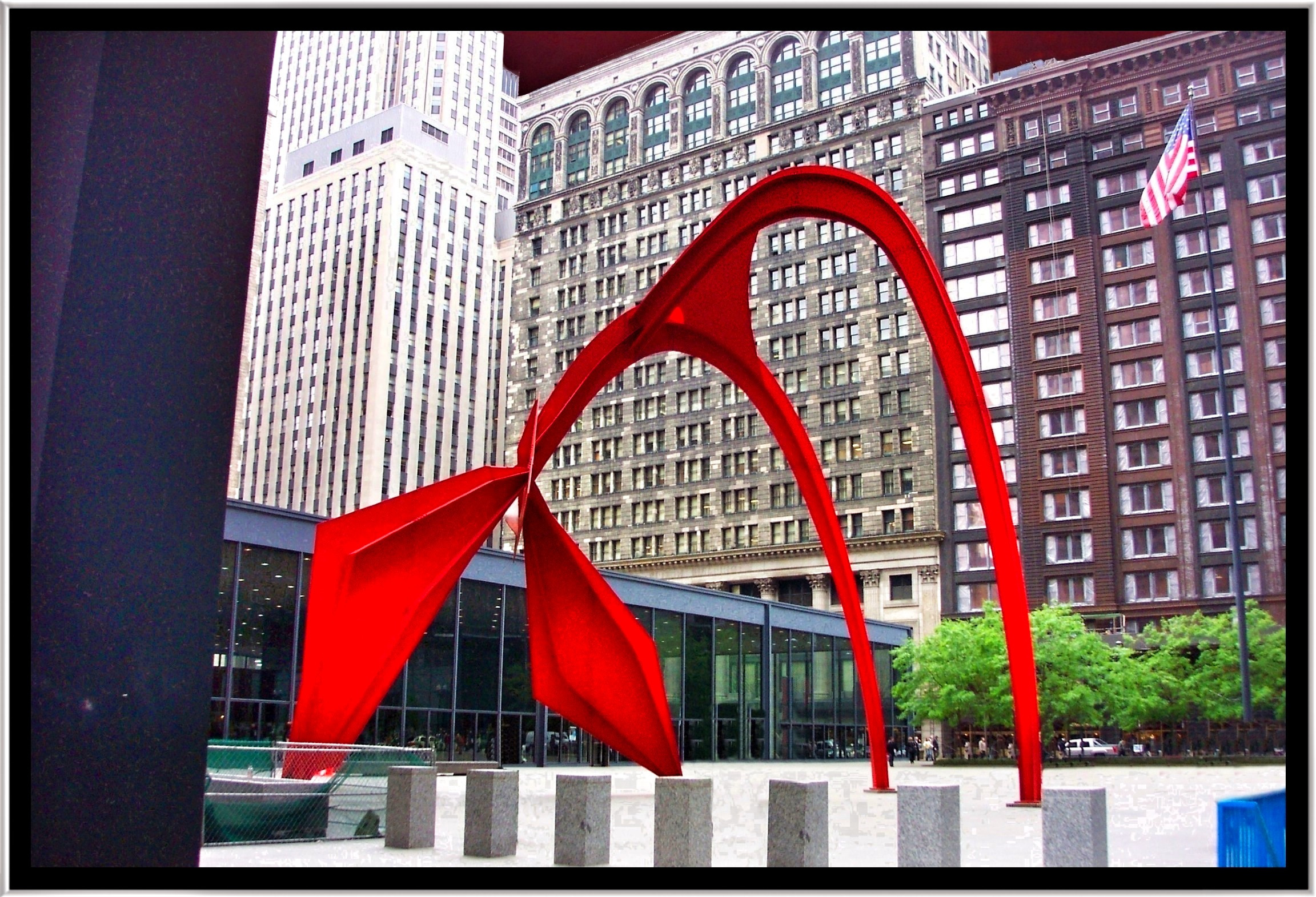
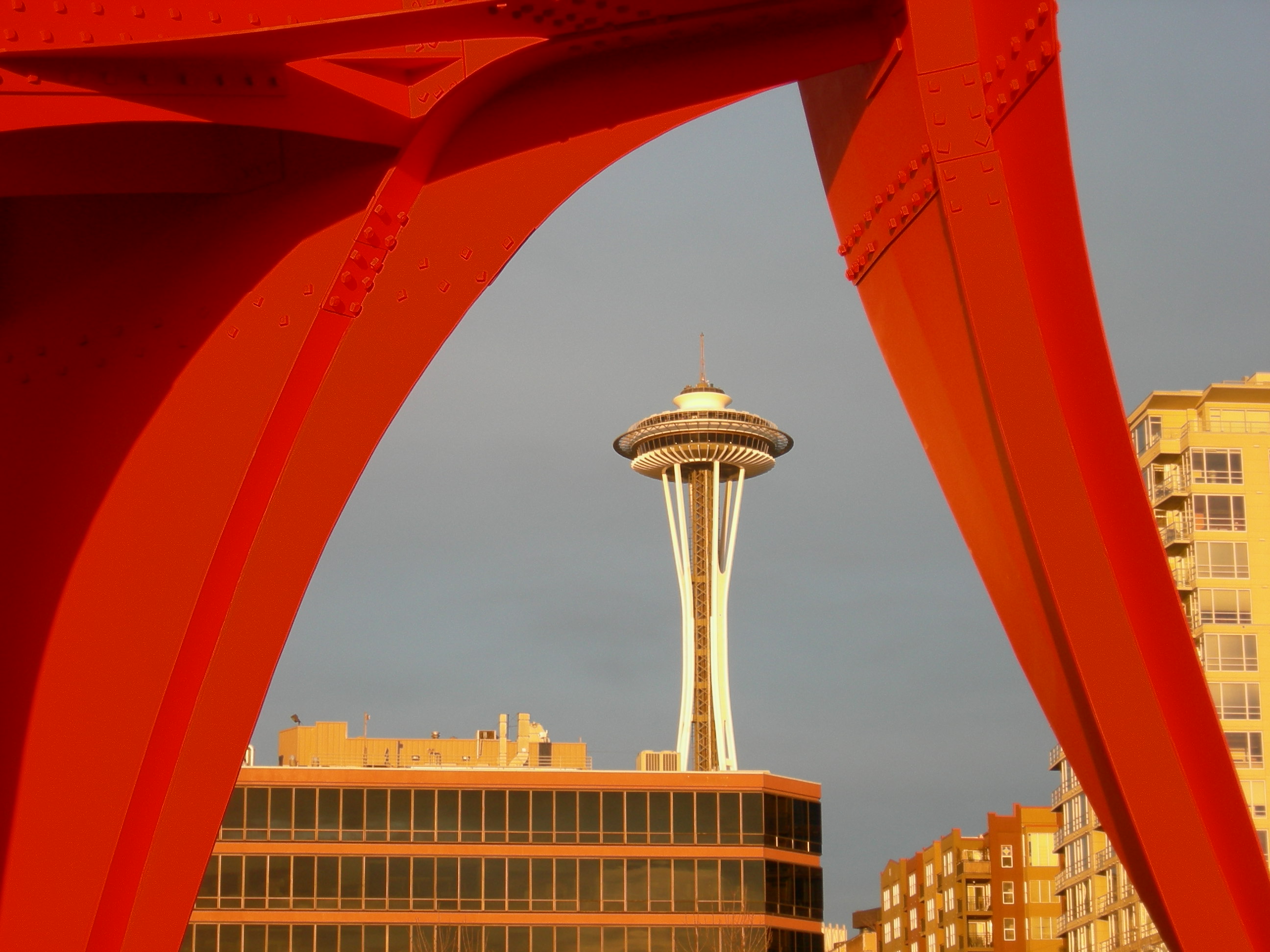
By the 1960s and 1970s Calder's stabiles had outgrown rooms. He was placing fifty-foot arches of welded steel in city plazas across America: Flamingo at the federal plaza in Chicago (1974), La Grande Vitesse in downtown Grand Rapids (1969), Trois Pics outside Grenoble (1967). Each was painted his signature vermilion red — a colour so closely linked to him that it became known as Calder red in the metal-finishing trade.
The same balance principle he had used on a desk in 1931 was now bearing wind loads and human traffic. The engineering held. The discipline scaled.
Connecticut and Saché — the parallel paper practice
From 1933 Calder lived and worked in a converted farmhouse in Roxbury, Connecticut. From the early 1950s he split his year between Roxbury and a stone house in Saché, in the Loire Valley of central France. Each location built the same way: a barn studio for sculpture, a separate room for paper work.
Alongside the welded steel, Calder painted gouaches — opaque water-based paint on heavy paper, fast-drying, no corrections. The forms migrated between media: spirals from his earliest wire work, suns and moons and stars, the same biomorphic vocabulary that hung in his mobiles. The gouaches were not preparatory sketches. They were a parallel practice in the same visual logic, just at the speed of a hand.
Late in his life critics began to argue that the gouaches deserved the same standing as the sculpture. The same balance, the same colour rules, the same engineer's insistence that every form earn its place. The same hand at work — only on a different surface.
What Calder left
Calder died in November 1976 at the age of seventy-eight, the day before a retrospective of his work opened in New York. He had invented the moving sculpture, named two categories of object, painted the cities of America vermilion red, and made colour and balance into a public-facing American visual language. The decoration of every children's nursery has a debt to him.
Three rules. Balance. Colour. Movement. Built first in steel — then on paper — then in fifty-foot vermilion arches over American plazas. The engineer's eye, never once put away.
Browse the archive of classical-art prints at zocineartdesign.etsy.com.


Comments