Six Paintings for the Anxious Mind: A Curator's Slow-Looking Prescription
Updated: Jun 17
Not all paintings calm the anxious mind. Some paintings make it worse. Goya's Black Paintings, Caravaggio's late executions, Bosch's hellscape panels, Munch's Scream — all are extraordinary art and all are wrong choices for the racing-mind evening. The six paintings below are chosen from the opposite end of the Western canon. They are the calm canon: Vermeer's domestic Delft interiors, Hammershøi's Copenhagen quiet rooms, Monet's late water lilies, Whistler's Thames nocturnes, Cézanne's patient mountain. Each was selected because its specific visual structure does measurable work on a racing mind — the canvases are organised around horizontal stability, low chromatic contrast, soft-edged transitions, the absence of human-figure facial expression, and the absence of narrative urgency. The slow-looking practice in this series is five minutes per painting (the abbreviated version of the twenty-minute protocol in the companion post). The prescription is to look at one painting from this series for five minutes in the late evening before bed, as a measured replacement for the phone the racing mind would otherwise be reaching for. The practice does not require belief in anything. It works because the visual cortex is doing what it is good at: pattern-locking onto a slow stable image. The racing mind quiets behind the eye that is doing the looking.
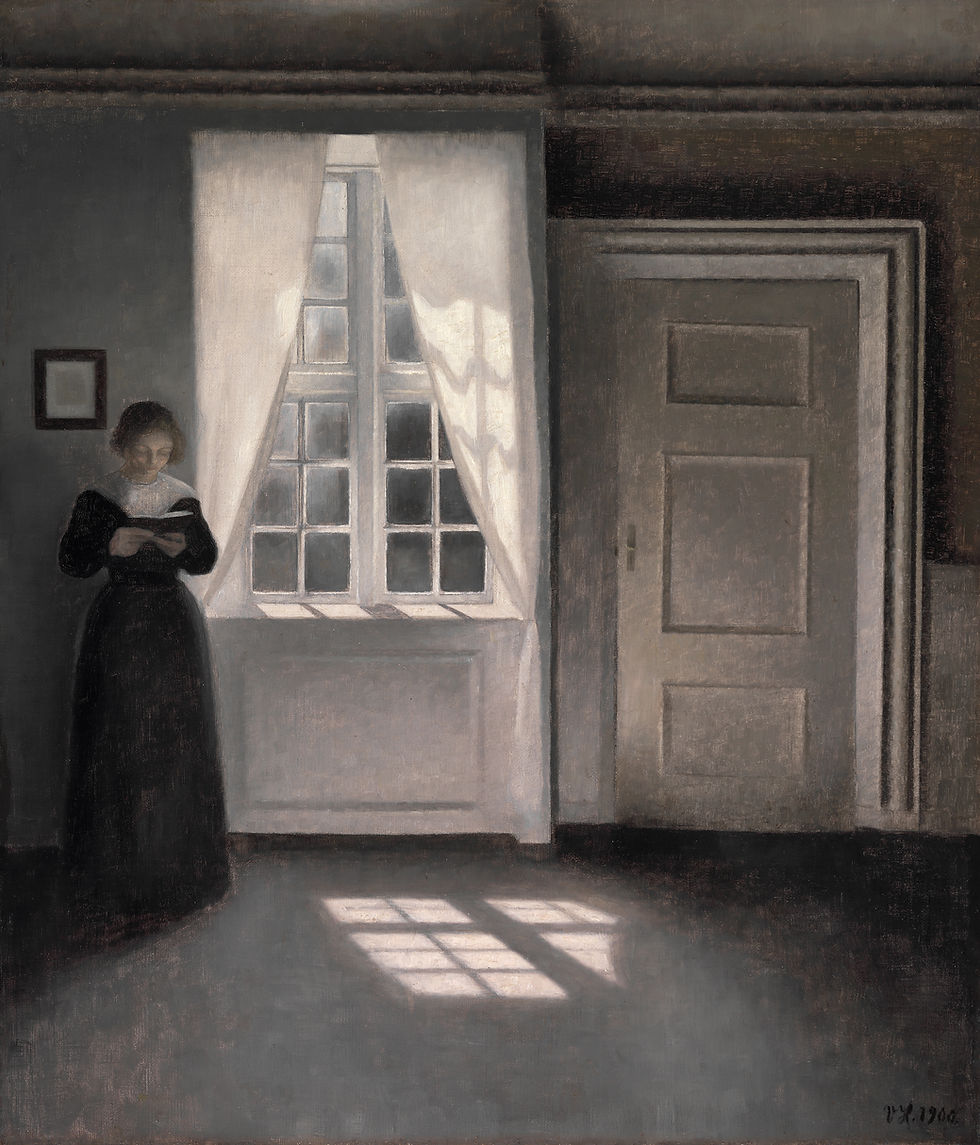
1. Hammershøi, Interior, Strandgade 30 (1900) — the racing mind
Hammershøi's Interior, Strandgade 30 is the slow-looking prescription for the racing-mind evening. A single woman in a high-collared dark dress is seen from behind, standing at a door in a quiet Copenhagen apartment interior, surrounded by cool grey light, an empty parquet floor, an empty table, a closed second door. The painting has almost no warm colour, no sharp edges, no narrative event, no facial expression visible. The visual cortex pattern-locks onto the slow vertical of the door, the slow horizontal of the parquet, the slow grey gradient from the cool-light window to the dark-doorway interior — all three are slow stable shapes that the racing mind cannot get traction against. Five minutes of looking at this painting is the closest thing the Western visual tradition has to an autonomic-nervous-system reset. The painting is the bedroom wall painting for the reader who is having a five-anxious-evenings week and wants the bedroom to do its share of the work.
2. Vermeer, Woman Holding a Balance (c. 1664) — the deliberation problem
Vermeer's Woman Holding a Balance is the prescription for the specific anxious-mind problem of held deliberation. The painting depicts a young woman in a blue jacket standing at a table, brass scales in her right hand, the pans empty, the wall behind her hung with a Last Judgement painting. The painting's whole moral argument is that the woman is choosing not to weigh material wealth in a room where eternal weighing is happening on the wall behind her. For the anxious-mind reader caught in the loop of "I should have done X / I should not have done Y / what is the right thing now," the painting offers a structural answer rather than a content answer: the held position is the answer. The brass scales are empty and balanced because the woman is choosing to hold them empty and balanced. The painting is the strongest Western statement of deliberation as a stable state rather than a transitional state. Look at this painting for five minutes when the deliberation loop is running.

3. Monet, Water Lilies with Cloud Reflection (c. 1916-26) — the over-stimulated visual cortex
Monet's late Water Lilies panels are the prescription for the over-stimulated visual cortex — the mind that has been on screens for nine hours, that cannot stop scanning, that has been reading too many small headlines. Monet's late water-lily panels deliver a continuous all-over green-and-blue chromatic field with no narrative event, no figure, no horizon-line; the eye cannot find a single edge to lock onto because the painting is constructed as continuous slow chromatic variation across two-by-six-metre canvases. The over-stimulated visual cortex has been trained by screens to scan, jump, and re-scan; the water-lily panels refuse that operation. The eye must slow because there is nothing to scan. Five minutes of slow-looking at a Monet water-lily reproduction (60 × 150 cm minimum print size for the effect to work) is the closest analog visual-tool to the late-evening screen-detox the over-stimulated mind needs.

4. Whistler, Nocturne in Blue and Silver: Chelsea (1871) — the late-evening over-thinking
Whistler's Nocturne series paintings are the prescription for the late-evening over-thinking loop — eleven at night, the day is finished, the mind is reviewing every conversation, the body wants to sleep and the mind refuses. Whistler painted a series of small canvases of the Thames at evening between 1871 and 1877 in deep blue-grey atmospheric tones with almost no contrast — a small boat at lower-left, the dim silhouette of the far bank, the indistinct gleam of a street-lamp in the fog. The paintings reject the over-thinking mind's preferred fuel: edge, detail, narrative, contrast. Whistler titled the paintings Nocturnes because he wanted them understood as visual equivalents of Chopin's small night-pieces — the same low-volume, low-contrast, slow-time register that classical music applies to late-evening sleeplessness. Five minutes of slow-looking at a Whistler nocturne immediately before sleep is the visual-equivalent of putting on a soft late-evening recording. Print at 60 × 80 cm horizontal, frame in unstained European oak, mount in the bedroom.
5. Cézanne, Mont Sainte-Victoire (c. 1904) — the patient-returning mind
Cézanne's late Mont Sainte-Victoire is the prescription for the mind that is anxious because it has been trying to make a decision for weeks and cannot finalise. Cézanne painted the same limestone mountain east of his Provence studio more than sixty times between 1882 and his death in 1906. The painting argues that the same subject can be returned to indefinitely and the return itself is what produces understanding. The late versions dissolve the mountain into structured colour-patches of ochre, sage-green, and lavender-violet — the patches do not fill in, the painting does not declare itself finished, the mountain is being approached again. For the anxious-mind reader caught in the I-must-decide-by-Friday pressure, the Cézanne offers a structural alternative: the decision can be returned to. Patient returning is a discipline. Five minutes of slow-looking at the Cézanne lets the mind recognise that the situation it cannot finalise this week may be a Mont Sainte-Victoire situation rather than a deadline situation.

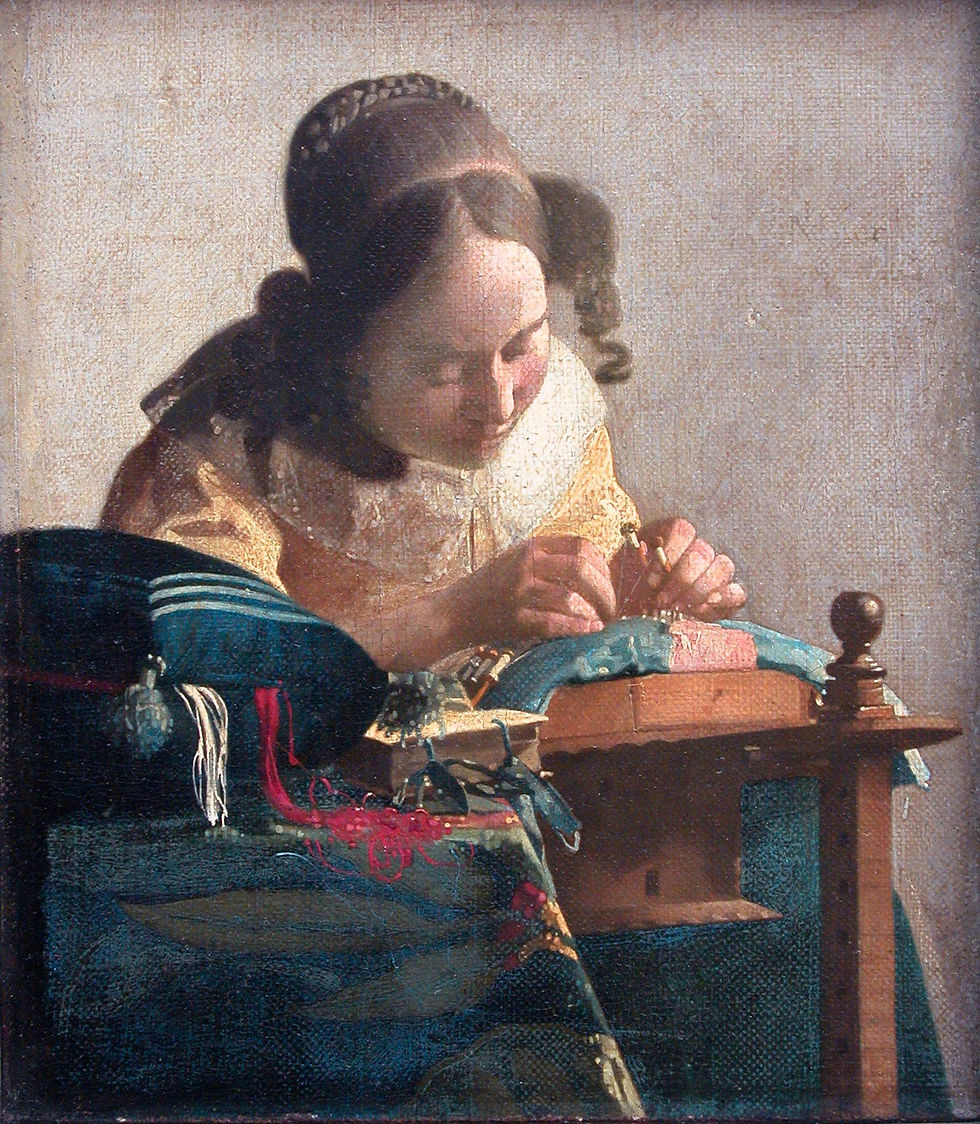
6. Vermeer, The Lacemaker (c. 1669-71) — the focused-attention reset
Vermeer's Lacemaker is the prescription for the specific anxious-mind state of cannot-focus-on-anything. The 24 × 21 cm canvas — Vermeer's smallest surviving painting — depicts a young woman bent in close concentration over her lace-pillow, fingers crossed in the act of binding two threads. The painting is the strongest Western statement of the high-concentration small-craft attention. For the reader whose attention has been spread thin across forty browser tabs and three Slack channels, the Vermeer lacemaker is the visual demonstration of attention itself — what it looks like, what it costs, what it produces. Looking at the painting for five minutes is not a metaphor for focused-attention; it is focused-attention, on the painting of focused-attention, by the reader who is trying to recover focused-attention. Print at 40 × 50 cm vertical (the small original allows a small print without aesthetic loss), frame in slim unstained European oak, mount above the desk or above the bedside table at close-reading distance.
How to use this series as practice
Three rules govern the calm-canon slow-looking practice. First: MATCH THE PAINTING TO THE STATE. The six paintings above are not interchangeable. The racing-mind state wants Hammershøi; the deliberation-loop wants Vermeer Balance; the screen-stimulated state wants Monet; the late-evening over-thinking wants Whistler; the cannot-finalise state wants Cézanne; the cannot-focus state wants Vermeer Lacemaker. Choose the painting that matches the specific state the mind is in this particular evening. Second: PRINT, NOT PHONE. The practice depends on the physical print being looked at on the wall, not the digital image being scrolled-to on the phone. The phone is the device the anxious mind is escaping; reaching for the phone to look at the painting reinforces the wrong loop. Mount the print on the wall, look at the wall. Third: FIVE MINUTES, NO PHONE IN THE ROOM. Set a timer (use the kitchen timer, not the phone timer). Put the phone in another room. Look at the painting for five minutes without checking anything. The practice's reward depends on the phone-absence; the racing mind cannot quiet behind the eye if the phone is within arm's reach.
Key takeaways
Not all paintings calm the anxious mind — Goya, Caravaggio, Bosch, Munch are extraordinary art and wrong choices for the racing-mind evening. The calm canon is specific: Vermeer interiors, Hammershøi rooms, Monet late panels, Whistler nocturnes, Cézanne mountain.
Six paintings + matched anxious-mind state: (1) Hammershøi Strandgade Interior = racing mind. (2) Vermeer Woman Holding a Balance = held-deliberation loop. (3) Monet Water Lilies Cloud Reflection = over-stimulated visual cortex. (4) Whistler Nocturne in Blue and Silver = late-evening over-thinking. (5) Cézanne Mont Sainte-Victoire = patient-returning mind. (6) Vermeer Lacemaker = focused-attention reset.
Three practice rules: (1) MATCH THE PAINTING TO THE STATE — the six paintings are not interchangeable. (2) PRINT, NOT PHONE — the practice depends on the wall, not the screen. (3) FIVE MINUTES, NO PHONE IN THE ROOM — kitchen timer, phone in another room.
Why this works: the visual cortex pattern-locks onto slow stable images; the racing mind quiets behind the eye that is doing the looking. The calm-canon paintings were constructed with horizontal stability, low chromatic contrast, soft edges, no facial expression, no narrative urgency — all of which are anti-anxiety visual properties.
Cadence: one painting per evening as needed. Standard rotation: keep one or two of the six prints permanently mounted in the bedroom, rotate the others through the reading nook or hallway. The practice compounds — the mind recognises the painting on the second and third use and the calming effect arrives faster.
Browse fine prints from the calm canon for the bedroom and reading nook in the archive at zocineartdesign.etsy.com.


Comments