Bosch's Ship of Fools: Reading the Little Panel of Human Folly
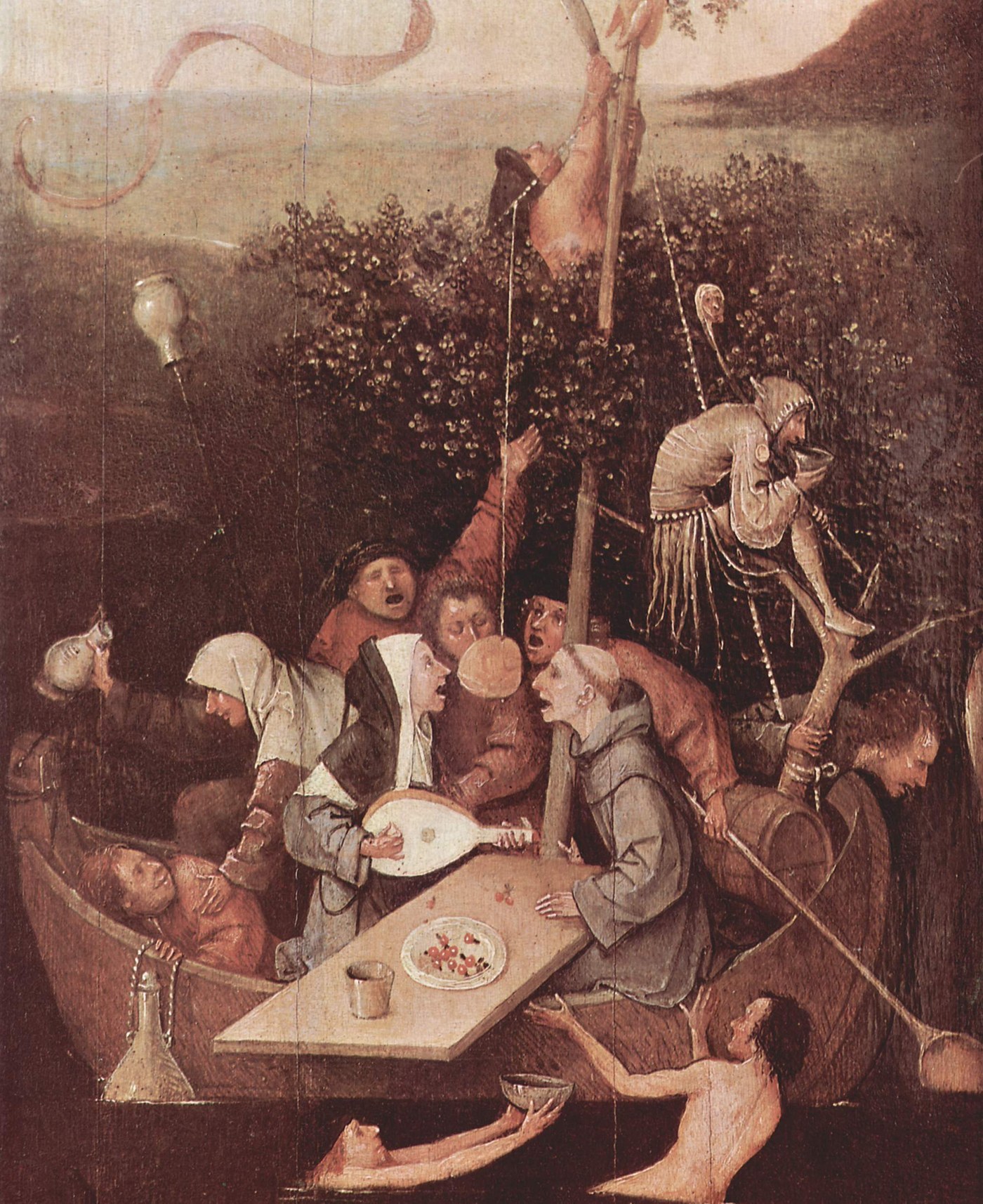
A crowded rowboat drifts on flat water, and nobody is steering. A nun strums a lute, a monk leans in to sing the same note back at her, and a plucked bird swings from a branch that has been jammed upright to stand in for a mast. This is the Ship of Fools, a small oak panel painted around 1500 by Hieronymus Bosch, and almost everyone aboard is too busy eating, drinking or singing to notice that the boat is going nowhere.
The panel is tiny, roughly 58 by 33 centimetres, yet it has become one of the most quoted images of human folly in European art. Bosch, who lived from about 1450 to 1516 in the Brabant town that gave him his name, built the scene from ordinary people behaving badly and then loaded every gesture with a second meaning.
Read slowly, the boat turns into an argument about appetite, self-deception and the thin line between a wise man and a fool. Here is what the panel shows, how it was put together, and why a five-hundred-year-old joke about drunk passengers still lands.
A Small Panel, Cut From a Larger Whole
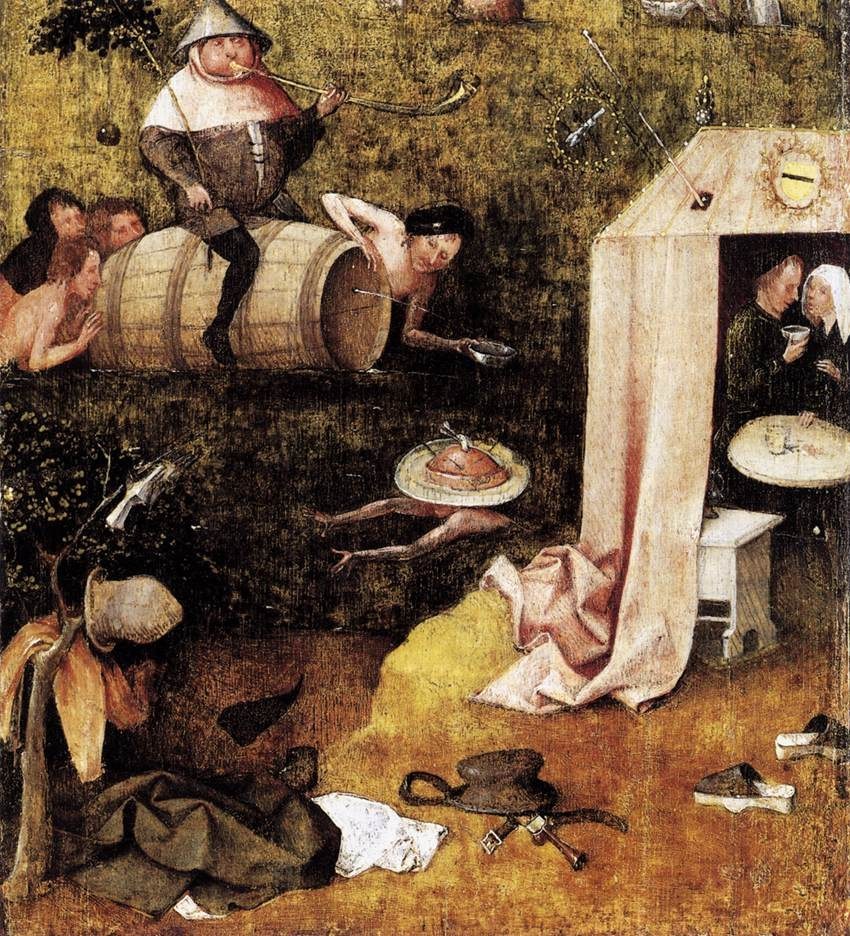
The Ship of Fools is a fragment. It began as the upper section of a tall painted wing, and at some point that wing was sawn straight across. The lower portion survives on its own as the Allegory of Gluttony and Lust, a scene of drink and appetite measuring about 35 by 31 centimetres, now kept in a New Haven collection. The two pieces were once a single continuous board, which is why the carousing below reads like a direct continuation of the party in the boat above.
The matching wing, Death and the Miser, is a narrow vertical panel of roughly 93 by 31 centimetres. It shows a dying man in his bedchamber, caught between an angel and a demon who offers a sack of gold, while Death itself steps through the door. Set beside the boat, it converts the whole object into a sermon in two halves, folly on one wing and the reckoning on the other. Scholars have proposed that these panels, perhaps together with a lost central image and a round Wayfarer painted on the closed exterior, once formed a single triptych about the vanity of worldly life, though the reconstruction remains a careful hypothesis rather than a settled fact.
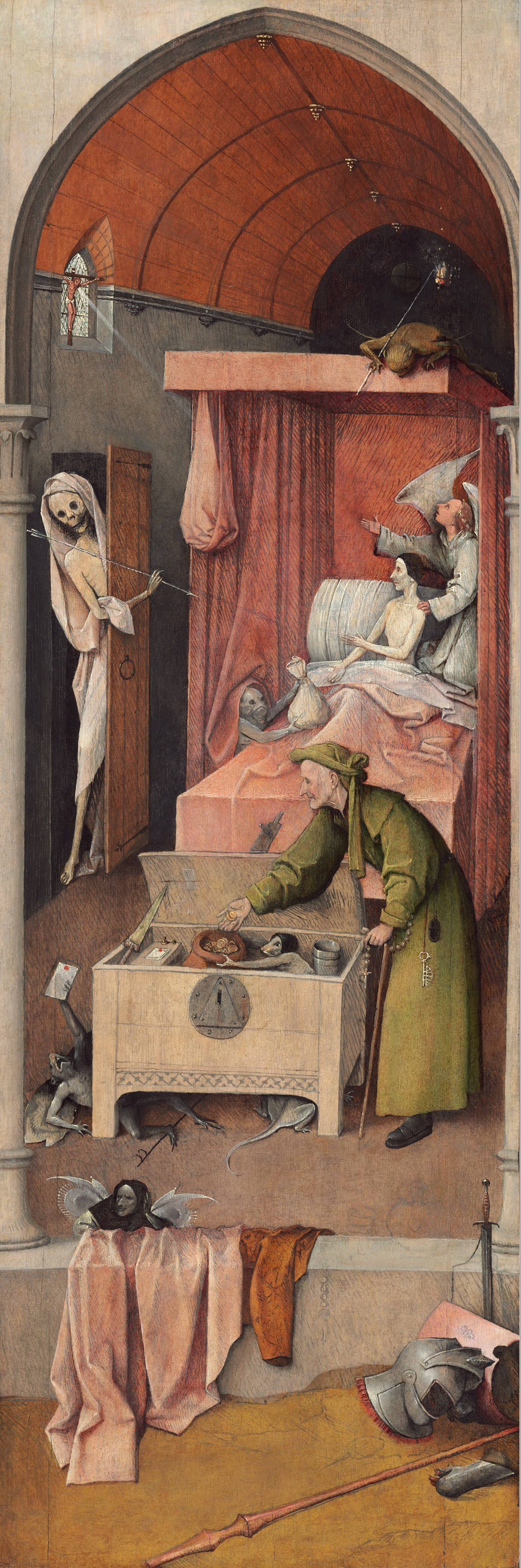
Death and the Miser is offered as an archival fine print in the ZocineArtDesign archive. View the listing here.
What Is Actually Happening in the Boat
Around ten passengers are packed into a vessel far too small for them. At the centre a nun cradles a lute while a monk opens his mouth to sing, the two of them locked in a duet that no one requested. A shallow dish of cherries sits on the plank that doubles as a table, and cherries in Bosch stand for fleeting sensual pleasure, sweet and gone in a moment. Setting a monk and a nun at the heart of the revel is a deliberate jab at a clergy that was supposed to steer other people away from exactly this.
Above their heads a roasted goose has been tied to the branch, and a man leans out with a knife to cut it down, driven less by hunger than by plain grabbing opportunism. Another passenger has already had far too much and is being sick over the side. In the water a swimmer holds up an empty bowl toward the boat, still begging for one more drink even as the current carries him away from it.
The mast is not a mast at all. It is a living tree, a leafing branch stood on end, and near its top Bosch hides a small owl among the leaves. The owl stares out without expression, and in his paintings it is an unsettled night bird tied at once to watchfulness, to heresy and to the blindness of people who cannot see in the dark. Lower down, a heavy cooking ladle has been pressed into service as an oar, which tells you precisely how seriously this crew treats the task of getting anywhere.
The Book That Named the Boat
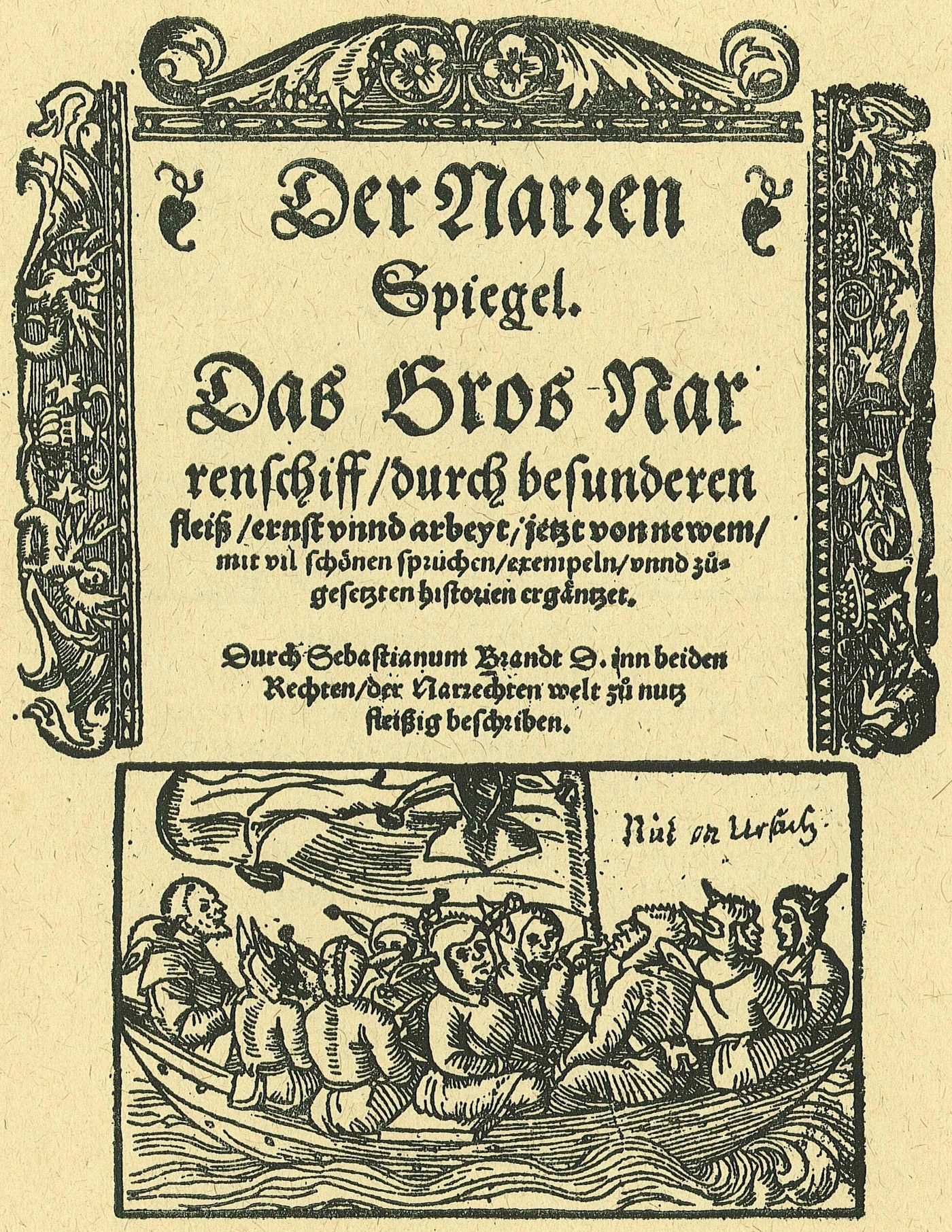
The painting did not invent its subject. In 1494 the Strasbourg humanist Sebastian Brant published Das Narrenschiff, the Ship of Fools, a long satirical poem in which more than a hundred varieties of fool climb aboard one boat and set sail for a paradise of idiots. It was among the first true bestsellers of the printing age, reprinted and pirated across German lands, and a Latin translation titled Stultifera Navis carried it to the rest of Europe by 1497.
Brant framed the whole poem with a line from the book of Ecclesiastes that he set at its head as a motto, "Stultorum infinitus est numerus," the number of fools is infinite, and then spent more than a hundred chapters proving the point. His fools sail toward a coined destination he calls Narragonia, the land of idiots, while an early printed edition lays the book out on its title page as a Narrenspiegel, a mirror of fools in which every reader is meant to find his own face. Bosch, working within a few years of the text, painted that mirror as a single overloaded rowboat, and handed the printed idea the face it has carried ever since.
The Sober Man Is the Real Fool
One figure seems to stand outside the whole affair. On a branch to the right, turned away from the singing, a jester in a hood sits alone with a fool’s bauble and a cup. He is the only professional fool aboard, the licensed jester whose entire job is to point at folly, and Bosch places him slightly apart, watching the rest. The joke is quiet and exact. The man dressed as a fool is the steadiest passenger in the boat, while the monk, the nun and the respectable drinkers are the ones who have genuinely lost the thread.
A thin pennant streams from the branch, and Bosch marks it with a crescent, a shorthand in his period for the worldly and the faithless. The reading is not subtle. A boatload of clergy and laypeople, too drunk and too entertained to steer, drifts under a godless flag while a roast bird turns slowly overhead. Every detail leans the same way, toward appetite winning and reason asleep at the tiller.
Why the Little Panel Still Holds
Part of the staying power is the scale. At 58 by 33 centimetres the panel is roughly the size of a serving tray, and Bosch fills that small field with a dozen readable faces, each caught in the middle of a blunder. You lean in, the way you would to read fine print, and the closer you look the more misbehaviour surfaces. Bosch worked in thin oil glazes over a pale ground, with a quick and confident hand, and modern dating of his oak panels places the whole group around 1500 to 1510.
The other part is that the joke has not aged. Bosch is not lecturing about one narrow sin so much as describing a permanent human habit of mistaking a good time for a destination. A crew that eats, sings and argues while the boat quietly drifts is a picture anyone still recognises. That is why the image keeps being borrowed, five centuries on, whenever a writer wants to describe a society that has stopped steering.
The Ship of Fools and its companion panels belong to a body of early Netherlandish painting that rewards long looking, and prints of these works, alongside the wider archive of vintage art, live in the ZocineArtDesign shop at zocineartdesign.etsy.com.
Questions People Often Ask
Where is Bosch’s Ship of Fools kept today?
The panel is held in a Paris collection. It is small, about 58 by 33 centimetres, and is usually shown as a single fragment rather than as part of the larger object it once belonged to.
Is the Ship of Fools a complete painting?
No. It is the upper part of a wing that was cut down. The lower section survives separately as the Allegory of Gluttony and Lust, and the opposite wing survives as Death and the Miser. The central panel that would have sat between them is lost, which is why any full reconstruction of the original object stays a proposal.
How is the painting related to Sebastian Brant’s book?
Brant’s Das Narrenschiff of 1494 is a printed poem cataloguing more than a hundred kinds of fool. Bosch’s panel is a painting made shortly afterward that takes the same premise, a boatload of fools going nowhere, and compresses it into one crowded scene. The book supplied the theme, and the painter supplied the picture that most people now picture first.


Comments