Caravaggio's Boy Bitten by a Lizard: The 1594 Painting That Invented the Modern Shock-Image
Updated: 6 days ago
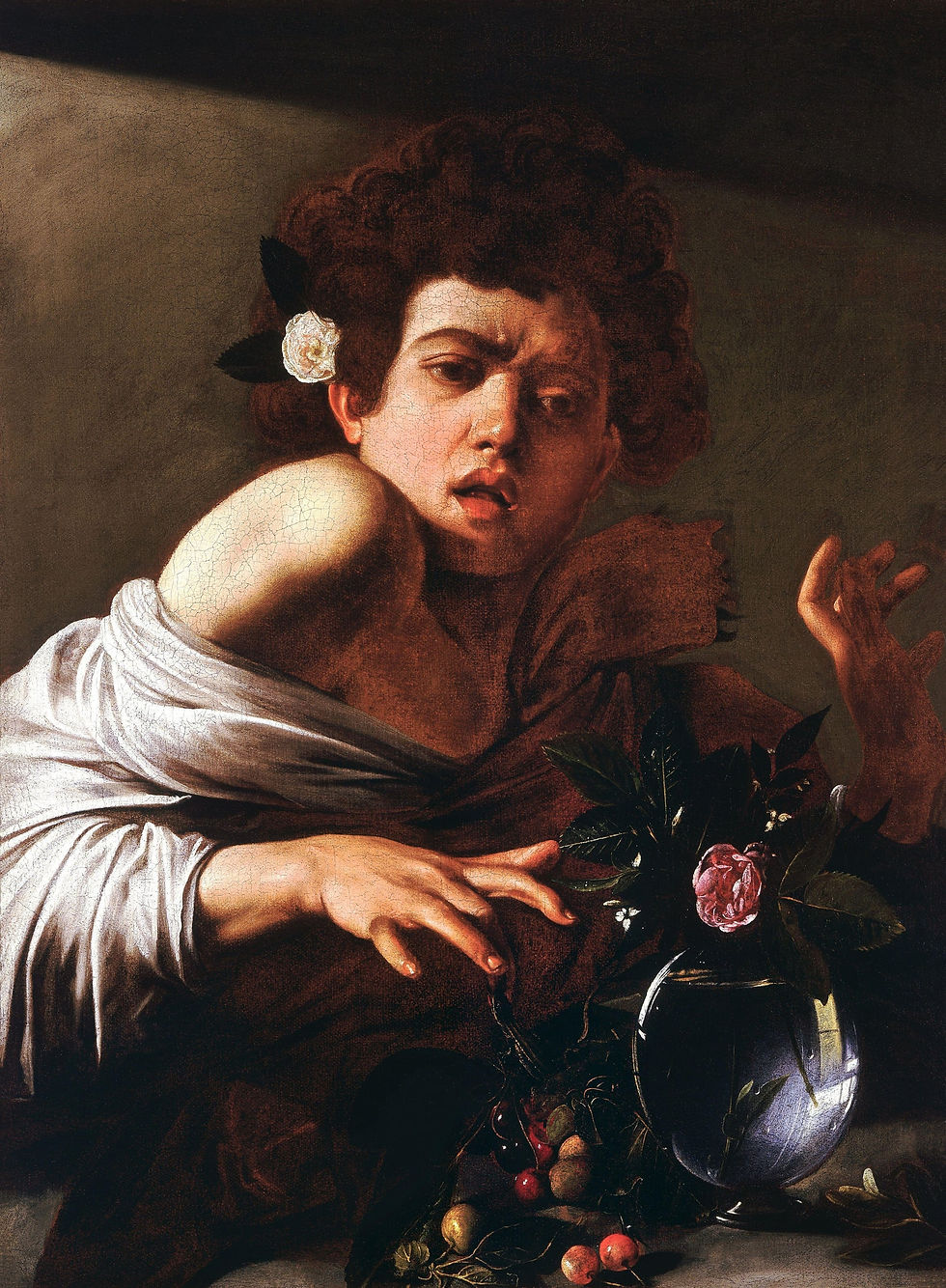
Caravaggio's Boy Bitten by a Lizard — painted in Rome around 1594, when the painter was still in his early twenties and not yet famous — is one of the strangest pictures of the entire Italian sixteenth century. It shows a handsome young man, half-undressed in a loose white shirt that has slipped off his right shoulder, leaning forward over a small wooden table set with cherries, a single rose in a glass carafe of water, and a bunch of green leaves. He has just reached for the cherries; a small grey-green lizard, half-hidden in the leaves, has caught his middle finger between its jaws and bitten it. The boy is in the middle of recoiling — his shoulders are turning away, his face is contorted into a grimace of surprise and pain, and his right hand, the bitten one, is suspended in the air in the exact instant of being pulled back. The picture exists to make the viewer feel that bite. It is the first major European painting built entirely around a moment of surprise — and through it, more or less single-handedly, Caravaggio invented a new kind of image that the entire Italian Baroque would spend the next hundred and fifty years elaborating.
The two versions: London and Florence
The picture survives in two autograph versions painted within months of each other, both made when Caravaggio was twenty-two or twenty-three and just establishing himself in Rome. One version, slightly later and slightly larger, hangs today in a London collection; the other, painted slightly earlier and more roughly worked, hangs in a private Florentine collection. The two pictures are not copies — both are by Caravaggio's own hand, both show the same young model in the same pose, the same lizard, the same cherries, the same glass carafe, the same rose, but the brushwork and the modelling of the boy's face are recognisably different in each. Both pictures hang at roughly two-thirds life-size: the London canvas is sixty-six by forty-nine and a half centimetres; the Florentine version is slightly larger at sixty-six by fifty-two. The picture was clearly a commercial success for the young painter — he was repeating it for a second buyer almost immediately after the first was finished.

In 1594 Caravaggio had been in Rome for roughly two years. He had arrived from Lombardy in the summer of 1592 at twenty or twenty-one, almost penniless, and was working in the studio of the painter Giuseppe Cesari (later known as the Cavaliere d'Arpino), who specialised in producing decorative work for cardinals and used Caravaggio as a paid hand for the still-life elements — flowers, fruit, drapery — in his larger compositions. The Boy with a Basket of Fruit of around 1593 is the picture that survives from this period; the Boy Bitten by a Lizard follows it a year later, after Caravaggio had broken with Cesari's studio and was working independently from a tiny rented room with no patron and no commissions. The Lizard is a speculation picture — a work made on his own initiative, with no buyer in advance, designed to attract the attention of the Roman picture-collecting market. It worked. By the time the second version was finished, the cardinal Francesco Maria del Monte had taken notice of Caravaggio's work and invited him into his household, where Caravaggio would spend the next several years producing the early masterpieces that established his reputation.
What the picture actually shows
Almost every element in the picture is there because the moment of surprise demanded it. The boy is shown half-length, the upper half of his body filling almost the entire canvas, set against a plain dark background with no architectural setting at all. Caravaggio has shown no room, no window, no curtain — only the boy, the table, and the dark. The light strikes him obliquely from the upper left, picking out his rounded shoulder, the side of his face, the white sleeve sliding down his arm, and the wet glistening surface of the glass carafe on the table. Behind him there is only blackness. This is the first appearance, in Caravaggio's surviving work, of the radical contrast of light and dark — the technique that would later be called tenebrism — that would become the central stylistic device of the Italian Baroque.
The action is shown in a single split-second. The boy's right hand is raised in the air, the bitten middle finger curled back, the wrist contorted; his shoulders are rotating away from the table; his face is twisted into a grimace that mixes pain and shock, his lips parted, his eyes narrowed in surprise. The lizard itself is rendered with extraordinary specificity — a wall lizard (Podarcis muralis), grey-green with dark dorsal stripes, its jaws clamped on the soft flesh just above the second knuckle of the boy's middle finger. The cherries that have been disturbed by the boy's reach are scattered on the table — three or four still in their bunch, two or three rolling free. The green leaves under which the lizard was hidden are still half-pulled-aside. The glass carafe of water in the foreground at the left of the table catches the light from the same upper-left source and is reflected so precisely that the viewer can see, in the curve of the glass, both the window light and the rim of the table.
The picture is, in other words, a still life with a figure superimposed on it — but the still life is the cause of the figure's reaction. Caravaggio has reorganised the relation between figure and object that European painting had taken for granted since the fourteenth century. Before this picture, objects in painting were attributes — symbols of identity, or props that signified status (a book for a scholar, a sword for a soldier). In the Boy Bitten by a Lizard, the object is an agent — the lizard bites the boy, and the boy's whole physiology and emotion are produced by the object's action. The picture is the first European painting in which the still life does something to the figure rather than belonging to it.
The vanitas reading: cherries, lizard, and the rose
The picture's surface is a moment of pain, but its iconography is moral — a fact that contemporary viewers in 1594 would have recognised immediately and that has been somewhat dimmed by four hundred years of intervening secular reading. Cherries, in late-sixteenth-century Italian painting, are an established symbol of erotic pleasure — the fruit of love, the fruit of the flesh, sometimes specifically the fruit of paradise that triggers the Fall. The lizard, more obscurely, is an emblem of treacherous concealment — a snake-in-the-grass figure, named in classical and Christian moral literature as the small hidden creature that turns innocent pleasure into sudden pain. The rose in the glass carafe — a single white rose, fully open, on a long stem — is the standard vanitas symbol of beauty that will not last. The three elements, taken together, form a compact moral allegory: he who reaches for the pleasures of the senses will be bitten by a hidden treachery, and the beauty that promised the pleasure is itself ephemeral.

This is the formal hinge of the picture. The Boy Bitten by a Lizard is a vanitas painting disguised as a genre scene. To a moralising sixteenth-century Roman viewer, the picture said: this is what happens when you reach for the cherry of pleasure. To the same viewer, examining the picture more closely, it added: notice that the rose is already half-open, that the cherries are already piled on the table rather than still hanging on the branch, that the lizard was there all along — the moral was inevitable from the beginning. To us, the picture looks like a moment of surprise; to its first audience, it looked like the visible structure of a moral law.
The earlier boys: Boy Peeling Fruit and the formula
Caravaggio's three or four "boy with object" pictures from his first Roman years — Boy Peeling Fruit (probably the earliest, c. 1592-93), Boy with a Basket of Fruit (c. 1593), Young Sick Bacchus (c. 1593), and the two Boy Bitten by a Lizard canvases (c. 1594) — form a compact group. All five use the same compositional formula: a single half-length youthful male figure, set against a plain dark background, with a still-life object or arrangement in the foreground that the figure interacts with. All five show the boy with one shoulder bared, the loose white shirt slipping off — a deliberately androgynous, sensual presentation. All five use the same dramatic side-lit modelling that would become Caravaggio's signature. And all five are working out the same problem: how to make a still life and a portrait fuse into a single emotionally charged image.

The Boy Peeling Fruit — the earliest of the series — is the picture in which Caravaggio first works out the formula. A boy in a loose white shirt is bent over a small heap of apricots and pears, paring a small green fruit with a knife. There is no surprise, no drama, no allegory yet — just the absorbed attention of a young man at a domestic task, lit by an oblique window light. But every later element is here: the half-length composition, the slipping shirt, the plain dark background, the still-life object pulled forward into the picture's foreground. The Boy Bitten by a Lizard took this formula and added a single new element — surprise — and the picture changed character entirely. The quiet portrait became a moment of violence; the still life became an agent; the picture began to do something to the viewer that European painting had not previously done.
The 1599 Basket of Fruit: still life as its own subject
By 1599 Caravaggio was working under the patronage of Cardinal del Monte and had been commissioned for a series of major altarpieces and ceiling paintings. In the same year, he painted a small picture that has no figure in it at all — just a wicker basket of fruit set on a plain wooden surface against an undifferentiated cream-coloured background. The Basket of Fruit, now in a private Milanese collection that was once a cardinal's library, is generally considered the first independent still life in European painting — the first picture in which a still life is the entire subject rather than an accessory, a corner, or a background element. The picture is roughly thirty by fifty centimetres, smaller than a sheet of paper, but its historical importance is enormous: every later still life in the European tradition — Dutch, Spanish, French, Italian — descends from it.

What is remarkable about the Basket of Fruit is not just that it has no figure — many medieval still-life elements had existed within larger compositions for centuries — but that it sustains the same intensity of attention that Caravaggio had given to the boys' faces. The grapes are not idealised; some are perfect, others are dimpled or beginning to shrivel. The apples include one with a small wormhole. One of the leaves is half-yellow with autumn. The peaches are at the moment of being too ripe. Caravaggio is treating the fruit the way he treated the boy's bitten finger — as a moment in the life of an actual object, observed with the same close attention that the boys' faces had received. The implicit argument of the picture is that a basket of fruit, looked at carefully enough, contains the same emotional weight as a portrait — and through this argument, the European still life as an independent genre was born.
Narcissus and the second great shock-image
Three or four years after the Boy Bitten by a Lizard, Caravaggio returned to the structural problem of the picture — how to organise the entire visual field around a single moment of psychological discovery — in a second great picture that pushed the technique still further. The Narcissus, painted around 1597-99 and now in a Roman collection, takes the Ovidian myth of the youth who falls in love with his own reflection in a pool and condenses the entire story into a single image. Narcissus is shown half-length, kneeling at the edge of an unseen pool, leaning forward to look at his own reflected face. The reflection — Narcissus's own image, but reversed and slightly dimmed by the water — fills the lower half of the picture, completing a near-perfect circle with the kneeling figure above. There is no landscape, no setting, no other figure — only Narcissus, his reflection, and the black water between them.

The Narcissus is the same picture-strategy as the Boy Bitten by a Lizard, scaled up and made cosmic. Where the boy is bitten by a lizard, Narcissus is trapped by his own reflection. Where the boy's recoil makes the viewer feel a single split-second of physical pain, Narcissus's still gaze makes the viewer feel the eternal frozen instant of a self-recognition that will never resolve. Both pictures organise the entire visual field — the lighting, the dark background, the half-length composition, the absence of setting — around a single psychological moment. Both pictures stripped European painting down to its most concentrated possible form: figure plus object, lit dramatically, posed at the centre of a single emotional event, with everything else removed.
Caravaggio's late career — the public altarpieces, the dramatic religious scenes, the violent biblical narratives that he produced from around 1600 onward and that culminated in the Calling of Saint Matthew, the Conversion of Saint Paul, the Judith Beheading Holofernes, and the David with the Head of Goliath — was a thirteen-year project of applying the visual strategy first worked out in the Boy Bitten by a Lizard to the entire repertoire of Christian narrative. Every later Caravaggio is built on the same principle: take a moment of psychological discovery, light it dramatically against blackness, strip out the setting, and hold the figure in the exact split-second of its emotional event. The whole Italian Baroque after Caravaggio — Artemisia Gentileschi, Orazio Gentileschi, Guercino, Ribera, Velázquez, Rembrandt's response to his Italian-Baroque sources — depends on the formula that Caravaggio had announced in this small picture of a boy and a lizard in 1594.
Key takeaways
Caravaggio's Boy Bitten by a Lizard, painted in Rome around 1594 when the painter was twenty-two or twenty-three, is the first major European painting built entirely around a moment of surprise. A boy in a slipping white shirt recoils as a lizard hidden among the cherries on the table bites his middle finger.
The picture survives in two autograph versions, both by Caravaggio's own hand — one in a London collection (slightly later, more polished) and one in a private Florentine collection (slightly earlier, more roughly worked). The picture was a speculation work made without a commission to attract the Roman picture-collecting market; it worked, and led directly to Caravaggio's patronage by Cardinal del Monte.
The picture is the first appearance in Caravaggio's surviving work of tenebrism — the dramatic contrast of light and dark against a plain blackened background — that would become the central stylistic device of the Italian Baroque.
Beneath the moment of surprise the picture is a vanitas allegory. Cherries (erotic pleasure), the hidden lizard (treacherous concealment), and the single rose in the glass carafe (beauty that will not last) form a compact moral argument: the pleasures of the senses contain hidden punishments, and the beauty that promises the pleasure is ephemeral.
The Lizard belongs to a small group of Caravaggio's early "boy with object" pictures — Boy Peeling Fruit (c. 1592-93), Boy with a Basket of Fruit (c. 1593), Young Sick Bacchus (c. 1593), and the two Lizard canvases (c. 1594). All five use the same half-length composition, dark background, dramatic side-lit modelling, and half-bared shoulder.
In 1599 Caravaggio painted the Basket of Fruit — a small picture with no figure at all, just a wicker basket of fruit against a plain background. This is generally considered the first independent still life in European painting, and every later still life — Dutch, Spanish, French, Italian — descends from it.
The Narcissus (c. 1597-99) is the Lizard's structural sequel: the same single-moment composition scaled up to a mythological subject. Both pictures strip European painting down to figure plus object, lit dramatically against blackness, posed at the centre of a single psychological event with everything else removed.
The entire mature Caravaggio — the Calling of Saint Matthew, the Conversion of Saint Paul, the Judith Beheading Holofernes, the David with the Head of Goliath — is a thirteen-year project of applying the Boy Bitten by a Lizard's visual strategy to the full repertoire of Christian narrative. The whole Italian Baroque after Caravaggio depends on the formula this small 1594 picture announced.
Browse Caravaggio, Italian Baroque, and tenebrist prints in the archive at zocineartdesign.etsy.com.
New in the Journal: Caravaggio's Judith Beheading Holofernes: The 1602 Painting That Made Violence the Subject of a Domestic Scene
More Caravaggio: Caravaggio: 5 Paintings Explained


Comments