Caravaggio: 5 Paintings Explained
Caravaggio (1571-1610) was an Italian Baroque painter who staged sacred and mythological scenes in sharp light against deep shadow. His breakthrough public work is The Calling of Saint Matthew (1599-1600). This guide explains five Caravaggio paintings and links to a full article on each. His 1602 version of the Judith story has its own article: Caravaggio's Judith Beheading Holofernes (1602).

Boy Bitten by a Lizard (c. 1594): why is it a shock image?
A boy with a rose behind his ear recoils as a lizard bites his finger. Caravaggio caught the sudden pain in a half-length figure, which was unusual for the time. The canvas, about 66 x 49.5 cm, is held in a London collection.
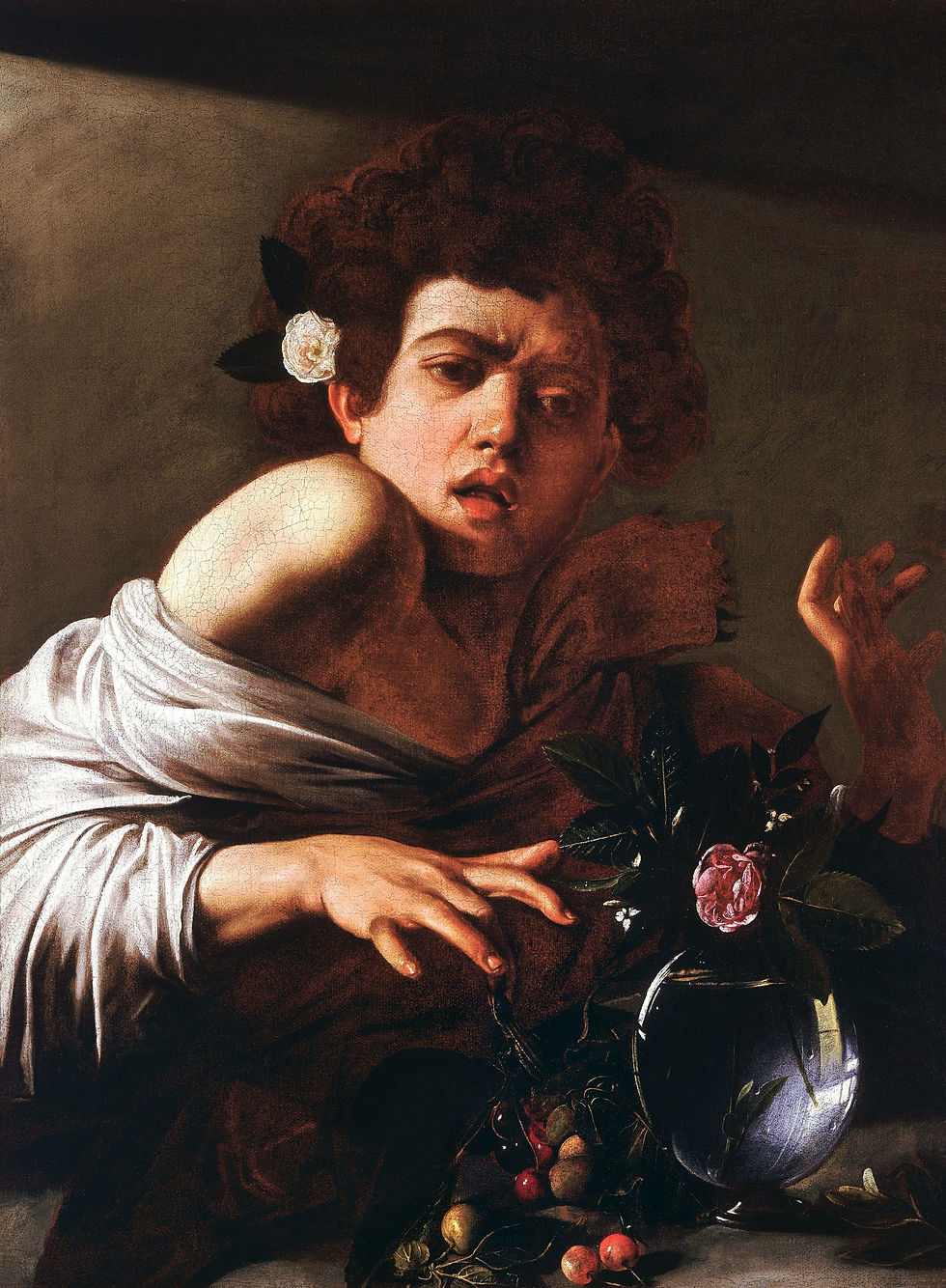
Read the full guide: Caravaggio's Boy Bitten by a Lizard
The Calling of Saint Matthew (1599-1600): what is the light pointing at?
A beam of light enters from the right and falls on Matthew, a tax collector sitting among men in modern dress. Christ points, and the light does the calling. The painting is in the Contarelli Chapel of San Luigi dei Francesi in Rome.
Read the full guide: Caravaggio's Calling of Saint Matthew: Meaning
Narcissus (c. 1597-99): is it really by Caravaggio?
The picture shows a young man kneeling over his reflection in a pool, so the figure and its double form a closed circle. It measures about 110 x 92 cm. Scholars debate the attribution, but it is widely discussed as his.

Read the full guide: Caravaggio's Narcissus (1599)
Judith and Holofernes (c. 1599): what does this version show?
Caravaggio painted the moment of the killing in raw, unsparing detail. This version is separate from the 1602 painting of the same subject.

Read the full guide: Caravaggio's Judith and Holofernes: Meaning
The Seven Works of Mercy (1606-07): why so many scenes in one canvas?
Caravaggio painted it in Naples after fleeing Rome. Seven acts of Christian charity are packed into a single street scene beneath the Virgin and Child. It hangs in the Pio Monte della Misericordia, for which it was made.

Read the full guide: Caravaggio's The Seven Works of Mercy
Frequently asked questions
What is Caravaggio's most famous painting?
The Calling of Saint Matthew (1599-1600) is among the most famous.
What is chiaroscuro?
Chiaroscuro is strong contrast between light and dark. Caravaggio pushed it into the style later called tenebrism.
Why did Caravaggio go to Naples?
He fled Rome in 1606 after a fatal fight and worked in Naples, where he painted The Seven Works of Mercy.
Zocine Art Design is an independent studio that prints classic paintings as wall art.
See Baroque art prints at Zocine on Etsy.
Comments