Pieter de Hooch's Courtyard of a House in Delft (1658): The Light Beyond the Door
The Courtyard of a House in Delft is an oil painting by Pieter de Hooch, dated 1658. It shows a passage and a small courtyard behind a Dutch house, with a woman and a child in the shade and a bright patch of sun beyond. Nothing dramatic happens. The painting is about order, brick and light, and it is one of the finest pictures of a Dutch home.

What does The Courtyard of a House in Delft show?
We look down a shaded passage with brick walls and a tiled floor. A woman and a small girl stand in it. Beyond them a doorway opens onto a courtyard in strong sunlight, and further still there is another doorway or gate. The picture is built from rectangles: doors, windows, brick courses and paving. Within that tidy grid, the small human figures are kept calm and gentle.
Why is the light so important?
De Hooch used the contrast between shade and sun to organise the whole painting. The passage in front is cool and dim. The yard at the back is bright. Your eye is drawn through the space like a visitor stepping through the house, from the cool inside to the warm outside. The effect is both realistic and a little magical, and it suggests the pleasure of a clean, well-kept home.
De Hooch and Vermeer
De Hooch lived in Delft in the 1650s, the same city and decade as Johannes Vermeer, and the two are often compared. Both painted women at work in quiet houses, both loved perspective and light, and both were members of the Delft painters' guild. Vermeer is more refined and more mysterious. De Hooch is more open and more practical: his rooms and yards are places where you can almost smell the brick. De Hooch moved to Amsterdam around 1660, and his style changed there.
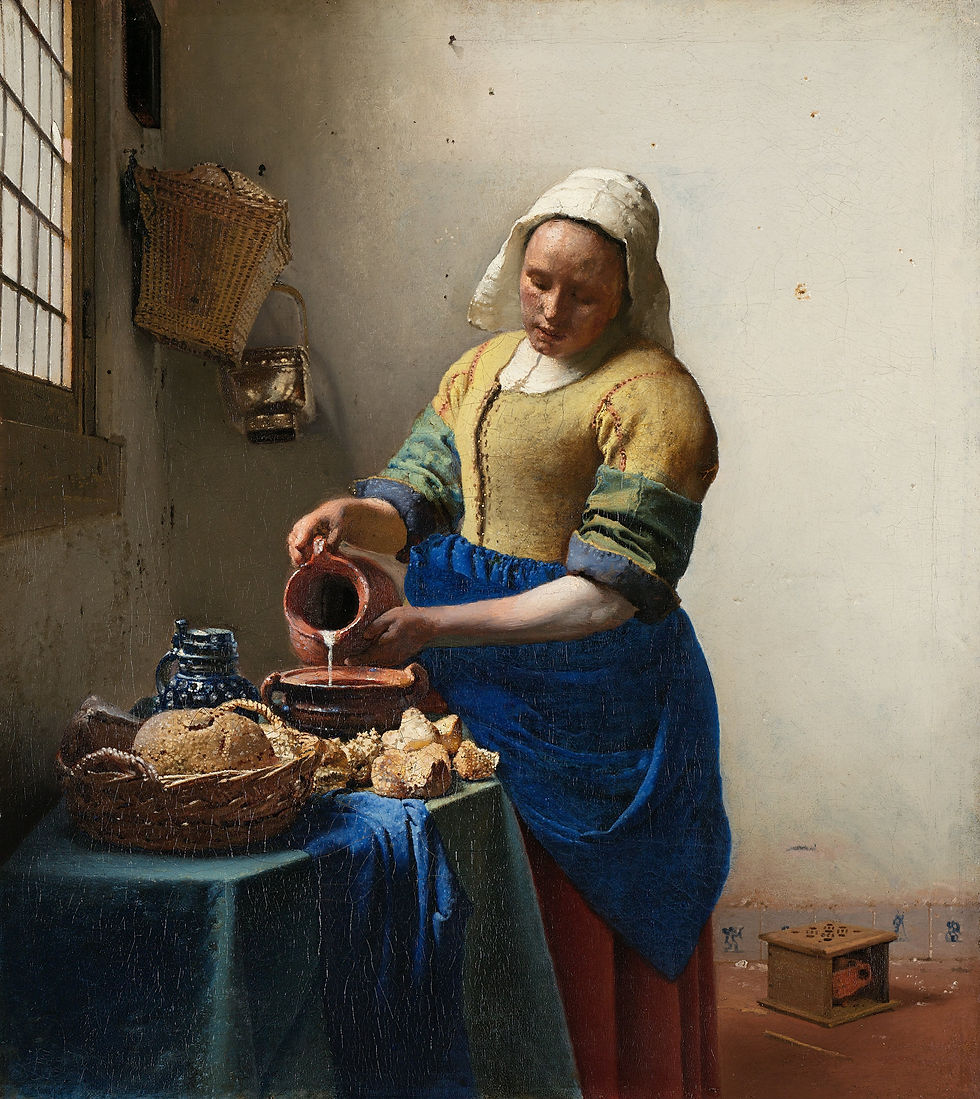
If you like this kind of picture, our guides to Vermeer's Milkmaid and Vermeer's paintings explained are natural next steps, and the Dutch Golden Age guide puts both painters in context.
A picture about home
In the seventeenth-century Dutch Republic, a clean and orderly house was a source of pride, and the housewife was often shown as the centre of it. Many paintings of this type carry a mild moral message about domestic virtue. In de Hooch's hands, the message comes lightly. What remains is the feeling: a safe house, a woman and a child, a sunny yard just beyond the door.
How should you look at it?
Start with the figures in the passage and notice how small they are in the architecture.
Follow the line of the floor to the doorway and the bright yard.
Count the doors and openings and see how they pull you inward.
Study the brick and the paving: they are painted with great patience.
Where does it work as wall art?
This is a good picture for a hallway, a dining room, a kitchen or a sitting room. Its warm reds and browns look natural on wood floors and in older houses, and its calm geometry sits well beside more modern furniture. It also makes a very good housewarming gift, because the subject is a home.
Frequently asked questions
When did Pieter de Hooch paint The Courtyard of a House in Delft?
It is dated 1658, when he was living in Delft.
What is the painting about?
It is a quiet scene of domestic life, built around the contrast between a shaded passage and a sunlit courtyard.
Did de Hooch paint with Vermeer?
They worked in the same city in the same years and are often compared, but there is no proof that they painted together.
What style is it?
It is Dutch Golden Age genre painting, with strong linear perspective and a close attention to light.
If you like paintings that make an ordinary home feel precious, The Courtyard of a House in Delft is available as a classic art print for a hall, kitchen or dining room.

Comments