Vermeer's Milkmaid: The Most Looked-At Wall in Dutch Painting
Updated: Aug 22
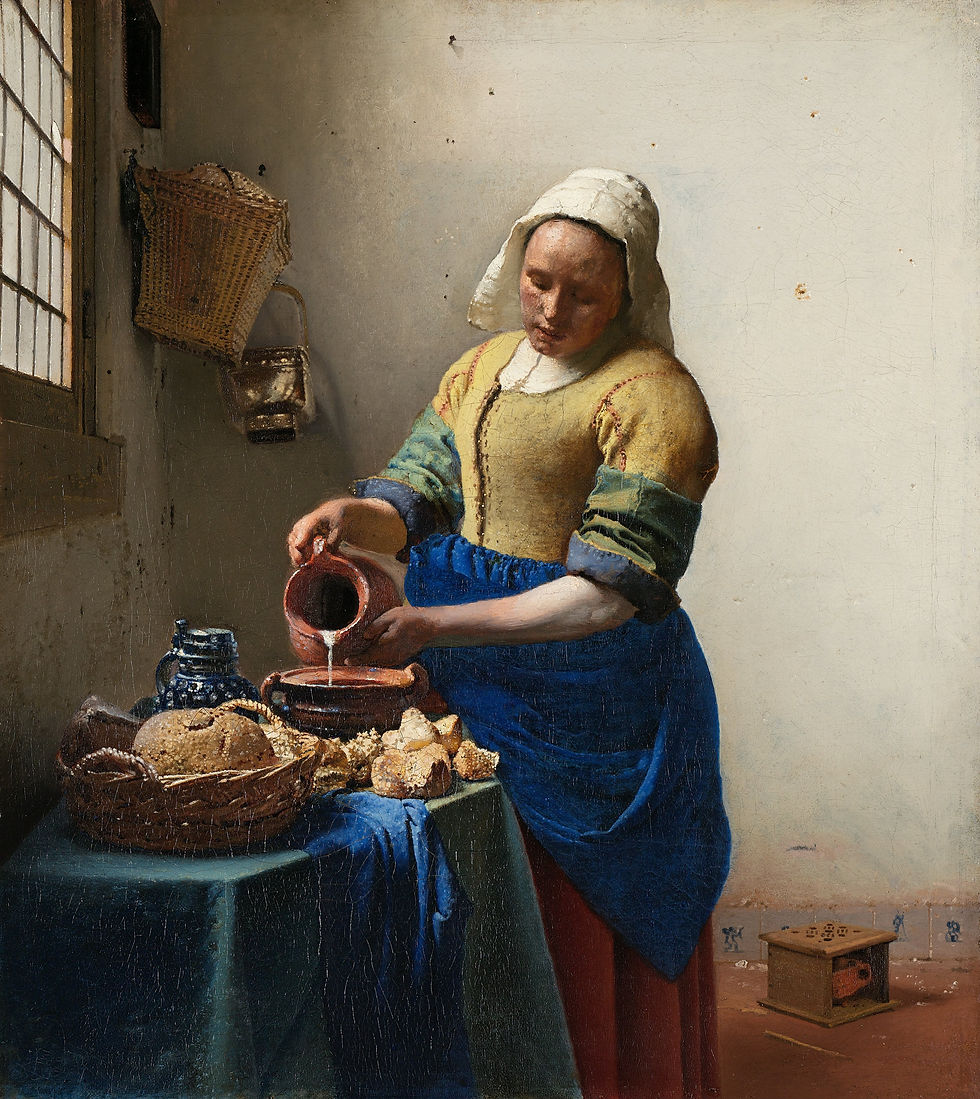
A young woman in a yellow bodice and a deep blue apron stands beside a table, pouring milk from a brown earthenware jug into a low bowl. The window on her left throws a steady morning light across her forehead, her sleeve, the loaves of bread on the table, the lip of the jug, the falling stream of milk. Behind her is a wall — a plain, mostly empty, light-grey-into-cream wall, with one small nail, a single nail-hole shadow, and a wicker basket and a brass pail hanging on a hook.
This is Johannes Vermeer's The Milkmaid, painted around 1658 when Vermeer was in his mid-twenties. It is roughly the size of a piece of A3 paper. It contains one figure, one window, one table, and one wall. It is one of the most carefully looked-at single objects in the entire history of European painting, and most of that looking is at the wall.
→ Available as a print: Vermeer's Milkmaid by Johannes Vermeer
What is happening in the picture

A woman is making bread pudding. The dish she is pouring milk into is a low Delft earthenware bowl already filled with broken pieces of stale bread. On the table beside it: more bread (a darker round loaf, a long pale loaf, a torn end), a blue-and-white Delftware jug at the back, and a woven straw basket. The pile of cloth at the lower right is probably a folded apron or napkin. On the floor at the far right corner: a small wooden foot warmer, the kind women set on the floor and rested their feet on against the cold of a tiled Dutch kitchen.
That is the entire action. A working woman, almost certainly a paid household servant, in the middle of a small and unremarkable domestic task. Vermeer does not embellish it. There is no mistress in the doorway, no man flirting from a side room, no music, no letter, no message. The picture refuses every narrative cue the seventeenth-century Dutch genre tradition normally offered.
The light

Everyone who writes about Vermeer writes about the light. With the Milkmaid the writing is justified. The light enters through the casement window on the left — you can see the small repair on one of the lower panes, painted as a careful patch of darker glass — and falls across the room in a single, broad, evenly-cooling band. The lit half of the figure (her forehead, her right cheek, the front of her bodice and apron, her hands, the lip of the jug, the stream of milk, the rim of the bowl) is warm. The unlit half (the back of her cap, the wall on her shadowed side, the wooden table-edge) is cool. The transition between the two halves is the entire compositional drama.
Vermeer uses a technique now associated almost exclusively with him: small dots of light-coloured paint sit on top of finished forms to indicate the way bright light catches the texture of an object. The bread on the table is dotted across its crust with tiny pale highlights. The wicker basket on the wall has the same dots along its braided edge. So does the brass pail. So does the rim of the bowl. Painted at the scale of the picture they look almost like grains. Stand at the right distance and they read as the trembling of light on an uneven surface.
The bread, the milk, the foot warmer
The objects in the picture were not a random selection. Bread pudding made from stale bread and milk was a household economy — a way to use up bread that was past eating fresh. The cracked nail-hole in the wall and the small section of cracked plaster were household economies too: cheap upkeep, not yet repaired. The foot warmer on the floor at the right corner is an object Dutch genre painters of the period had quietly coded as erotic — a woman, alone, who had wrapped warmth around her own feet rather than a husband's. Vermeer puts it in the picture and refuses to make anything of it. The woman is not looking at us. The foot warmer is just there.
The deep blue of her apron is what is now called Vermeer blue — natural ultramarine, ground from imported lapis lazuli, the single most expensive pigment available to a seventeenth-century European painter. Vermeer used it more lavishly than any of his contemporaries. He used it on a household servant's apron. That decision is the painting's quietest argument about who deserves to be painted carefully.
The wall, doing the most work

Roughly two-fifths of the canvas is a single empty wall. The wall is a near-uniform light grey-cream, broken only by the basket and pail at upper left, a single nail and its tiny cast shadow upper right, and a small dark mark below it — perhaps a nail-hole patched poorly, perhaps a scuff. Stand close to the painting and the wall is full of subtle variation: warmer near the window, cooler in shadow, faintly textured to suggest old plaster, even broken in one corner by a barely visible map of small dots that read as airborne dust catching the light.
In a Dutch interior painting from the 1650s, an empty wall this size would normally be filled — with a hanging tapestry, a framed print, a leaded mirror, a still-life arrangement on a shelf. Vermeer paints almost nothing. The decision is what gives the figure her weight. Take away the wall and the painting becomes a Dou or a Steen — busy, anecdotal, decorative. Keep the wall and the Milkmaid becomes the calm, almost ceremonial figure she is.
Where this fits in Vermeer's career
Vermeer painted the Milkmaid early. He was about twenty-six. He had been a member of the Delft painters' guild for five years. His earlier pictures were larger and more ambitious in subject — biblical scenes, mythological scenes, the kind of paintings ambitious young Dutch painters made when they were trying to establish a reputation. The Milkmaid is the first painting in which Vermeer found the subject he would spend the rest of his life inside: a single interior, a single figure, a single window on the left, a steady morning light. Almost every Vermeer that followed — the Woman in Blue Reading a Letter, the Lacemaker, the Geographer, the Astronomer, the Girl with a Pearl Earring — recycles some part of this picture's setup.

He painted only about thirty-five pictures in his entire life. The Milkmaid is the one that taught him how.
Key takeaways
Vermeer's Milkmaid (c. 1658) is small (45.5 x 41 cm) and shows one figure in the middle of one domestic task: making bread pudding by pouring milk over stale bread.
The light enters through a single window on the left and falls across the figure and the table in a steady cool morning band. The lit half of the figure and the unlit half are the entire compositional drama.
Roughly two-fifths of the canvas is an almost empty wall. The decision to leave the wall alone is what gives the figure her ceremonial weight.
The deep blue of her apron is natural ultramarine — ground lapis lazuli, the most expensive pigment available in seventeenth-century Europe. Vermeer used it on a household servant.
The painting is the first in which Vermeer found the subject he would spend the rest of his career inside: a quiet interior, a single figure, a window on the left. Almost every later Vermeer is a variation on this picture.
Browse Dutch Golden Age and Vermeer prints in the archive at zocineartdesign.etsy.com.
New in the Journal: How to Read a Crowded Painting: Slow Looking with Bruegel and Jan Steen
New in the Journal: Judith Leyster: The Lodestar of the Dutch Golden Age
New in the Journal: Why the Old Masters Painted Animals Like Portraits
New in the Journal: Vermeer's View of Delft: The Painting Marcel Proust Said Was the Most Beautiful in the World


Comments