Picasso's Guernica and How a Single Painting Argues Against War
Updated: Jul 25
On the afternoon of 26 April 1937, German and Italian aircraft flying for the Nationalist side in the Spanish Civil War bombed the Basque town of Guernica for roughly three hours. The town held no military target. The market was open. The bombs were incendiary and the strafing was at low altitude over the streets. Estimates of the dead range from two hundred and fifty to over a thousand, in a town of around seven thousand people. The reporters who arrived the next day described a smouldering ruin. The news reached Paris within four days.
Pablo Picasso, fifty-five years old, living in Paris, had been commissioned in January 1937 by the Spanish Republican government to paint a mural for the Spanish Pavilion at the Paris International Exposition that summer. He had been stalling. He read the reports from Guernica on the first of May, made the first sketches on the same day, and worked steadily for thirty-five days. The painting was finished on the fourth of June 1937 and installed in the pavilion in time for the exposition. It measures three and a half metres tall by seven and a half metres wide. It is in black, white, and grey. It is the most famous painting of the twentieth century, and it is an argument.

The argument, piece by piece
Guernica is not a depiction of the bombing. There is no town visible, no aircraft, no recognisable Basque architecture. Picasso made a deliberate decision in the first sketches to strip the scene of journalistic detail and replace it with a stage of seven figures and one room. Each figure is doing one thing. The argument is built from what each figure is and what each figure is doing.
On the left, a bull stands with its head turned toward the viewer. Picasso identified the bull in interviews as brutality and darkness — not Spain, not the Republic, not Franco, but the principle of cruelty itself. The bull is calm. The bull is the only figure in the painting that is not in distress. It is the witness, or the cause, or both.
Below the bull, a woman holds a dead child. Her head is thrown back. Her mouth is open in a sound the painting cannot show but the line of her tongue and teeth insists on. The child's body is limp. This is the figure that quotes Christian Pietà imagery — the mother holding the dead son — and applies it to a civilian killed by a bomb in a market town.
In the centre, a horse rears in agony. A spear has entered its side. The horse's mouth is open in the same scream as the mother's. Picasso said the horse stood for the people — the dying civilian body of the Republic. The horse's wound is the painting's centre. Everything else is arranged around it.
On the right, a woman falls from a burning building, her arms above her head, her body lit from below. Behind her, another woman runs toward the centre, her face turned up. A third figure, in the upper-right corner, leans out of a window holding a lamp — a small oil lamp, of the kind used in Spanish farmhouses. The lamp is the painting's only light source. It is the same square stable lantern that lights the central figure in Goya's Third of May.
On the ground, a soldier lies dismembered. His severed arm still grips a broken sword. Beside the sword, a small flower — possibly the only sign of growth in the painting — has pushed up through the rubble. The broken sword is the failed defence. The flower is whatever survives the failure.
Where the grammar comes from
Almost every formal device in Guernica is borrowed from a single Spanish painter who died seventy-nine years before Guernica was made. Picasso grew up in Spain and saw Francisco de Goya's Third of May 1808 (1814) repeatedly in the royal collection in Madrid. The Third of May is the painting that ended the European convention of heroic war imagery and replaced it with the painting of senseless violence. Picasso inherited that decision and extended it.
The list of inheritances is direct. The light source in Goya's Third of May is a square stable lantern on the ground between the firing squad and the victims. The light source in Guernica is a small oil lamp held out of a window. Both lamps illuminate only the victims. The killers — French soldiers in Goya, the off-frame bombers in Picasso — stand in their own darkness or are not shown at all.
The central white-shirted figure in Goya's Third of May raises his arms in a pose that quotes Christ on the cross. The mother in Guernica throws her head back in a pose that quotes Christian Pietà. Both are deliberate citations of religious iconography applied to a secular civilian execution. The argument in both cases is the same: nothing about this killing is holy and yet the painter is borrowing the visual language of holiness, because the visual language of holiness is what European painters have for showing the moral weight of a death.

Behind the Third of May stands Goya's other war project — the eighty-two etchings of The Disasters of War (1810-20), kept private in his lifetime and published in 1863. The Disasters show what the Third of May implies. They are deadpan, unflinching, captioned in Goya's own handwriting: I saw it. This too. This is worse. Picasso owned a set of the Disasters in Paris. He had been looking at them for forty years before Guernica. The black-and-white palette of Guernica is one of the most direct visual citations a painter can make. Goya's prints were black and white. Picasso made his mural black and white. The choice is the citation.
Delacroix and the Goya line in French painting
Goya's grammar did not reach Picasso through a single channel. It reached him through the line of French painters who had been working in it for over a hundred years. The first major French painting to use the Goya grammar in public was Eugène Delacroix's Scenes from the Massacre at Chios (1824), exhibited at the Paris Salon ten years after the Third of May.
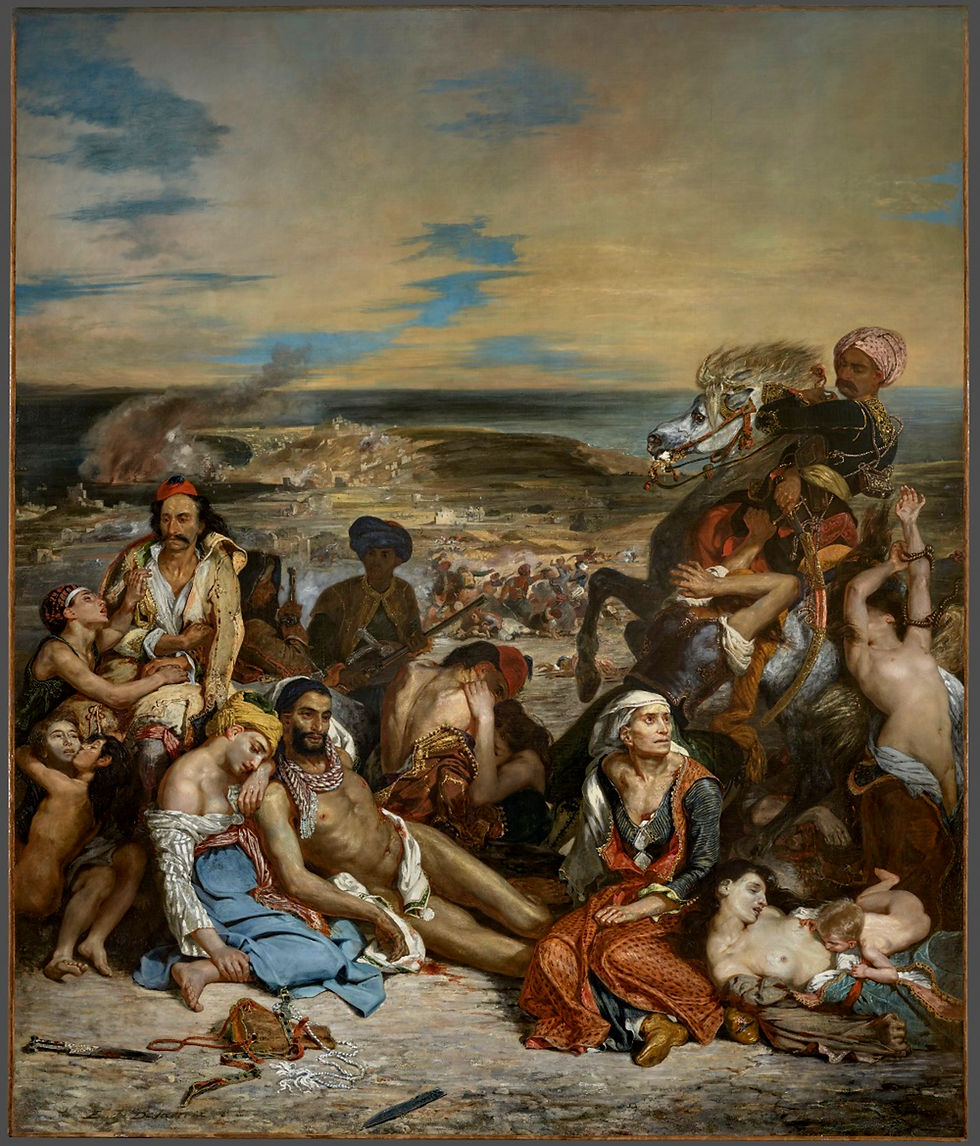
The Chios painting shows the aftermath of the Ottoman massacre of Greek civilians on the Aegean island of Chios in April 1822 — roughly twenty thousand killed and forty-five thousand sold into slavery, out of an island population of around one hundred and twenty thousand. Delacroix had not been to Chios. He worked from newspaper accounts and from engravings, exactly as Picasso would work from the press reports of Guernica a hundred and thirteen years later. The painting is over four metres tall. It shows a group of survivors arranged in a loose pyramid at the front of the picture, with mounted Ottoman soldiers in the distance. The survivors are not posed heroically. A woman is dragged by a horseman. A child clutches a dead mother's breast. A young man stares directly at the viewer with no expression. The painting was met at the Salon with the same charge that would later be levelled at Manet and at Picasso: it was anti-heroic, it was politically inflammatory, it did not deliver the patriotic image the genre was supposed to produce.
The Chios is the painting that proves the Goya grammar had become available to French Romantic painters by 1824. Théodore Géricault's Raft of the Medusa (1819) had done the preparatory work; the Chios was the first French canvas to apply that grammar to a specific contemporary massacre with a specific date. Édouard Manet, who would paint the Execution of Emperor Maximilian forty-four years later in the same direct citation of Goya, was an heir to Delacroix as much as he was an heir to Goya.

Picasso, who had moved to Paris in 1900 and lived inside the French painterly tradition for thirty-seven years before Guernica, inherited both halves of the line — Goya through his Spanish childhood and through the prints he owned, and Goya again through Delacroix, Géricault, and Manet. Guernica is the point at which both halves meet and the grammar passes into the twentieth century.
The pavilion, the tour, the long exile
Guernica was first shown in the Spanish Pavilion at the Paris International Exposition between July and November 1937. The pavilion was a modest building. The mural took up an entire wall of the entrance hall. Visitors were divided. The pavilion's official catalogue described the painting as a denunciation. The Nationalist press in Spain attacked it as a fraud. The French critic Anthony Blunt — later notorious for other reasons — dismissed it in print as too private and too cubist to function politically. The Republican government took the painting on tour after the exposition closed: Scandinavia, England, the United States, Brazil, to raise money for Spanish refugee relief.
By the time the painting reached the United States in 1939, the Republic had lost the war. Franco was in power in Madrid. Picasso refused to allow Guernica to return to Spain while Franco was alive. He left the painting in the keeping of a New York collection on long-term loan, with the explicit instruction that it was to be returned to Spain only when the country was again a republic with the civil liberties he understood the painting to defend. The painting stayed in New York for forty-two years.
Franco died in November 1975. Spain returned to democracy and adopted a new constitution in 1978. Picasso had died in 1973 and did not live to see it. In 1981, after lengthy negotiations and on the condition that the painting be displayed in Madrid, Guernica was flown to Spain and installed first at the Casón del Buen Retiro and later in the Madrid collection where it has hung since 1992. The painting has not left Spain since 1981. The conservators no longer allow it to travel.
How does a painting argue?
There is a longstanding scepticism in political theory about whether art can do anything against war. The bombs continued. The Spanish Republic was lost. Forty years of dictatorship followed Guernica's first exhibition. The painting did not save a single life in 1937 and did not shorten the Civil War by an hour. The argument the painting makes is not the kind of argument that prevents the thing it argues against.
What the painting does is harder to measure. It makes a position visible. Every subsequent painter, every photographer, every documentary filmmaker working on the imagery of civilian death after April 1937 has been working in Guernica's shadow whether they know it or not. The black-and-white palette of war photography in the second half of the twentieth century — Robert Capa, Don McCullin, James Nachtwey — works inside Guernica's frame. The convention that an anti-war image withholds heroism, anonymises the killers, lights the victim from below, and treats the dead civilian as the moral centre of the picture — every part of that convention has Guernica as its model. The painting did not stop the war it depicted. It changed what it became possible to say about war afterward, and what it became no longer possible to say.
This is what it means for a painting to argue. The argument is not about the immediate event. The argument is about the visual vocabulary the culture will use for the next event. Goya's argument from 1814 is still operating. Picasso's argument from 1937 is still operating. The argument is not finished.
Key takeaways
Guernica (1937) was commissioned for the Spanish Pavilion at the Paris International Exposition and painted in roughly thirty-five days in response to the German and Italian bombing of the Basque town of Guernica on 26 April 1937.
The painting is structured as seven figures and one light source — bull, horse, fallen soldier, mother with dead child, falling woman, running woman, woman with the lamp. Each figure makes one part of the argument; the lamp lights only the victims, exactly as in Goya.
Almost every formal device in Guernica — the lit-from-below light source, the Christ-Pietà citations, the black-and-white palette, the refusal of heroic posture, the anonymised killers — is borrowed directly from Francisco de Goya's Third of May 1808 (1814) and from Goya's Disasters of War prints (1810-20).
The Goya grammar reached Picasso through two channels: directly from his Spanish childhood and the prints he owned, and indirectly through the French Romantic tradition of Eugène Delacroix's Massacre at Chios (1824) and Édouard Manet's Execution of Emperor Maximilian (1868-69).
Picasso refused to allow Guernica to be returned to Spain while Franco was alive. The painting spent forty-two years in a New York collection on long-term loan and was finally flown to Madrid in 1981, six years after Franco's death and eight years after Picasso's.
Guernica did not stop the Spanish Civil War and did not save the Republic. What it did was establish the visual grammar — black and white, civilian-centred, killer-anonymous, light from below — that documentary war photography and war painting have used ever since.
Browse Spanish painting and Goya prints in the archive at zocineartdesign.etsy.com.
New in the Journal: Ten Spanish Painters Who Shaped the Western Canon


Comments