Slow Looking as a Couple: How to Share One Painting for Twenty Minutes Together
The slow-looking practice changes shape when two people do it together. The four-stage twenty-minute protocol from the companion post on the same site (five minutes description, five minutes biography, five minutes what-changes, five minutes return) becomes a shared attention practice the moment a second viewer joins. The pause between Stage 1 and Stage 2 becomes a small conversation; the biographical material gets divided between the two viewers (one Googles, one reads aloud); Stage 3's recognition is doubled because each viewer sees what the other viewer missed. The practice is unusually good as a date-night structure. It is short enough to fit inside one evening, structured enough to keep both viewers engaged without small-talk gymnastics, and substantive enough that the conversation continues into dinner. The five paintings below are recommended for couple-slow-looking — each one is constructed around two-figure dialogue (Cassatt, Vermeer Music Lesson), warm-evening conversational register (Renoir), long-married quiet (Hammershøi), or the central-couple romance register (Klimt Kiss). The practice is the strongest single "things to do together at home that are not eating dinner" structure the museum-curator tradition has to offer.

How the couple version of the protocol works
Stage 1 (Pure description, 5 min): Each viewer describes physical facts out loud, alternating sentences. "A woman in pale grey holds a teacup." — "There is a small striped pillow on the chair behind her." — "The second woman wears a darker pink-and-grey day-dress." Alternating forces both viewers to keep finding new facts and prevents the more-verbal partner from monopolising. Stage 2 (Biography, 5 min): Divide the labour — one viewer opens Wikipedia or the museum-collection's catalogue page on a phone or tablet and reads aloud the biographical and historical context; the other viewer keeps her eyes on the painting and watches what the new information changes as she hears it. Stage 3 (What changes, 5 min): Both viewers look at the painting together for the whole five minutes; alternating sentences again, this time about what is now visible that was not visible in Stage 1. Stage 4 (Return, 5 min): Silent looking for the full five minutes — the practice ends in the quiet that the couple has built together over the previous fifteen minutes. The post-practice conversation typically continues into dinner. The practice can be done in front of a print at home or in front of an institutional original on a Sunday museum visit; both work.
1. Cassatt, Tea (c. 1890) — the conversational couple
Cassatt's Tea is the slow-looking painting for the conversational couple — the partners who talk constantly, who have been together long enough to develop their own shared shorthand, who use a shared meal as a daily checkpoint. The painting depicts two women in pale cream and dove grey seated side-by-side at a low table with the silver tea-service; the viewer is positioned at conversational distance. The painting reads at distance as a calm domestic scene and rewards close looking with the specific quiet of long shared attention — neither figure is looking at the viewer, neither is speaking, both are present to the same tea-service and to each other. The painting is the canonical visual statement of conversational-couple quiet. Print at 70 × 100 cm horizontal, frame in slim black-stained European ash, mount in the kitchen-dining transition or in the small living-room. The Cassatt rewards the couple that does the slow-looking practice in their own dining room with their own tea.
2. Vermeer, The Music Lesson (c. 1662-65) — the dialogue couple
Vermeer's Music Lesson is the slow-looking painting for the couple whose relationship is built around shared intellectual or creative work — a couple where both partners are writers, or musicians, or share a studio, or are working on the same long-term project together. The c. 1662-65 canvas depicts a young woman at a virginal (early keyboard instrument) standing with her back partly to the viewer; a male music-teacher stands beside her at the same instrument; a mirror above the virginal reflects the woman's face. The painting reads as the strongest Vermeer statement of the shared-skill teaching-and-learning dynamic — the dialogue is not about courtship but about the music being made. The mirror's reflection of the woman's face is the painting's surprise: the woman is looking up at the man, not at the keyboard. Print at 60 × 70 cm vertical, frame in unstained European oak, mount in the shared study or above the piano. The Vermeer rewards the couple-of-collaborators that does the practice after a working morning.

3. Renoir, Two Sisters / On the Terrace (1881) — the warm-evening couple
Renoir's Two Sisters (On the Terrace) is the slow-looking painting for the warm-evening couple — the partners whose ideal evening is a long late-summer dinner outdoors, a slow walk afterward, no urgency about returning home. The 1881 canvas depicts two female figures (in fact a young woman and a small girl) seated on a Chatou-restaurant terrace with the Seine in the background, the older figure in a navy dress and red hat holding a basket of small flowers, the younger figure in white with bright bonnet-flowers. The painting reads as the canonical Impressionist statement of late-afternoon warm-evening sociability — the small basket of flowers, the river behind, the held position between the meal that has just finished and the rest of the evening that is still to come. Print at 70 × 80 cm horizontal, frame in unstained European oak with a wide cream-cotton mount, mount in the kitchen-dining transition or above the sideboard. The Renoir is the painting for the couple whose summer-Sunday slow-looking happens after a long lunch.

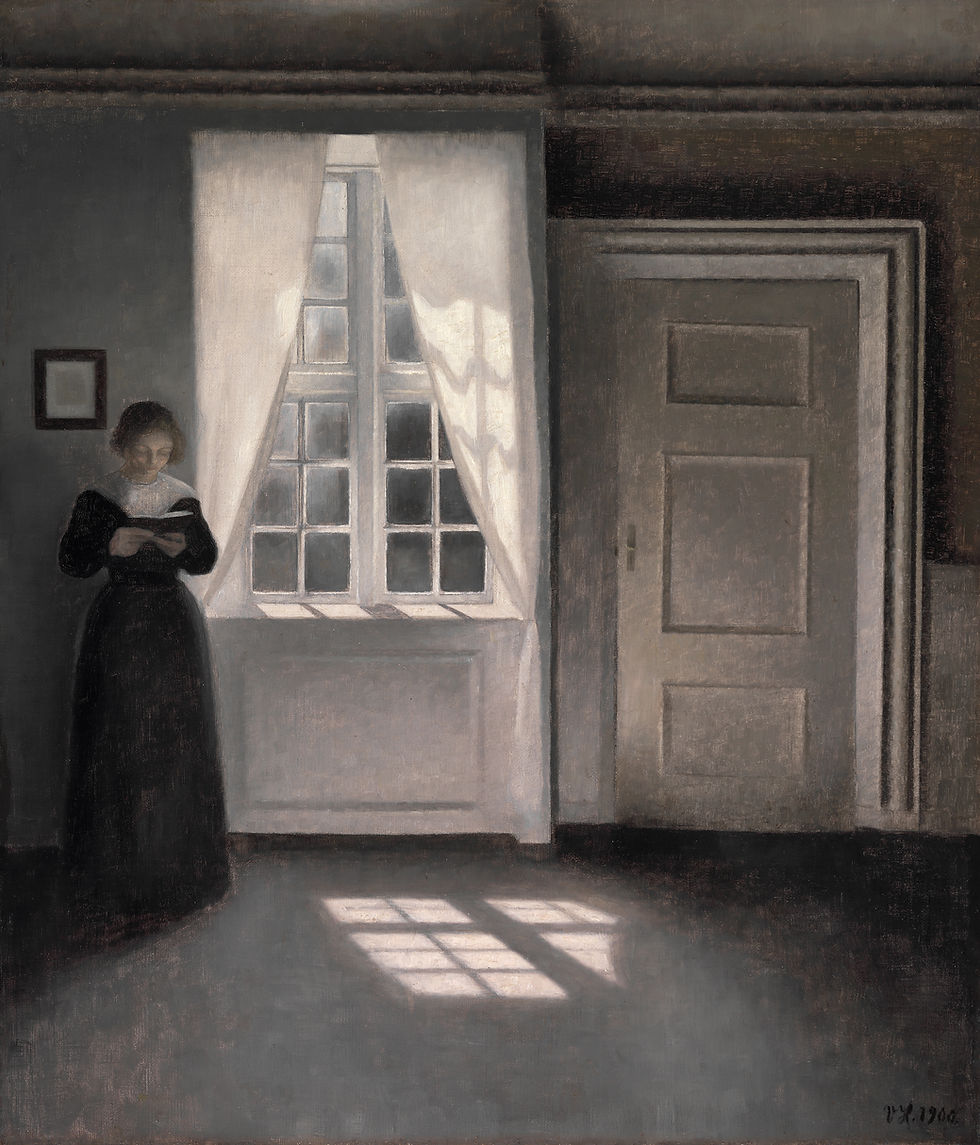
4. Hammershøi, Interior, Strandgade 30 (1900) — the long-married couple
Hammershøi's Interior, Strandgade 30 is the slow-looking painting for the long-married couple whose quiet is the relationship rather than its absence. A single woman in a high-collared dark dress is seen from behind, standing at a door in a quiet Copenhagen apartment interior, surrounded by cool grey light. Hammershøi painted this Strandgade-30 apartment more than sixty times across his career — almost always with his wife Ida as the model, almost always from behind, almost always in the same cool grey light. The paintings are the strongest Northern-European visual statement of the long married quiet — the wife is present, the husband is present (he is the painter, behind the canvas), the room is the third party that holds them both. Couples that have been together fifteen years or longer recognise the register on first viewing. Print at 60 × 75 cm vertical, frame in unstained European oak, mount in the bedroom or in the bedroom-sitting-area. The Hammershøi rewards the long-married couple's slow-looking practice as a wordless evening routine.
5. Klimt, The Kiss (1907-08) → the romance couple
Klimt's The Kiss is the slow-looking painting for the couple in romance — the early-relationship couple, the long-relationship couple in a romance-renewal period, the couple celebrating an anniversary or another consequential moment. The 1907-08 canvas depicts a kneeling couple wrapped together in an enormous gold-leaf cloak on a flower-strewn cliff-edge; the man bends to kiss the woman's cheek; the woman's face is the painting's emotional fulcrum, eyes closed, hand on his cheek. The painting is the canonical Western romance image of the early twentieth century — the gold-leaf is physical (Klimt used real metal-leaf, not paint imitation), the gesture is specific (cheek-kiss not mouth-kiss, the painting's romantic register is anticipation rather than consummation), and the flower-cliff is unstable enough that the embrace must hold itself up. Print at 80 × 80 cm square, frame in slim gold-leaf European oak, mount in the master bedroom above the bed. The Klimt is the strongest single bedroom painting for the romance couple — the slow-looking practice in front of the actual print on the bedroom wall is the most concentrated version of the romance the painting depicts.

Three rules for the couple-version of the practice
Three rules govern the couple-version. First: ALTERNATING SENTENCES IN STAGES 1 AND 3. The more-verbal partner monopolises naturally; the alternating rule fixes the asymmetry without anyone having to negotiate it explicitly. The rule is structural; both partners follow it without it being personal. Second: ONE PHONE OPEN FOR BIOGRAPHY ONLY (STAGE 2). The phone is open for the biographical reading-aloud and immediately put back face-down between stages — the practice fails the moment either partner reaches for the phone for any other reason. Set the timer on a kitchen timer or a watch, not on the phone. Third: NO POST-PRACTICE INTERPRETATION-DEBATE. The practice ends in Stage 4's quiet and continues into dinner conversation. The conversation should be whatever it naturally becomes after twenty minutes of shared attention — the practice is not a homework assignment that requires a debrief. Couples that try to debate the painting's correct interpretation immediately after Stage 4 undo the work the practice has just done.
Key takeaways
Slow looking changes shape when two people do it together. The four-stage twenty-minute protocol becomes a shared attention practice that doubles as relationship time — short enough for one evening, structured enough to engage both partners, substantive enough that the conversation continues into dinner.
Five paintings recommended for couple-slow-looking: (1) Cassatt Tea = conversational couple. (2) Vermeer Music Lesson = collaborator couple sharing intellectual/creative work. (3) Renoir Two Sisters On the Terrace = warm-evening couple. (4) Hammershøi Strandgade Interior = long-married couple. (5) Klimt The Kiss = romance couple.
Three couple-version rules: (1) ALTERNATING SENTENCES in Stages 1 and 3 — structural fix for the more-verbal partner's monopolisation. (2) ONE PHONE OPEN FOR BIOGRAPHY ONLY in Stage 2 — phone is for reading-aloud only, put face-down between stages. (3) NO POST-PRACTICE INTERPRETATION-DEBATE — the practice ends in Stage 4's quiet, the conversation continues into dinner organically.
Placement guidance: Cassatt + Renoir = kitchen-dining transition or small living-room. Vermeer Music Lesson = shared study or above the piano. Hammershøi Strandgade = bedroom or bedroom-sitting-area. Klimt Kiss = master bedroom above the bed.
Cadence: once per week (Sunday-evening practitioner's standard), once per month (slower long-married cadence), once per relationship-milestone (the anniversary practice). The same painting at the same wall on the same Sunday-evening compounds — the couple recognises the painting on the third use and the practice becomes a small ritual.
Browse fine prints suitable for couple slow-looking practice in the archive at zocineartdesign.etsy.com.


Comments