Arcimboldo's Four Seasons: Portraits Built from Fruit, Flowers, and Bare Branches
Updated: Aug 4
Look closely at a portrait by Giuseppe Arcimboldo and the face falls apart into a heap of produce. A cheek is a ripe peach, a nose is a cucumber, an ear is a fat ear of corn, and the collar is woven straw. Step back, and the pile of fruit resolves into a serene human profile. This is the trick that made Arcimboldo the most surprising painter at the imperial court, and the Four Seasons is the series where he perfected it.
The Four Seasons is a set of four allegorical heads, one for each part of the year, each head assembled entirely from the plants, flowers, and fruits that belong to its season. Spring is built from blossoms, Summer from ripe fruit and vegetables, Autumn from the harvest and the wine barrel, and Winter from the bare bark of an old tree. Arcimboldo painted the first complete set in 1563 and a second, more elaborate set in 1573, and both survive today.
Below is what each of the four heads is actually made of, why a court painter spent years building faces out of vegetables, and how these strange profiles carried a serious political message about the emperor who commissioned them.
A Head Grown From the Garden
Arcimboldo was born in Milan around 1526 and trained first as a designer of stained glass and tapestry cartoons, work that taught him to think of an image as a mosaic of separate small parts. In 1562 he was called north to serve the Habsburg court, where he would work for three successive Holy Roman Emperors, Ferdinand I, Maximilian II, and Rudolf II, until his death in 1593.
His signature invention was the composite head, a portrait profile assembled from dozens of individually painted objects. Each element is a small, botanically precise still life in its own right, and the astonishing thing is that they add up to a convincing face rather than a random pile. The lineage runs back to the grotesque head studies of Leonardo da Vinci, whose drawings circulated in the Milan where Arcimboldo grew up. What Leonardo sketched as caricature, Arcimboldo turned into a courtly game with rules.
The timing was not an accident. The emperors he served were passionate collectors who filled cabinets of curiosities with exotic plants, rare animals, and natural specimens shipped from across the known world. A painter who could render a foreign fruit or a new-world ear of corn with the exactness of a specimen was worth his salary twice over, once as an artist and once as a kind of visual naturalist. Arcimboldo also designed festivals, costumes, and mechanical devices for the court, so the composite heads sit inside a whole career built on invention and spectacle.
These pictures were never meant as simple jokes. They were learned puzzles, designed to be unpacked slowly by an educated audience who enjoyed the double reading, the moment when a still life becomes a portrait and back again. The Milanese art theorist Gregorio Comanini, writing in 1591, praised exactly this quality, the way the paintings marry deep seriousness to playful invention.
The Four Heads, Season by Season
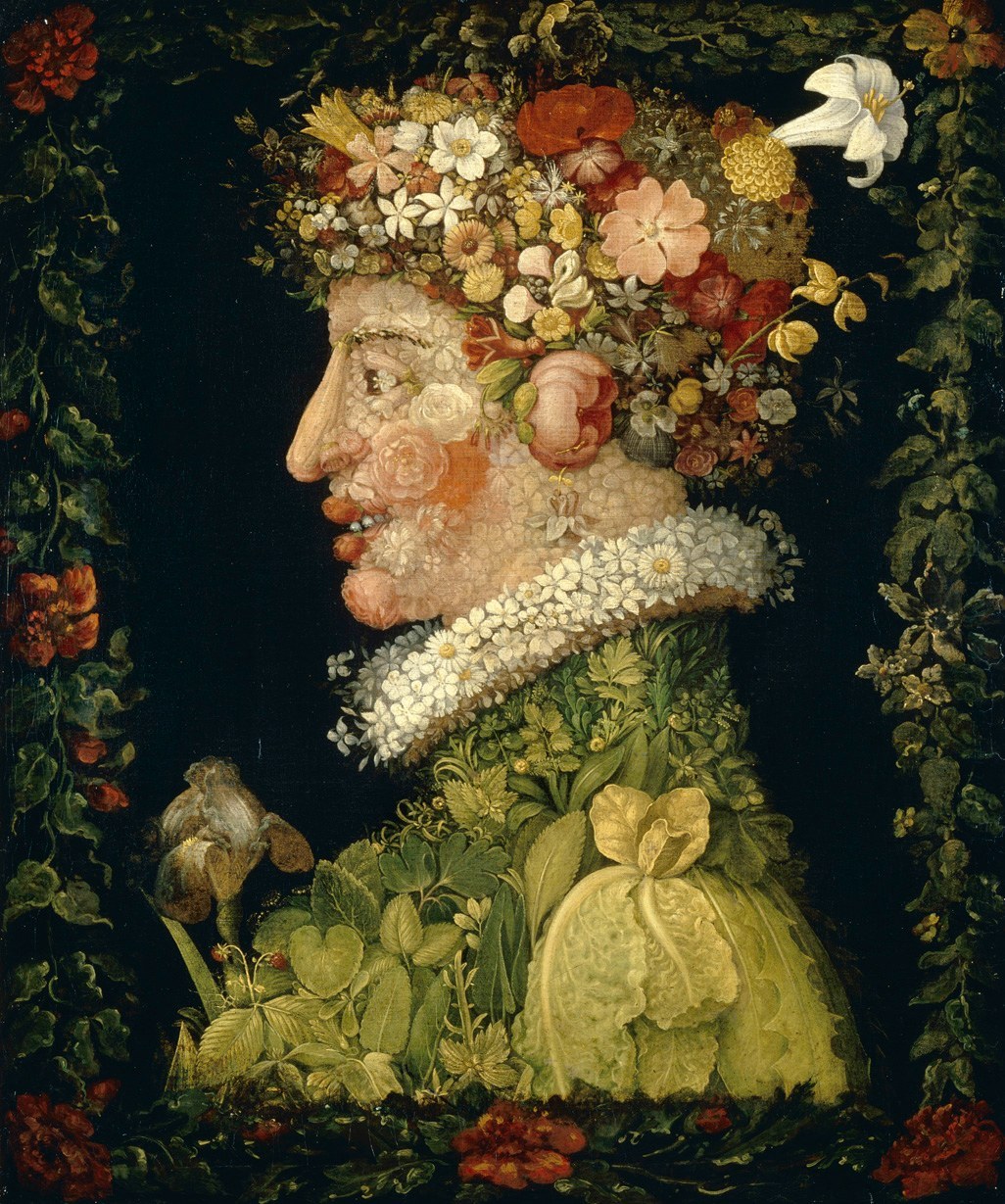
Spring is the youngest face, a fresh profile composed of hundreds of flowers. Roses form the cheek and lips, a lily and pale buds shape the nose and brow, and green leaves stand in for the collar and shoulder. Read as an allegory of age, Spring is childhood and early youth, the year and the human life both just beginning.
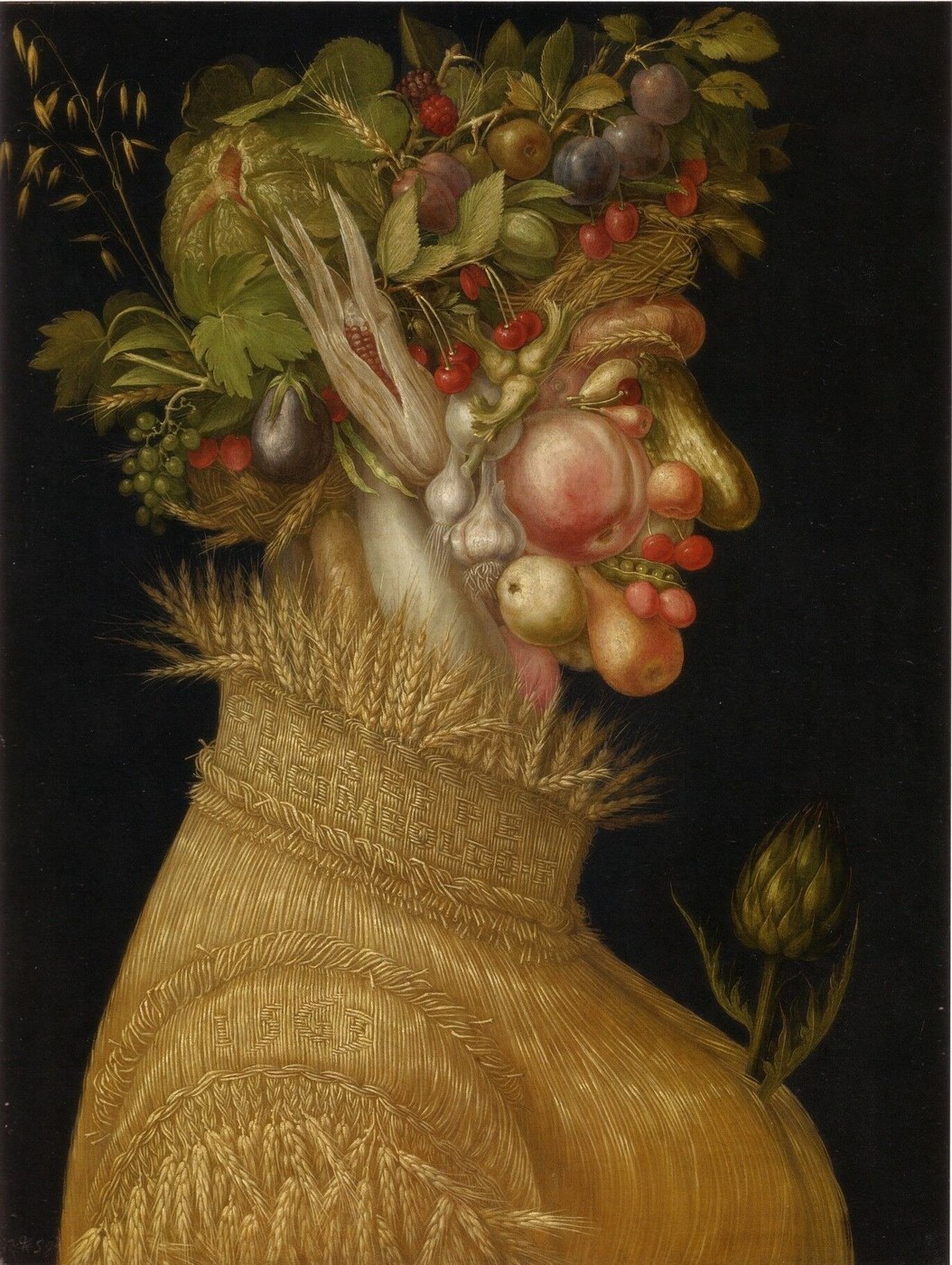
Summer is the head shown above, and it is a market stall of ripe produce. The cheek is a peach, the nose a cucumber, the chin a pear, the teeth are white peas or beans, and the ear is a golden ear of corn. In the 1563 version the woven straw collar carries the artist name and the date stitched into the weave, a signature hidden inside the costume itself. Summer is the figure at the height of maturity, warm and abundant.
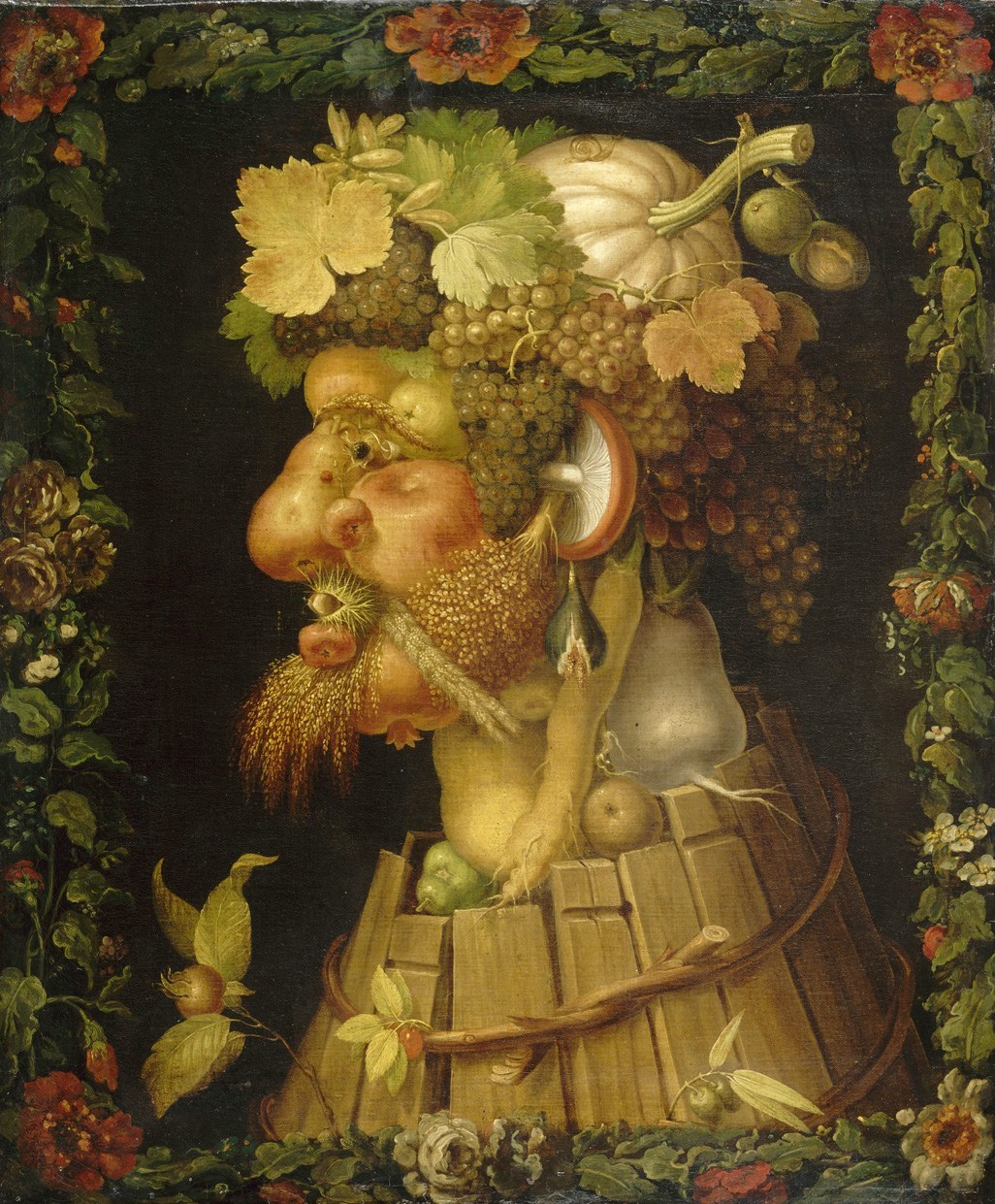
Autumn is middle age, thickening and a little coarse. The cheek is a rosy apple, the chin a pomegranate, the ear a split mushroom, and a burst fig sits below. Grapes and vine leaves crown the head like tangled hair, and the whole bust rests inside a wooden wine barrel bound with staves and withy hoops, a nod to the harvest and the pressing of the grapes.
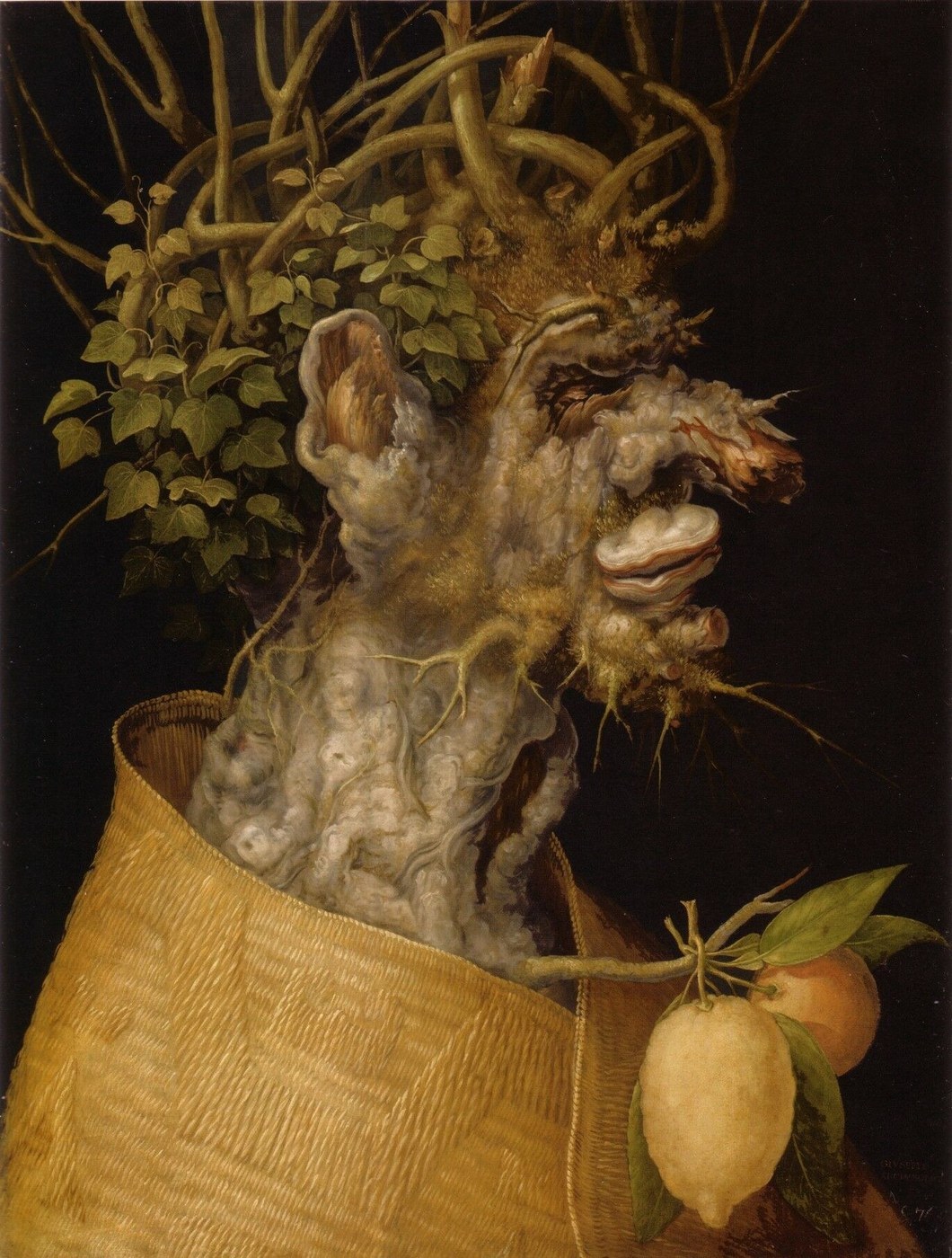
Winter is old age, and it is the most inventive of the four. The face is the stump of a gnarled old tree, its skin rough bark, its nose a broken branch, its mouth a bracket fungus. Ivy and a few dead twigs stand in for thinning hair. Only two bright notes survive the cold, a lemon and an orange hanging from a stub of branch at the chest, a reminder that even in the dead season the imperial house keeps its fruit.
Painted for an Emperor
The Four Seasons was not decoration. It was a piece of imperial propaganda, and it was designed to travel as a set with a companion series, the Four Elements of Air, Fire, Earth, and Water, which Arcimboldo painted in 1566. Together the eight heads formed a single argument, pairing each season with an element so that the whole of nature and time appeared to revolve around the throne.
A set of the Seasons was presented to Emperor Maximilian II at the New Year celebrations of 1569, accompanied by explanatory Latin verses from the court scholar Giovanni Battista Fonteo. Fonteo spelled out the flattery in plain terms, describing images in which “the seasons and the elements alike bow to a single everlasting reign.” The gnarled Winter wrapped in a straw cloak, the only head that endures the cold and still bears fruit, was read as the emperor himself, the constant ruler who carries his realm through every season.
The message was portable enough to be re-gifted. In 1573 Maximilian II ordered a second full set, now the best preserved of all, to be sent as a diplomatic present to Augustus, Elector of Saxony. In that set the profiles are ringed with garlands and threaded with Habsburg emblems, including the flint and steel of the Order of the Golden Fleece, quietly stamping the imperial brand onto the gift. The four heads were hung to face one another in pairs, so that the year seemed to turn in a closed circle within the room.
One Life Turning With the Year
Beyond the court flattery, the four heads carry an older and more human idea. Line them up and they trace a single life from the flowering face of Spring to the mature abundance of Summer, the coarsening richness of Autumn, and the bare bark of Winter. The cycle of the year becomes the cycle of a person, blooming, ripening, decaying, and returning. It is this second reading, quiet under the spectacle, that keeps the pictures from being mere novelty and gives them their strange melancholy.
Arcimboldo was celebrated in his own lifetime and then almost forgotten for three centuries. His reputation was rescued in the 1930s, when a new generation of artists recognised in these fruit-and-vegetable faces a direct ancestor of their own taste for the dreamlike and the double-imaged. Today the Four Seasons reads at once as a courtly riddle, an early masterpiece of still-life painting, and one of the most quietly unsettling meditations on ageing in the history of art.
Questions Collectors Ask
How many versions of the Four Seasons did Arcimboldo paint?
Arcimboldo and his workshop produced several sets. The two principal painted-by-hand sets are the first from 1563, of which Summer and Winter survive in a Vienna collection, and the complete second set from 1573, held in a Paris collection. Individual seasons were copied and repeated for various patrons, so more than a dozen related heads exist across European collections today.
Are the heads really made of identifiable plants?
Yes. Arcimboldo painted each fruit, flower, and vegetable with the accuracy of a natural-history illustrator, and botanists have identified dozens of specific species in the four heads. That precision was part of the point at a court that prized both learning and the study of the natural world.
Where can you see the original Four Seasons today?
The surviving 1563 heads of Summer and Winter, oil on limewood panel and roughly 67 by 50.8 cm, are held in a Vienna collection. The complete 1573 set, oil on canvas and roughly 76 by 63.5 cm, is held in a Paris collection, where all four seasons hang together as Arcimboldo intended.
For more strange and beautiful faces from the old canon, the wider archive of vintage art prints lives at zocineartdesign.etsy.com.
Further Reading from the Zocine Journal
New in the Journal: Ten Portraits That Taught Europe How to Look: From Arnolfini to Madame X


Comments