Mannerism Explained Through Five Paintings: The Quiet Strangeness After the Renaissance
Updated: Sep 8
Raphael died in Rome in April 1520, aged thirty-seven. Leonardo had died the year before. Michelangelo was alive but in his late forties, increasingly absorbed in the Sistine ceiling's sequels, and would not paint another easel picture of consequence for two decades. The High Renaissance — the period in which Italian painting solved the problems of anatomy, perspective, balance, and grace, and produced the calmest, most lucid pictures in Western art — was, in a single year, over.
What came next is the strangest movement in Italian painting. The young painters who had grown up watching Raphael and Michelangelo did not try to repeat them. They could not. The problems were solved. So instead they bent the solutions. Necks lengthened. Bodies twisted into impossible spirals. Colour shifted from the lucid earth tones of the Renaissance into chilly acid greens, sulphur yellows, and pinks the colour of melon flesh. Space stopped obeying perspective. Faces drained of warmth and grew faintly otherworldly.
Vasari, writing in 1568, called this new style maniera — a word that means style itself, or stylishness, the way of working. It became, in English, Mannerism: the painting of the manner. For four centuries after Vasari, Mannerism was treated as a decadent fall from grace, a fading away. Beginning in the 1920s, art historians rescued it. The movement is now read as one of the most knowingly strange and intellectually ambitious chapters in European painting.
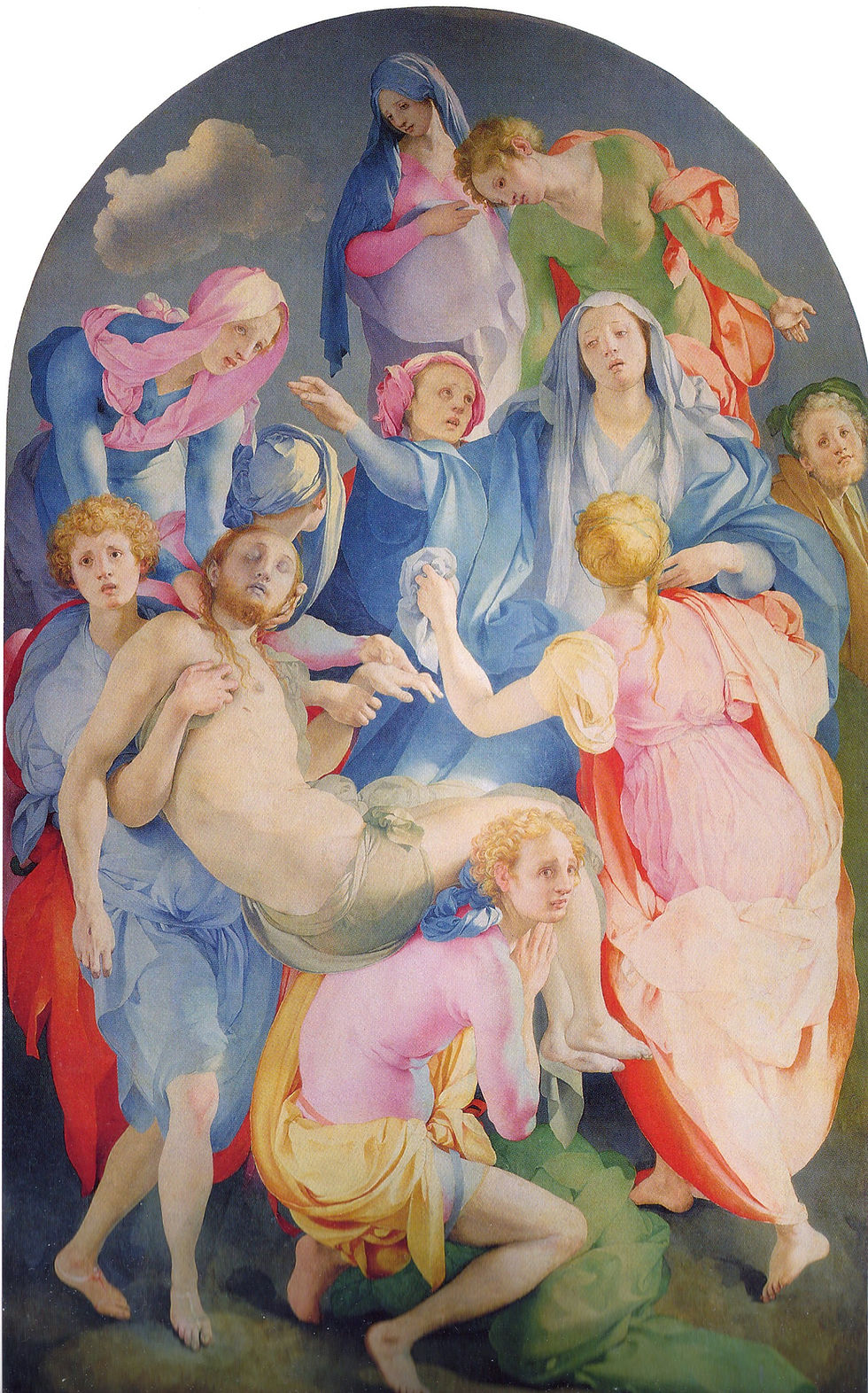
Pontormo, and the painting where Mannerism announces itself
Jacopo Pontormo (1494–1557) was a Florentine painter who had trained with Andrea del Sarto. In 1525 he received a commission for an altarpiece in the small Capponi family chapel in the church of Santa Felicita in Florence. The painting he produced over three years is the picture that art historians now treat as the most precise definition of Mannerism — the first work that turns its back on Renaissance balance without apology.
The subject is the Deposition: the body of Christ being lowered from the cross. But Pontormo does not paint a cross, and he does not paint a ground. Eleven figures float in a shallow, undefined space, holding the body of Christ between them. The Virgin Mary, on the right, leans backward in a faint. Two crouched young men beneath Christ's body strain to support its weight while balanced on tiptoe — both faces lifted toward the viewer with expressions of caught breath. The colour is wrong on purpose. Christ's flesh is the milky pink of a peach. The blue of Mary's robe is the cold blue of a winter morning. The pale rose of a young man's drapery is the colour of a cosmetic. No painter before Pontormo had used this palette in a sacred picture.
The composition is a slow circular swirl. There is no ground line, no horizon, no cross, no setting. The figures form a vertical column held in mid-air. Every face is turned somewhere — toward Christ, toward the viewer, toward the Virgin — but none look at each other. The painting is grief, but a grief paused before tears, held still in the strange interior way grief actually happens. Pontormo, by all contemporary accounts a melancholic and shy man, knew what he was painting.
Parmigianino, and the Madonna with the elongated body
Francesco Mazzola — known as Parmigianino, the little one from Parma — was thirteen years younger than Pontormo. He was a beautiful young man, said by Vasari to have looked like an angel and to have worked too quickly and too brilliantly for his own good. He died at thirty-seven, ruined by his late obsession with alchemy. Before that, between 1534 and 1540, he painted the picture that became Mannerism's other defining canvas: the Madonna with the Long Neck.

The Madonna sits on a low cushion in the foreground. Her body is impossibly elongated: the head is small, the neck is long, the shoulders narrow, the torso slender, the legs disappearing under the skirt in a column of pale blue silk. On her lap lies a Christ child who is asleep, almost flopping out of her arms, and who is the size of a six- or seven-year-old child, not an infant. The Madonna's hand cups her child's chest with a gesture of barely-arrested tenderness. Behind her, a column of impossible architecture rises out of nothing, with a tiny figure of a prophet at its base, holding a scroll.
The painting is unfinished. Parmigianino died before he could complete the architectural background, and an inscription in his hand explains that the work was suspended by the painter himself. What survives reads as one of the most beautifully impossible images in European painting. The Madonna's body is not a body — it is a calligraphic stroke. The Christ child is not a baby — he is a small dead Christ, foreshadowing the Pietà. The space is not a space — it is a stage set. Mannerism, in Parmigianino's version, becomes a form of visual writing.
Bronzino, and the cold portrait court of Florence
Agnolo Bronzino (1503–1572) was Pontormo's student, and inherited the Florentine workshop after Pontormo's death. Bronzino's contribution to Mannerism was the court portrait — the portrait of the Medici family at the highest possible polish of formal painting. His sitters appear as if sealed in glass: skin flawless, eyes calm, clothing rendered with the precision of a textile photograph. Bronzino's portraits are the visual equivalent of a court protocol — there is no warmth, no informality, no spontaneity. The sitter is reduced to dynasty and dress.

Bronzino also painted mythological allegories, the most famous of which is the picture often called An Allegory with Venus and Cupid (c. 1545), painted as a diplomatic gift from the Medici to the French king. Venus and Cupid embrace and kiss in the foreground while six other figures crowd the space behind them: a small child throwing roses, two masks on the floor, a screaming figure tearing at her hair, an old man with an hourglass, a young woman whose body ends in a serpent's tail and whose hands offer a honeycomb and a sting. The painting is a riddle. Scholars have been arguing about exactly what it means since the seventeenth century.
The painting is sometimes called Allegory of Lust, sometimes Allegory of Time and Folly. The most accepted reading is that Venus and Cupid represent erotic love, the child is Folly, the screaming woman is Jealousy or perhaps Syphilis (the disease was new in the 1540s and visible at court), the masks are Deceit, the old man with the hourglass is Time, and the serpent-bodied young woman is Fraud. The painting is, in this reading, a moral against erotic indulgence. But the painting itself is so beautifully painted, so seductively cool, that no viewer experiences it as a moral warning. The picture argues against itself.
El Greco, the late Mannerist working outside Italy
Domenikos Theotokopoulos — El Greco, the Greek — was born in Crete in 1541 and trained in Venice and Rome before settling in Toledo, in central Spain, in 1577. He stayed there for the rest of his life. He inherited the Italian Mannerist vocabulary — elongated figures, acidic colour, restless composition, flames of drapery rising like vertical fires — and pushed it harder than any Italian had dared.
In El Greco's pictures, bodies stretch beyond what Parmigianino imagined. Saints stand seven heads tall, then eight, then nine. The colour grows colder and more chemical — silver, sulphur, lead-white, a smouldering carmine. The drapery does not fall; it surges. Skies are not blue or grey but a livid green-violet, lit from inside by a storm that is not in the picture. Where Pontormo's Mannerism was an interior melancholy and Bronzino's was a courtly polish, El Greco's was a religious ecstasy — the Counter-Reformation translated into paint.
By the time El Greco was working in the late 1580s and 1590s, Italian Mannerism itself was almost over. Caravaggio was a child in Lombardy who would soon paint his way out of it; Annibale Carracci was already preaching a return to nature. The movement that had begun with Pontormo's Deposition in 1525 closed with El Greco's late great pictures around 1610, a hundred years almost exactly. Outside Italy, in Catholic Spain, the late Mannerist style had become a vehicle for visionary religious painting that no Italian painter would ever attempt again.
Why Mannerism matters now
For most of the seventeenth, eighteenth, and nineteenth centuries, Mannerism was dismissed. The Baroque painters of Caravaggio's generation rejected it as artificial. The Neoclassical painters of David and Ingres treated it as a regrettable interruption between Raphael and the proper return to clarity. The Impressionists ignored it. The Pre-Raphaelites of the 1850s actually took their name from a polite hostility to it — they wanted to paint before Raphael, before the elongations and the artificial poses.
The rescue began in the 1920s, when scholars associated with the Warburg circle and the early formalist art historians began to read Mannerism as an intellectually ambitious response to the closure of the Renaissance, rather than a fall from it. Walter Friedländer's essays of the 1920s are the canonical re-evaluation; John Shearman's 1967 book Mannerism is the standard mid-century synthesis. By the late twentieth century, Mannerism had been fully restored to the Italian sequence: a hundred-year period of deliberate strangeness between Raphael's death and Caravaggio's emergence, in which painters who had inherited a perfectly solved tradition tried, on purpose, to make it unsteady again.
Twentieth- and twenty-first-century painters have returned to Mannerism repeatedly. The thin, elongated figures of Modigliani descend directly from Parmigianino. The cold court protocol of contemporary fashion photography descends from Bronzino. The visionary religious paintings of certain modern Spanish painters — and a few American painters of the New York School — descend from El Greco. The movement that was once dismissed as decadent is now read as the first chapter in the modern history of artificial, strange, and self-conscious painting.
Key takeaways
Mannerism is the Italian painting style of roughly 1520 to 1600, beginning with the deaths of Raphael (1520) and the end of the High Renaissance, and closing with the emergence of Caravaggio and the early Baroque.
The defining traits: elongated figures, twisted poses, acidic and chilly colour, ambiguous space, and a knowingly artificial finish.
Jacopo Pontormo's Deposition (1525-28) is treated as the announcement of the new style. Parmigianino's Madonna with the Long Neck (1534-40) is its most celebrated single image.
Bronzino's court portraits define the Florentine Mannerist register at its most polished; his Allegory with Venus and Cupid is its most condensed allegorical riddle.
El Greco, working in Toledo from 1577 onward, pushed the Italian Mannerist vocabulary further than any Italian, producing the late visionary religious painting of the movement.
Mannerism was dismissed for three centuries after the Baroque rejected it, and only restored to the Italian sequence in the twentieth century. It is now read as one of European art's most knowing chapters.
Browse Renaissance and Mannerist prints in the archive at zocineartdesign.etsy.com.
New in the Journal: Arcimboldo's Four Seasons: Portraits Built from Fruit, Flowers, and Bare Branches


Comments