Julia Beck: The Swedish Painter Who Chose Paris and Water Reflections
Julia Beck was a Swedish painter who spent almost her entire working life in France, where she became one of the very few women of her generation able to earn a full living from her art. Born in Stockholm in 1853 and settled near Paris by 1883, she built her reputation on quiet river landscapes, painting water, reeds, and the shifting light of a pond with a patience that recalls the young Claude Monet. This is the story of how a bookbinder daughter trained in calligraphy became a plein-air landscape painter, why France remembered her long before Sweden did, and what to look for in the reflections that fill her canvases.
A Bookbinder Daughter Who Learned to Draw Letters
Julia Beck was born in Stockholm in December 1853, the daughter of Franz Beck, a bookbinder who had emigrated from the Rhineland region of Germany and built a respected workshop in the Swedish capital. As a child she and her brother Victor helped in the family bindery, and it was there, lettering diplomas and gilding luxury bindings, that she learned the calligraphic discipline that would shape her hand for the rest of her life.
Her father supported her wish to train as an artist rather than a craftsman. She began with courses in wood engraving and decorative painting at a Stockholm craft school between 1869 and 1872, then entered the free five-year state art course at the royal academy in Stockholm, which had opened its doors to women only in 1864. Female students were taught in a separate ladies section, with the same instructors as the men but fewer classes. Beck did not stay quiet within those limits. With a fellow student she helped found the academy student club and its newspaper, Palettskrap, which ran from 1877 to 1937.
The Move to Paris and the Studios That Took Women
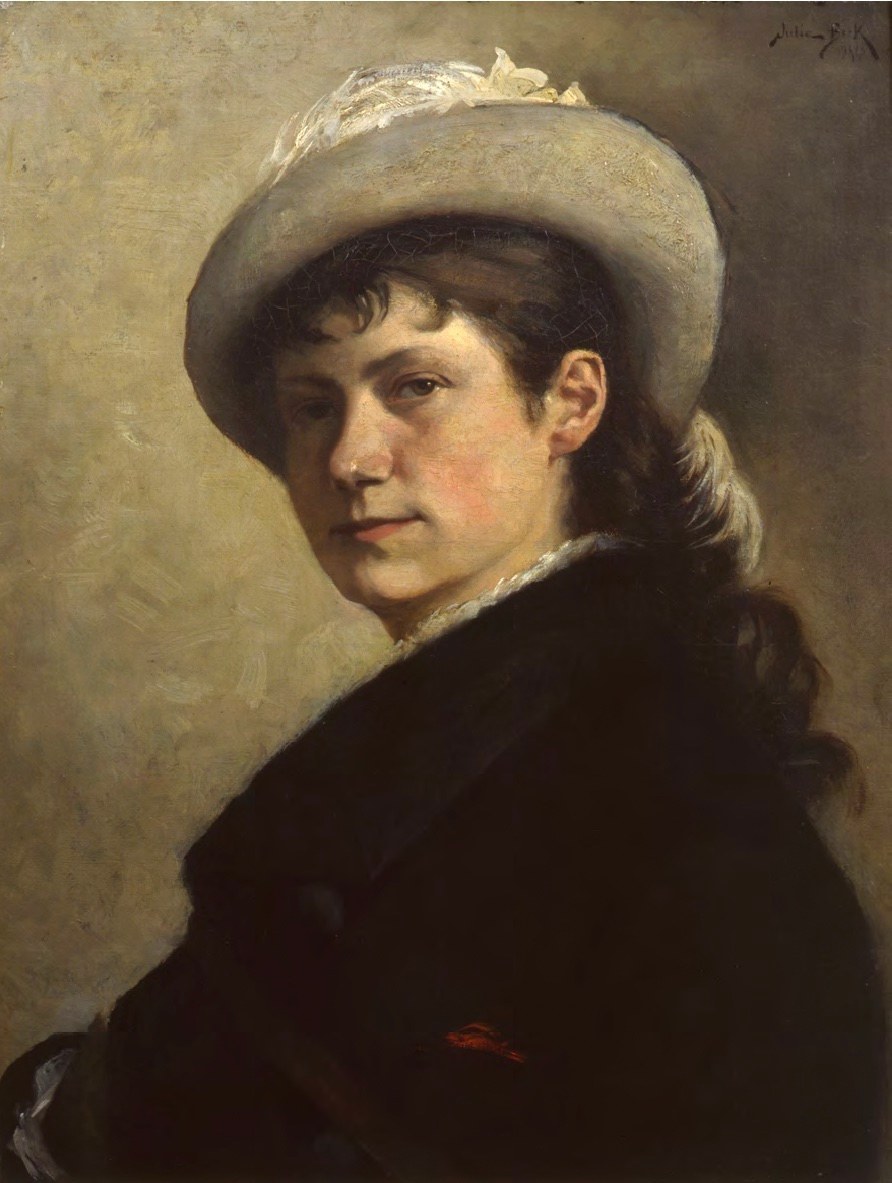
In 1880 Beck exhibited for the first time at the official annual Paris salon, then the surest proof that a young painter had arrived. Her entry was a realistic self-portrait in a plumed hat, and critics singled it out for its depth of character and refined colour. The success drew her permanently toward France. In 1881, at the age of 28, she enrolled at a private Paris atelier that accepted women, studying under the academic masters Leon Bonnat and Jean-Leon Gerome. The French state art school would not admit women until the 1890s. Seeking a lighter palette, she later moved to the studio run by the Belgian painter Alfred Stevens.
For a time she shared rooms with a remarkable circle of Nordic women painters, among them Hildegard Thorell, Anna Norstedt, Elisabeth Keyser, and the Norwegian Harriet Backer. They worked within a strict social order that gave them less freedom of movement and fewer commissions than their male peers, and they built their own networks in response, painting one another portraits and exhibiting together. Beck showed for years at the annual salon organised by the union of women painters and sculptors in Paris.
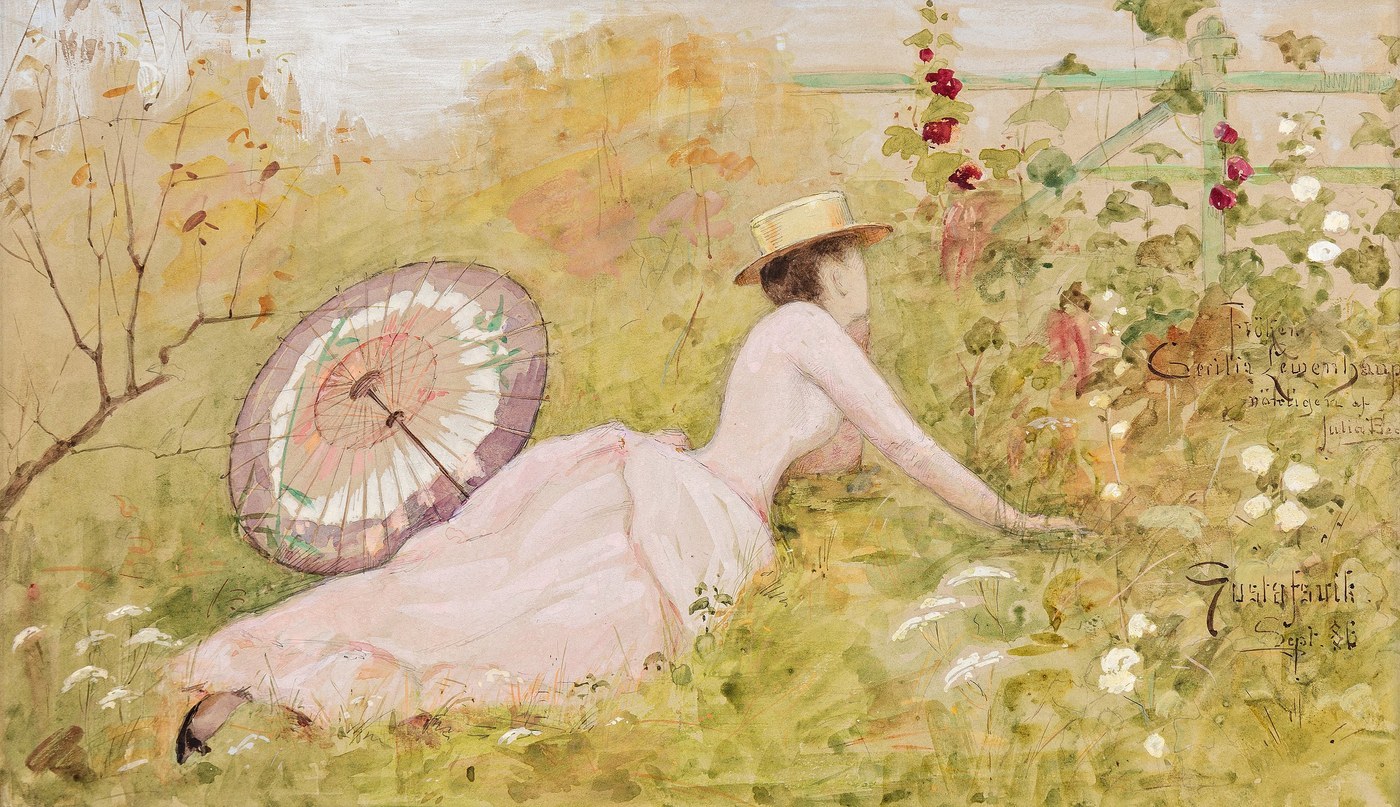
To fund the landscapes she cared most about, Beck specialised in portraits, a genre that paid reliably. Her 1886 portrait of the young Cecilia Lewenhaupt shows the assured, tonal realism that kept her commission book full and made her one of the few Swedish women of the decade who never needed a second income.
Grez-sur-Loing, Where the Water Became the Subject
In the early 1880s Beck joined the stream of Scandinavian artists drawn to Grez-sur-Loing, a village on a slow tributary of the Seine south of Paris that had become an international colony of painters, writers, and musicians. Grez gave her two things she would keep for life. The first was the plein-air method of working entirely outdoors, in front of the motif, instead of reworking studio sketches. The second was a subject she would never exhaust, which was still water.
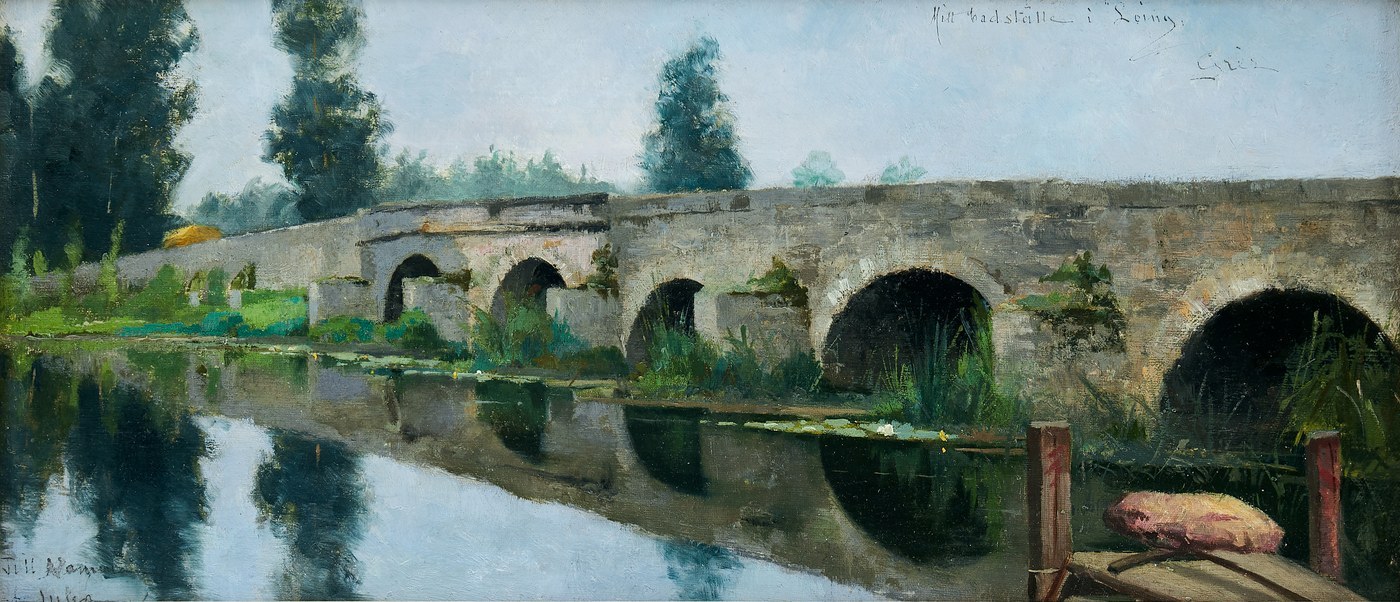
She painted the old stone bridge at Grez in 1885 and the reach of river at Nemours in the same year, and from then on the reflecting surface of a river or pond became the true centre of her art. She also supported the reform-minded Swedish opposition movement of the decade, whose spring 1885 exhibition, shown under the banner "From the shores of the Seine", opened Stockholm to the French plein-air manner she had already adopted. The phrase was a small manifesto in four words, announcing that the future of Nordic landscape now ran through France.
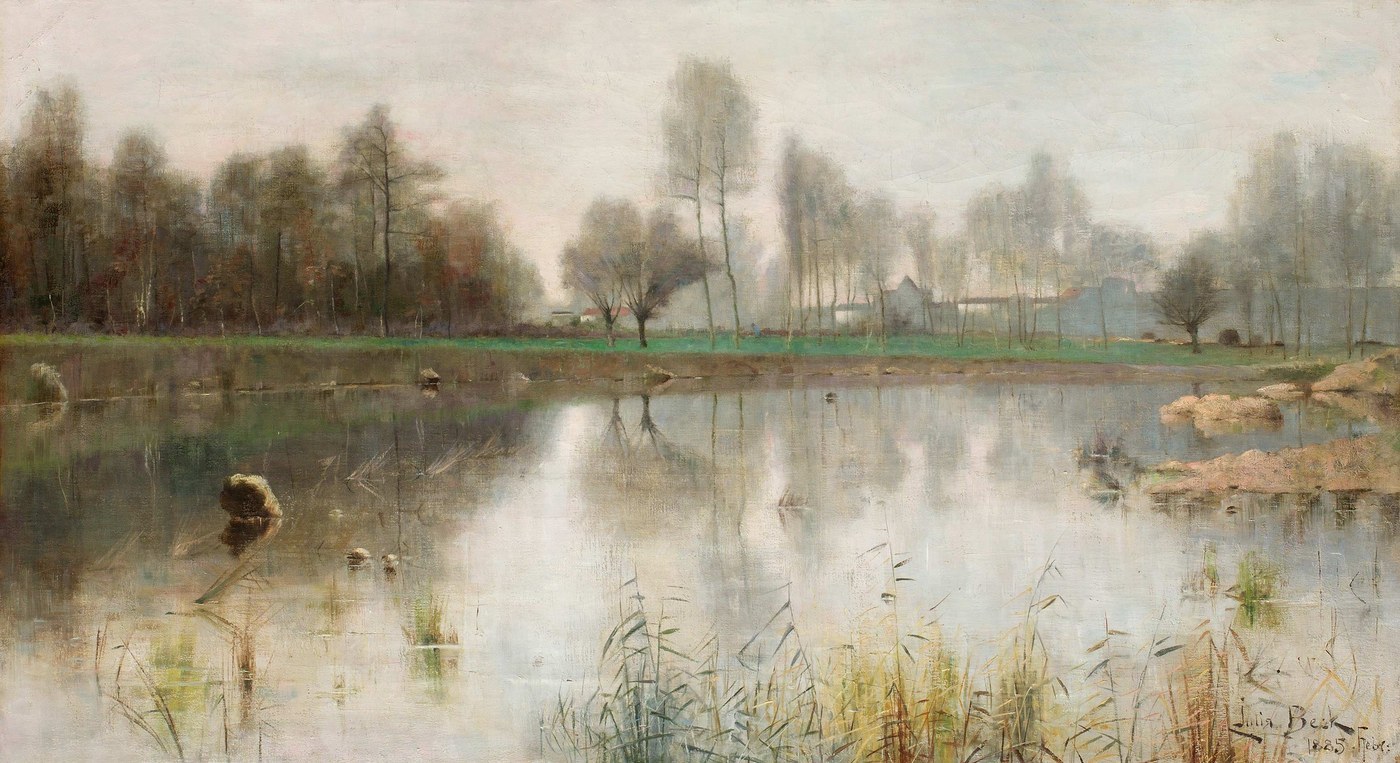
Reading the Reflections
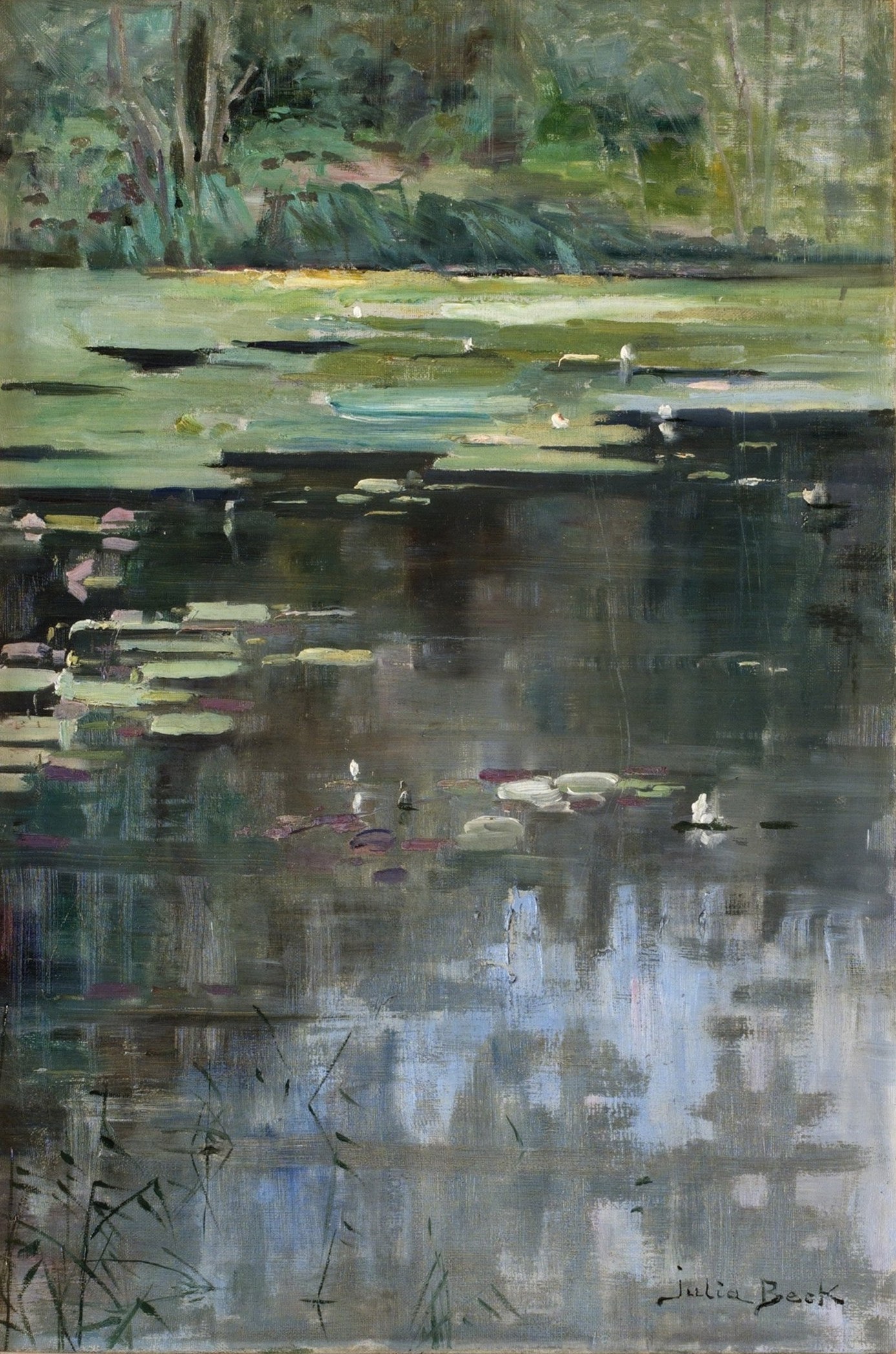
Stand in front of a Julia Beck landscape and the first thing to notice is that almost nothing happens above the waterline. People are rare. The drama is the surface of the water and what it holds, which is inverted trees, a wedge of pale sky, and the pink and green discs of lily pads breaking the mirror. In a canvas such as her river landscape with water lilies she keeps the palette deliberately muted, a romantic greyscale of blues and greens, so that the eye reads reflection rather than object.
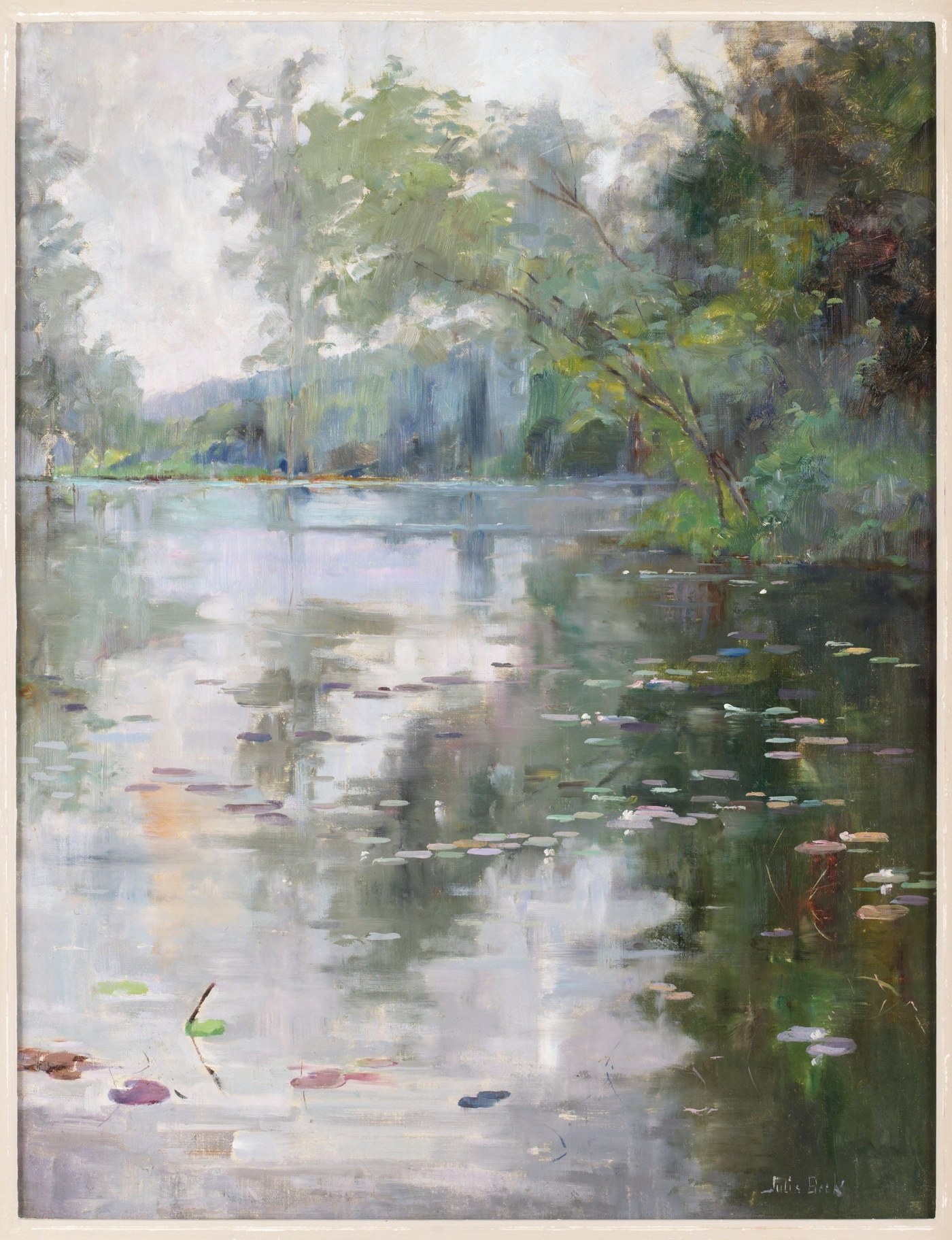
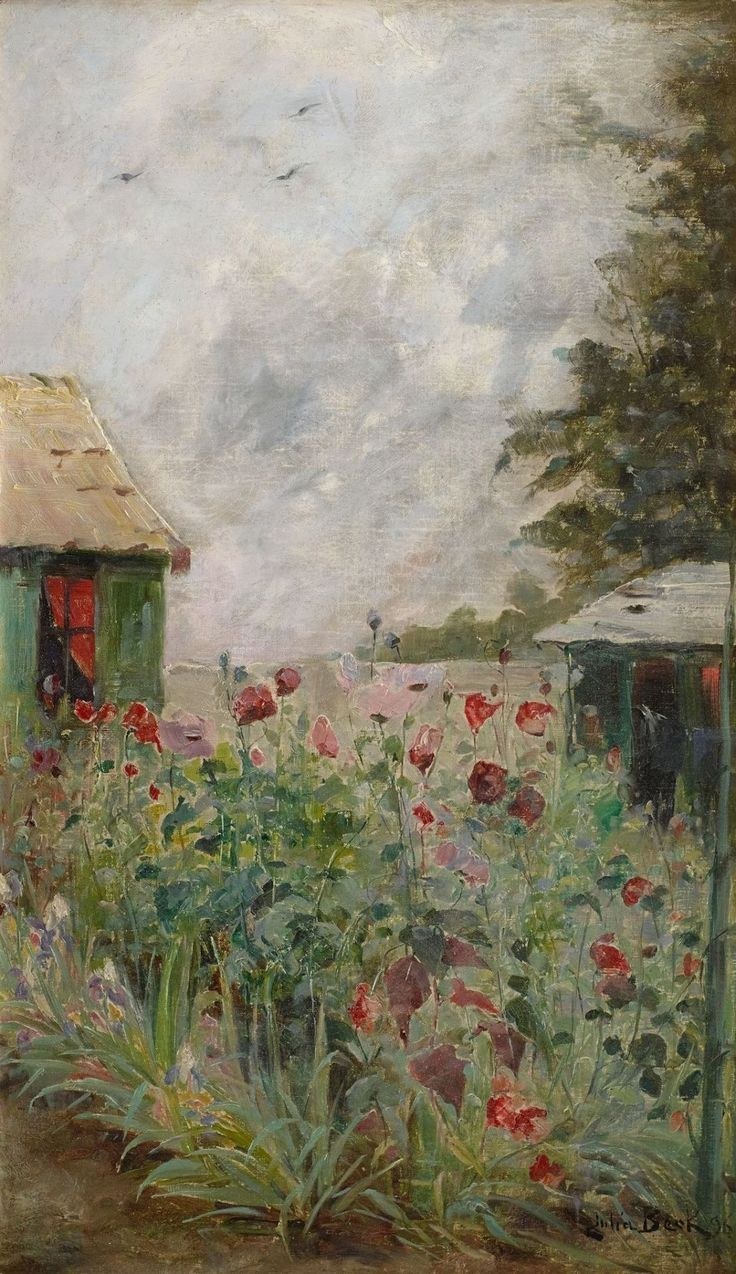
The reeds and foliage she pushes into the foreground are drawn with the flat, deliberate strokes of the calligrapher she was trained to be, and they echo the Japanese and Chinese brushwork then fashionable in Paris. Her fascination with lily pads and shifting light runs parallel to Claude Monet, who was building his own water garden in these same years, though Beck arrived at the motif on her own and kept it cooler and quieter. Where Monet chased the blaze of noon and the fire of sunset, Beck preferred the grey hush of early morning and the last hour before dusk, when the water goes silver and the trees dissolve into their own reflection. When she did turn to full colour, as in her 1896 field of poppies, the same restraint holds the brightness in check, and even her red flowers sit inside a cool green field rather than shouting against it.
Vaucresson, Late Honours, and a Long Silence
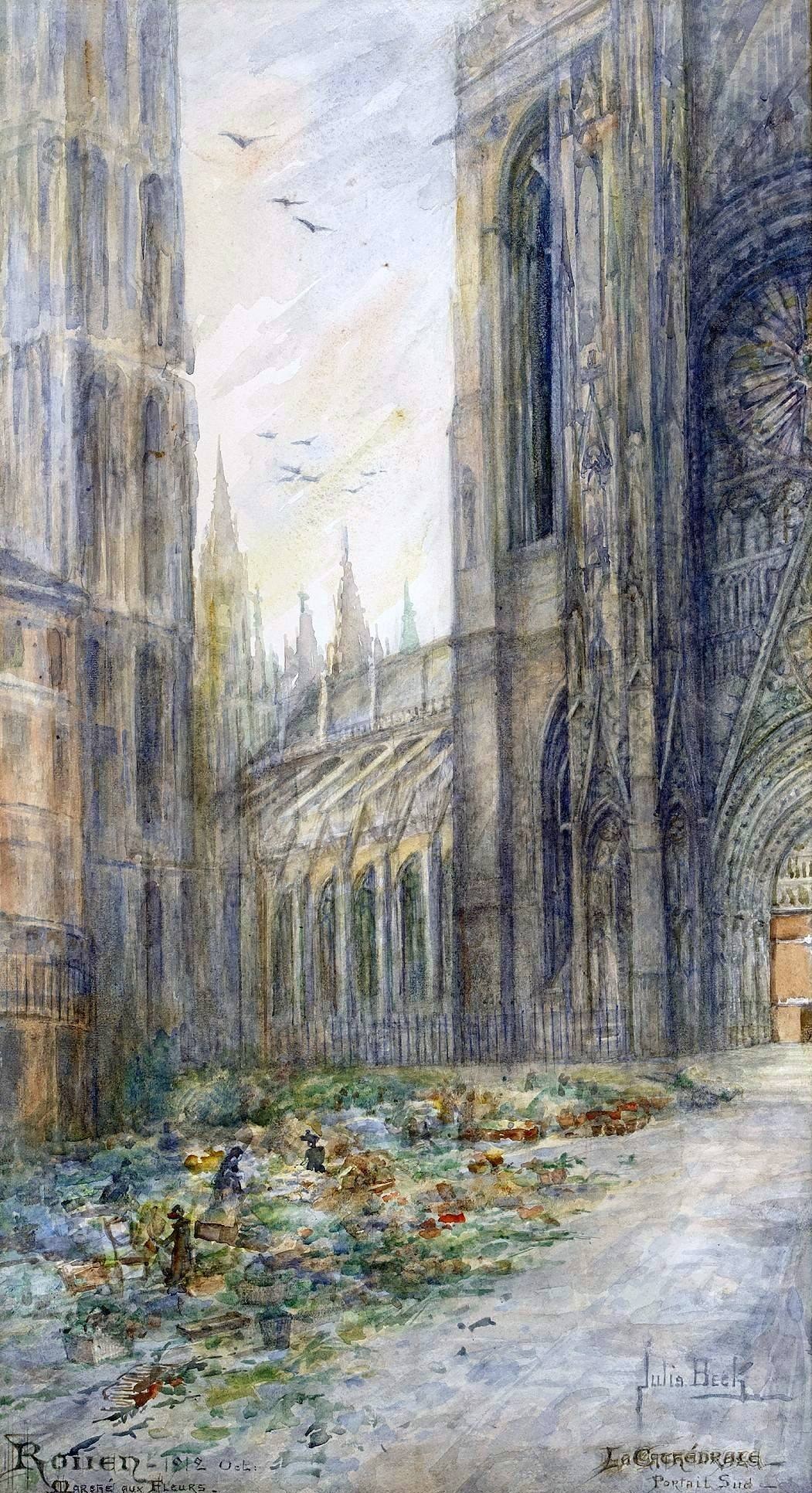
In 1888 Beck settled in Vaucresson, a small town a short train ride west of Paris, from which she could reach both her painting subjects and her clients in France and in the Belgian cities of Gent and Bruges. France appreciated her throughout her life. She collected medals at exhibitions in Paris and abroad, painted a busy flower market at Rouen in 1912, and in 1934, in her early eighties, was made a knight of the French Legion of Honour.
Sweden was less generous. Caught in the nepotism of the period art politics, she was not permitted to show in the Swedish pavilion at the 1900 World Fair in Paris, one reason her name faded at home. She died in Vaucresson in 1935, on the French soil she had chosen more than fifty years earlier.
Why She Was Forgotten, and Found Again
Because Beck lived and sold her work in France, her paintings scattered into private French hands rather than gathering in a single Swedish gallery, and her reputation at home thinned to almost nothing. It took until 2012 for a museum in the Swedish town of Mora to assemble a modest retrospective of around 20 of her paintings, a show that traveled on to Stockholm the following summer. Today her studies and finished canvases sit again in Swedish public collections, and a fuller picture of her achievement has begun to return. She was a calligrapher daughter who painted some of the most sensitive water reflections of her generation, and she did it a long way from home.
Questions Readers Ask
Who was Julia Beck?
Julia Beck, who lived from 1853 to 1935, was a Swedish landscape and portrait painter who spent most of her career in France. She trained in Stockholm and Paris, settled near the French capital in the 1880s, and became known for atmospheric river landscapes and water reflections painted in a muted, Impressionist-leaning palette.
What is Julia Beck best known for painting?
She is best known for quiet French river and pond landscapes, especially scenes of water lilies and reflecting water at Grez-sur-Loing and around Vaucresson. She rarely included figures, concentrating instead on light, foliage, and the mirror of the water surface. To earn a living she also painted many portraits, a practice that funded the landscapes she preferred.
Why is Julia Beck not well known in Sweden?
Because she lived, exhibited, and sold her work mainly in France, most of her paintings entered private French collections rather than Swedish museums. Swedish art politics of the period also sidelined her, and she was barred from the Swedish pavilion at the 1900 World Fair in Paris. Her reputation only began to recover after a retrospective in 2012.


Comments