Parmigianino's Madonna with the Long Neck (c.1534-40): The Unfinished Mannerist Icon
Parmigianino's Madonna with the Long Neck is an oil painting on panel, begun around 1534 for a family chapel in Parma and never finished. Its stretched Virgin, oversized limbs and a column that supports nothing made it a landmark of Mannerism, the style that followed the High Renaissance by breaking its rules on purpose.

The facts at a glance
Artist: Girolamo Francesco Maria Mazzola, called Parmigianino (1503-1540)
Dates: begun about 1534, unfinished when he died in 1540
Technique: oil on panel, about 219 x 135 cm
Commissioned for: a chapel in the church of Santa Maria dei Servi, Parma
Today: a Florence collection, since the seventeenth century
Why is the Virgin so long?
Nobody is sure, and that is part of the picture's appeal. Raphael and Leonardo had taught painters to find an ideal in natural proportion. Parmigianino, who had trained in Parma and worked in Rome before the sack of 1527, chose another ideal: grace through exaggeration. The Virgin's neck is a column of flesh, her fingers are far longer than life, and her body slides down the panel like poured silk.
The distortion is not clumsy. Every line is controlled, and the long curve from her head to her foot is the real subject. Giorgio Vasari, writing a generation later, praised Parmigianino's grace even as he lamented how little the painter finished.
The child who seems about to slip
The infant Christ lies across his mother's lap in a pose that borrows from a pieta: a pale, heavy, sleeping child, not the lively baby of earlier altarpieces. Many readers see an early hint of the Passion in it. The angels crowd into the left corner, their faces pressed together, and one holds a vase that catches the light on its curved side.
A column that holds up nothing
On the right the space opens suddenly. A row of tall columns rises with no building around it, and below them a tiny, bearded figure unrolls a scroll. He is usually identified as a prophet or Saint Jerome, but he is drawn at a scale that makes no sense next to the Virgin. The deliberate mismatch is the point. The picture will not give you one stable viewpoint.
Visit the Journal's guide to Mannerism explained through five paintings for the wider story of this style.
Why the panel was never finished
Parmigianino took the commission in 1534 and kept it for years. The altarpiece was delayed again and again, and records of the time mention pressure on the painter to deliver. He left Parma in 1539 and died the following year at Casalmaggiore, not yet forty. The lower right of the panel, around the prophet, shows how much was still to be painted. The picture reached Florence in the seventeenth century.
Where it fits
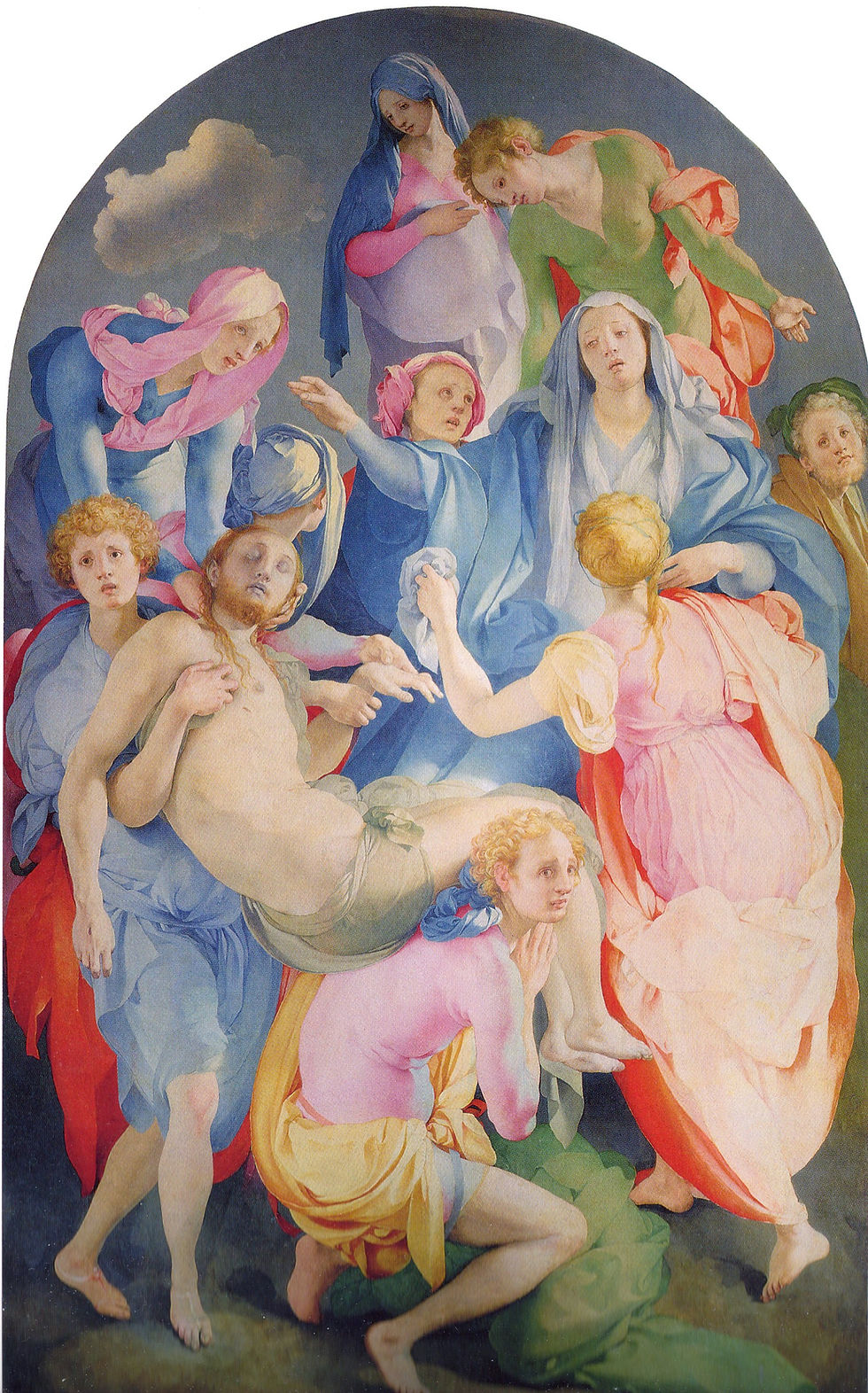
Pontormo's Deposition of the same period does a similar thing with colour and crowding; read Pontormo's Deposition, the Mannerist altarpiece that refused to use a cross beside it. For the artists who came before, The Italian Renaissance in Ten Artists sets out the High Renaissance against which Parmigianino rebelled.
Zocine Art Design is an independent studio that prints classic paintings as wall art.
Frequently asked questions
Why does the Virgin have such a long neck?
Parmigianino exaggerated her proportions to make an ideal of grace, a hallmark of Mannerism. The elongated neck, hands and torso are deliberate, not errors.
When was the Madonna with the Long Neck painted?
It was begun around 1534 for a chapel in Parma and left unfinished when Parmigianino died in 1540.
Where is the Madonna with the Long Neck today?
It hangs in a Florence collection, where it has been since the seventeenth century.
Is the Madonna with the Long Neck a Renaissance or a Mannerist painting?
It is Mannerist, a style that grew out of the High Renaissance and distorted its ideals on purpose.
Browse Parmigianino and other classic art prints in the archive at Zocine on Etsy.
New in the Journal: Pontormo's Deposition (1525-1528): The Mannerist Altarpiece That Refused to Use a Cross
New in the Journal: Mannerism Explained Through Five Paintings: The Quiet Strangeness After the Renaissance
New in the Journal: The Italian Renaissance in Ten Artists: From Giotto to Titian

Comments