Vermeer's Girl with a Pearl Earring: A Painting Without a Story
Updated: Jul 30
A young woman in a blue and yellow turban, in three-quarter view against a flat black ground, turning toward the painter with her mouth half-open as if she has just been called for. Her eyes are wet. The light is falling on her from the upper left. A single pearl drop hangs from her left ear and catches the light in a small reflection of the room behind the painter. No background. No setting. No story.
This is Girl with a Pearl Earring, painted around 1665 by Johannes Vermeer in Delft, the Netherlands. It is roughly 44 by 39 centimetres — smaller than a sheet of newspaper. It is one of about thirty-five surviving paintings by Vermeer, and the most reproduced of all of them. It has become, in the centuries since, what the Mona Lisa is for the Italian Renaissance: the small, calm, mysterious portrait of a woman that the entire popular imagination knows by sight, and that no one has ever quite been able to read.

What you actually see
Almost nothing. That is the painting's first and most surprising feature. There is no setting — the background is a deep, dark, unmodulated black, with no chair, no wall, no window, no signature object. There is no clothing of station — the girl wears a plain ochre jacket with a white linen collar, no jewellery except the single pearl, no embroidery, no lace. There is no biographical clue. The painting refuses to identify its sitter.
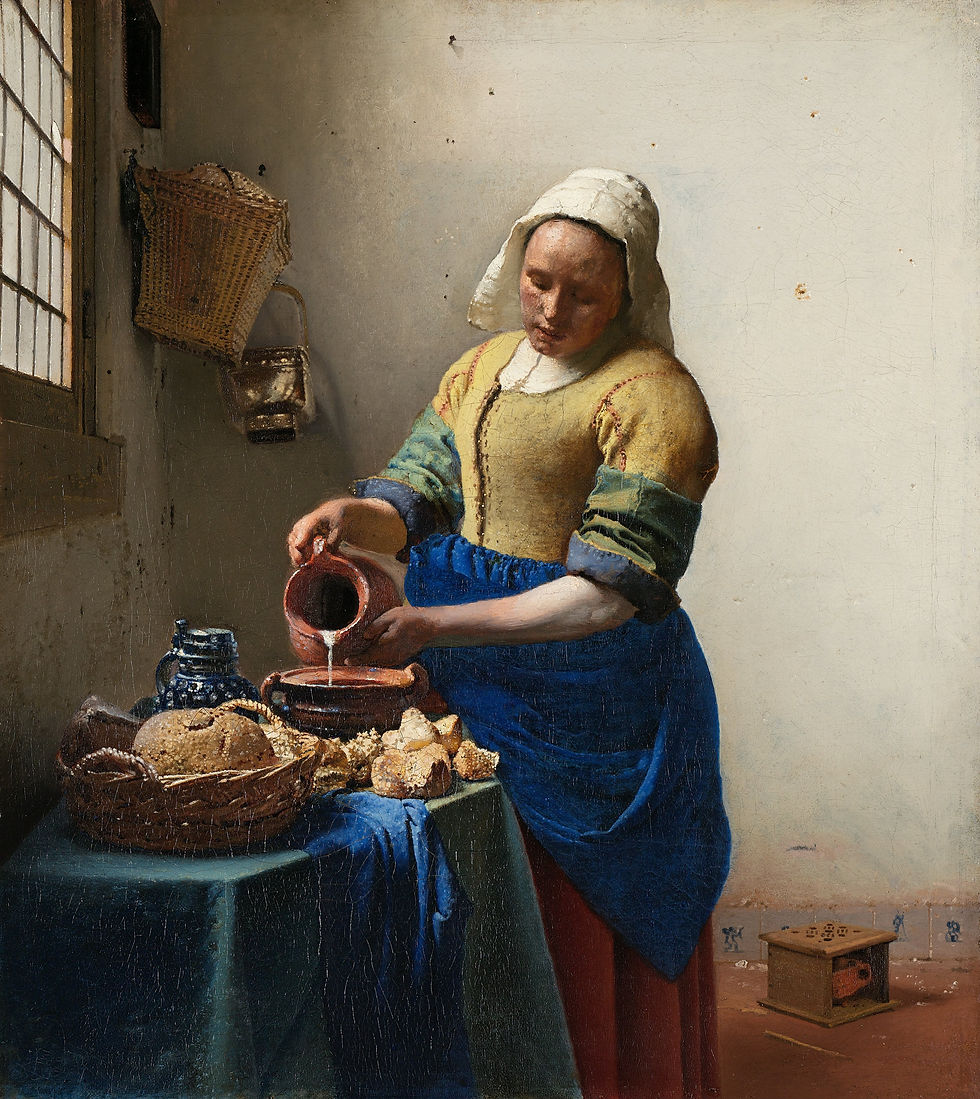
What there is: the head, the turban, the earring, and the gaze. The head is three-quarter view, the body half-turned toward the painter, the eyes looking out at us. The turban is the painting's loudest element — a deep ultramarine blue wrapped around the head with a long yellow tail of cloth falling over the left shoulder. The blue is mineral pigment ground from lapis lazuli, the most expensive paint available to a seventeenth-century Dutch painter, imported from Afghanistan via Venice. Vermeer used it where another painter might have used cheaper smalt or azurite. The yellow is lead-tin yellow, the same pigment Vermeer used for the milkmaid's bodice and the standing girl's jacket in his other domestic interiors.
The face is built from very thin layers of paint. The skin is so fine you can read it as porcelain rather than tissue. The wet light in the eyes is two single highlights, painted with the corner of a tiny brush. The pearl is two strokes — a white highlight on the upper edge and a soft reflected light on the lower edge — and nothing in between. The pearl is, on close inspection, not a sphere. It is a painted illusion that the eye fills in.
This is not a portrait. It is a tronie.
The Dutch had a specific word for a painting that looks like a portrait but is not actually a portrait of a specific sitter. The word is tronie — pronounced like trohny — and it refers to a head-and-shoulders painting of an unidentified person in an exotic costume or with a strong expression, intended as a study of a type rather than a record of an individual. Vermeer's Girl is a tronie. The young woman is not anyone's daughter or wife or patron. She is a model in a turban, painted as an exercise in handling colour, light, and a turned head.
Other Dutch painters painted tronies. Rembrandt painted dozens of them — old men with beards, young men in oriental headdresses, old women with veils. The genre was a small industry in seventeenth-century Holland; tronies sold well as relatively affordable pictures for Dutch middle-class collectors. Vermeer painted only a few that survive. The Girl with a Pearl Earring is one of two or three known tronies from his hand. The exotic turban and the pearl are the two markers of the genre — both signalling that the figure is not from the painter's local Delft society, but is a constructed type.
The pearl itself is almost certainly not a real pearl. A pearl of the size Vermeer paints — and visibly tear-drop shaped — would have been one of the most valuable objects in seventeenth-century Europe, well beyond the means of any model Vermeer would have used. The pearl is probably a tin-coated glass bead or a polished crystal: a costume jewel, painted by Vermeer with the same patience he would have given a real one. The illusion is not in the object; it is in the painting.
The painter and the small Dutch town
Vermeer (1632-1675) lived his whole forty-three-year life in Delft, a small Dutch town between Rotterdam and The Hague. He was a member of the local painter's guild, married a Catholic woman from a slightly better family, lived in his mother-in-law's house, fathered eleven children, painted very slowly (perhaps two or three paintings a year), and died deep in debt. The Girl with a Pearl Earring was painted in the middle of his career, around 1665, when he was thirty-three and at the height of his technique.
He had no significant pupils. He sold mostly to a single patron in Delft, a printer named Pieter van Ruijven, who collected him quietly across two decades. After his death his widow Catharina was forced to give two paintings to a baker to settle a bread debt. The catalogue of his surviving work is small — between thirty-four and thirty-six paintings, depending on attribution — because he simply did not paint very many.

Vermeer was almost forgotten for two centuries after his death. The Girl was bought in The Hague at auction in 1881 for two guilders and thirty cents — about the price of a meal in a good restaurant — and recognised as a Vermeer by the buyer, a Dutch military officer, who left it to the city of The Hague on his death. The painting was hung in the city collection in 1903 and slowly became famous over the twentieth century. The novel and the film versions in the early 2000s made it global.
The recent restoration
The painting was restored in 1994 and again, with extensive modern analysis, in 2018-19. The 2018 conservation team x-rayed the picture, scanned it with infrared, took microscopic paint samples, and re-photographed every square centimetre under several different lighting conditions. The findings are now public and have changed the way the painting is read.
The background, which had appeared a flat unmodulated black for centuries, was actually originally a deep green — a translucent green glaze laid over a dark ground, intended to suggest an indistinct curtain or wall behind the figure. The green glaze has darkened over three and a half centuries to look almost completely black; restoration could not safely reverse the change without damaging the original paint. The figure was painted against a slightly less abstract background than the modern picture suggests.
The painting was also found to be unsigned — there is no Vermeer monogram anywhere on the canvas — and to have been heavily overpainted in earlier centuries, with parts of the white collar and the yellow tail of the turban repainted by restorers as late as the nineteenth century. The 2018 conservation removed several layers of overpaint and revealed slightly more of Vermeer's own brush than the picture had shown in eighty years. The eye highlights are a fraction more luminous now than they were before 2019.
Why the painting still works
Three hundred and sixty years later, the picture is one of the most reproduced single images in Western art. It hangs in The Hague in a permanent room of its own. People queue to stand in front of it. The painting is small enough that you can comfortably take it in from a few feet away, and intimate enough that the gaze the girl gives the viewer is the gaze you would give a friend who had just walked into a room.
What makes it work is the refusal. The painting will not tell you who the girl is. It will not tell you what she is doing. It will not tell you what is about to happen. The viewer is forced into the role of the painter — looking at a model who has turned at the sound of a voice, in the half-second before something happens that the painting does not show. The narrative is not in the picture; the narrative is what the viewer brings to the picture. The painting is, in this sense, the most participatory portrait in seventeenth-century European art.
There is also the matter of the technique. Vermeer's faces are painted with a thinness and luminosity that no other Dutch painter quite matched. The skin reads as living tissue not because it is shaded carefully, but because the underlying ground glows through extremely thin upper layers. The painting is not painted; it is glazed. Standing in front of the Girl in person, the face appears to be lit from inside the picture. No reproduction quite captures it; the painting itself, in the small room in The Hague, is the only place where the full effect lives.
Key takeaways
Vermeer's Girl with a Pearl Earring (c. 1665) is a small (44.5 × 39 cm) oil-on-canvas painting that hangs in a permanent collection in The Hague.
The painting is not a portrait but a tronie — a Dutch genre of head-and-shoulders studies of unidentified figures in exotic costume, intended as exercises rather than records of specific sitters.
The blue turban is painted in ultramarine, the most expensive pigment available to a seventeenth-century Dutch painter — lapis lazuli, ground and mixed by Vermeer himself, imported from Afghanistan.
The pearl is almost certainly not a real pearl. It is painted with two strokes — a white highlight and a reflected light — and the illusion of roundness exists only in the viewer's eye.
Vermeer (1632-1675) lived his entire life in Delft, painted perhaps three pictures a year, and died deep in debt with thirty-five paintings to his name. He was largely forgotten until the late nineteenth century.
The 2018-19 restoration showed the original background was a deep translucent green that has darkened to look black, and revealed several layers of older overpaint that have been removed.
Browse Vermeer and Dutch Golden Age prints in the archive at zocineartdesign.etsy.com.
New in the Journal: Best Vermeer Paintings: Nine Works That Define a Quiet Master


Comments