Spitzweg's The Poor Poet (1839): A Cold Attic and a Warm Joke
The Poor Poet is a small oil painting by the German artist Carl Spitzweg, made in 1839. It shows a writer lying in bed in a bare attic, wearing a nightcap, with an open umbrella over the blanket to keep off the rain from the roof. It is one of the most loved paintings in German art, and it is gentle comedy at its best.

What does The Poor Poet show?
The room is tiny and low. The ceiling slopes, the walls are bare, and a window lets in a thin light. The poet lies on a thin mattress with his knees up, a quill in his mouth, and he counts the beats of a line on his fingers. An umbrella is open above him, because the roof leaks. Around him are a few books, a candle, a piece of paper and a small iron stove with a pipe running up through the room.
Everything is small and everything is poor, yet the picture is cosy. The warm browns, the glowing window and the careful details make the attic feel strangely like a home.
The jokes in the picture
Spitzweg laughs, but lovingly. The umbrella is the obvious joke. Another is the stove: commentators have long read it as a hint that the poet has burnt his own manuscripts for heat, and the pile of paper nearby makes the point. The poet is counting syllables on his fingers, so we know that he is still working on the next poem, in spite of the cold. It is a picture about devotion to writing, and about the gap between art and money.
What is Biedermeier?
The Poor Poet belongs to the Biedermeier period in German-speaking Europe, roughly the years between 1815 and 1848. Biedermeier culture turned from big politics to home, family, small pleasures and the quiet corner. Spitzweg painted this mood better than anyone: little scenes of bookworms, bachelors and eccentrics, full of affection and a sense of humour.
Spitzweg himself was trained as a pharmacist and became a painter largely by teaching himself. His pictures are small, and they are meant to be looked at closely.
How does it compare with other interiors?
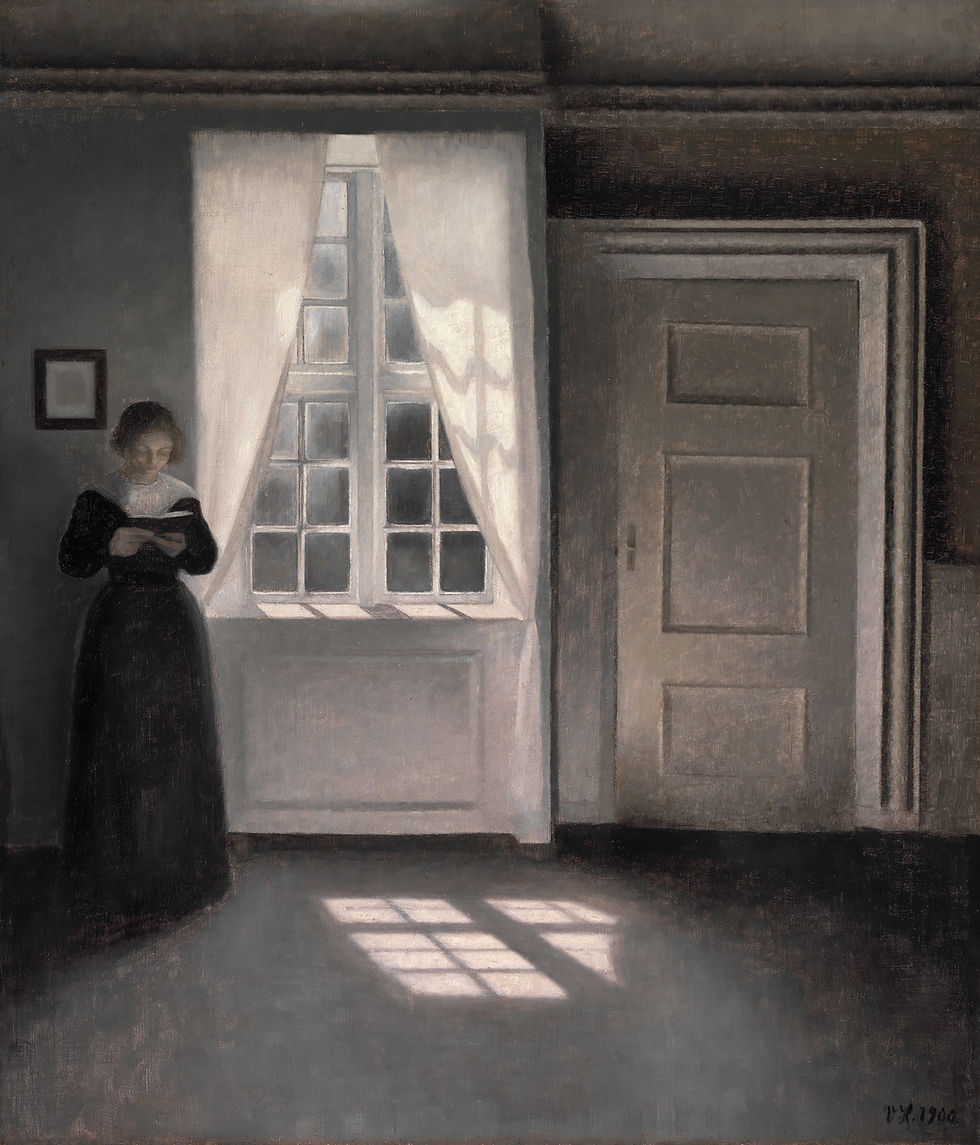
It is a very different attic from Hammershøi's grey rooms, which we discuss in Hammershøi's interiors, and different again from Vermeer's calm Dutch houses. Here the room has a story and a joke in every corner. For other quiet rooms to hang next to it, see our guides to home office and study wall art, library wall art and dark academia library art.
How should you look at it?
Start with the open umbrella, then look at the poet's face and his fingers.
Find the quill in his mouth and the candle by the bed.
Look at the stove and the paper near it.
Let your eye settle on the window and the thin light it lets in.
Where does it work as wall art?
The Poor Poet is small and friendly. It suits a study, a library, a writing desk, a hallway or a reading nook, and it is an excellent gift for writers, students and anyone who loves books. Its warm browns look good against wood and green walls, and it is a good winter picture.
Frequently asked questions
When did Spitzweg paint The Poor Poet?
In 1839. He painted more than one version of the subject, and the best-known one hangs in Munich.
Why is there an umbrella over the bed?
The attic roof leaks, so the poet opens an umbrella over his blanket. It is Spitzweg's way of showing how poor he is.
What style is The Poor Poet?
It is a Biedermeier genre painting, a gently humorous scene of everyday life in the German-speaking world.
What is the poet doing?
He is lying in bed, composing, with a quill in his mouth and his fingers counting the beats of a line of verse.
If you like small, human paintings with a sense of humour, The Poor Poet is available as a classic art print for a study, a library or a writing corner.


Comments